Learn how to develop an app for IoT devices, including development process, technologies, costs, and best practices for building secure and scalable IoT apps.

Can I Develop an App for IoT Devices?
The rapid growth of connected technologies has transformed the way businesses and consumers interact with devices. From smart homes and wearable fitness trackers to industrial automation and connected vehicles, the Internet of Things (IoT) is becoming an essential part of modern digital ecosystems. This leads many businesses and entrepreneurs to ask an important question: Can I develop an app for IoT devices?
The answer is yes. Developing applications for IoT devices allows businesses to monitor, control, and manage connected devices through mobile or web interfaces. These applications communicate with sensors, machines, and hardware systems to collect data, automate processes, and provide real-time insights.
IoT app development involves integrating hardware devices, connectivity protocols, cloud platforms, and mobile applications into a single ecosystem. A well-designed IoT app enables users to remotely control devices, analyze real-time data, and automate workflows.
Industries such as healthcare, manufacturing, logistics, agriculture, smart homes, and automotive are rapidly adopting IoT technologies to improve efficiency and enhance user experiences.
In this guide, we will explore how IoT app development works, including development solutions, features, technology stack, cost considerations, and the latest trends in connected applications.
Why IoT App Development Is Important
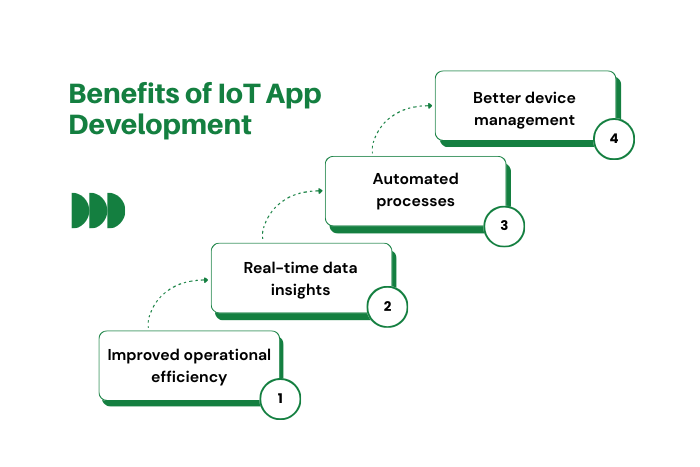
IoT applications play a major role in enabling real-time communication between devices and users. They help organizations improve operational efficiency, collect valuable data, and automate complex processes.
Here are the key reasons why IoT app development is important:
Real-Time Device Monitoring
IoT apps allow users to monitor connected devices and systems instantly.Automation of Processes
Businesses can automate operations such as manufacturing workflows or smart home controls.Data Collection and Analytics
IoT devices generate large volumes of data that can be analyzed for business insights.Remote Device Control
Users can control devices remotely through mobile or web applications.Improved Operational Efficiency
Connected systems reduce manual intervention and improve productivity.Better Customer Experience
IoT-enabled applications provide personalized and automated user experiences.
IoT app development enables businesses to build intelligent systems that connect physical devices with digital platforms.
Types of App Development Solutions for IoT Devices
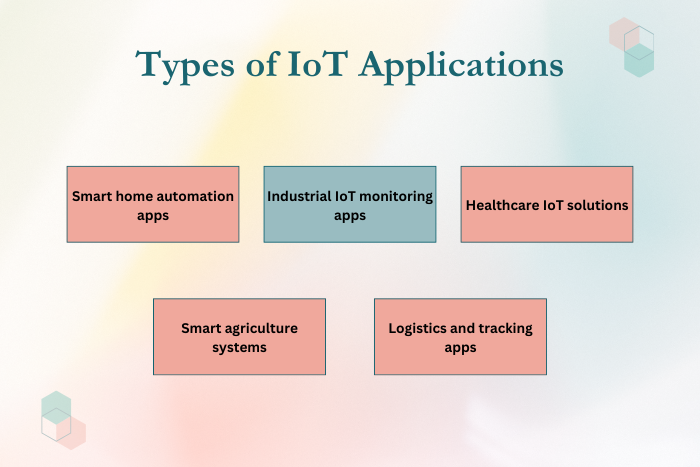
IoT applications can be developed for different industries and device ecosystems. These solutions vary depending on the purpose of the connected system.
Smart Home IoT Applications
Smart home apps allow users to control connected household devices.
Smart lighting systems
Home security monitoring
Smart thermostats
Voice-controlled appliances
Industrial IoT Applications
Industrial IoT apps help companies monitor and control machines and production systems.
Equipment monitoring
Predictive maintenance
Asset tracking
Manufacturing automation
Healthcare IoT Applications
IoT apps are widely used in healthcare to track patient data and monitor medical devices.
Remote patient monitoring
Wearable health trackers
Smart medical equipment
Logistics and Supply Chain IoT Solutions
Logistics companies use IoT applications to track shipments and manage supply chains.
GPS tracking systems
Fleet management apps
Warehouse monitoring
Agriculture IoT Applications
IoT solutions help farmers optimize agricultural processes.
Soil moisture sensors
Smart irrigation systems
Crop monitoring tools
These solutions demonstrate how IoT applications can transform various industries.
Key Features of IoT Applications
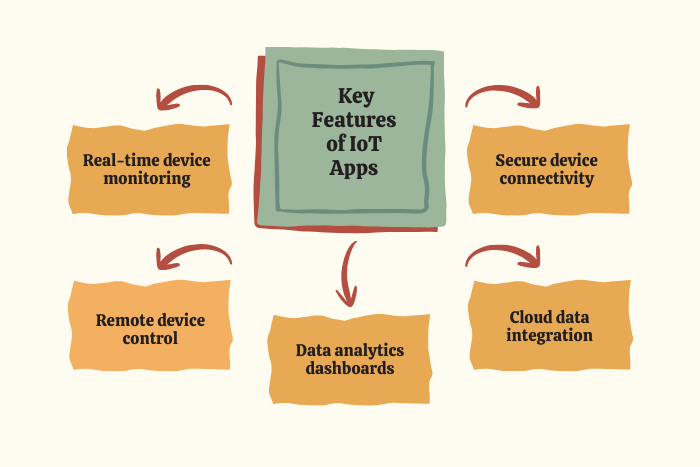
IoT applications include several advanced features that enable seamless communication between devices and users.
Key features include:
Real-time device monitoring and alerts
Secure device connectivity
Data synchronization with cloud platforms
Remote device control and automation
Device status tracking
Data analytics dashboards
Push notifications and alerts
Integration with sensors and hardware modules
These features help IoT applications deliver efficient and intelligent device management.
App Development Process for IoT Devices
Developing an IoT application involves several stages that ensure smooth communication between devices, software, and cloud infrastructure.
Requirement Analysis and Planning
Identify the purpose of the IoT system, target devices, and business goals.IoT Architecture Design
Design the architecture connecting devices, gateways, and cloud platforms.Hardware and Sensor Integration
Integrate sensors, controllers, and embedded hardware systems.Mobile or Web App Development
Build the user interface for controlling and monitoring IoT devices.Backend and Cloud Development
Develop servers and cloud infrastructure for storing and processing IoT data.Connectivity and Protocol Implementation
Implement communication protocols such as MQTT, HTTP, or CoAP.Testing and Device Validation
Test the system with multiple devices and real-world scenarios.Deployment and Monitoring
Launch the IoT system and monitor performance.Maintenance and Updates
Update applications regularly to support new devices and features.
This structured development process ensures reliable and scalable IoT applications.
Technology Stack for IoT App Development
IoT development requires a combination of hardware, software, and cloud technologies.
Programming Languages: Python, Java, C++, JavaScript
Mobile Development: Flutter, React Native, Swift, Kotlin
IoT Platforms: AWS IoT, Google Cloud IoT, Azure IoT Hub
Databases: MongoDB, MySQL, PostgreSQL, Firebase
Connectivity Protocols: MQTT, CoAP, HTTP, WebSockets
Hardware Platforms: Arduino, Raspberry Pi, ESP32
Cloud Platforms: AWS, Microsoft Azure, Google Cloud
Analytics Tools: Apache Kafka, Hadoop, Spark
Using the right technology stack ensures efficient communication between IoT devices and applications.
Cost Factors in App Development for IoT Devices
The cost of developing an IoT application depends on several technical and operational factors.
Major cost factors include:
Number and type of IoT devices
Hardware and sensor integration complexity
Mobile or web application development
Cloud infrastructure and storage costs
Data analytics and processing tools
Security implementation and encryption
Maintenance and updates
Complex IoT ecosystems involving multiple devices and large data streams usually require higher development budgets.
Latest Trends in IoT App Development
IoT technology continues to evolve with new innovations that improve connectivity and device intelligence.
Some key trends include:
Edge Computing for faster data processing
AI-powered IoT analytics
5G connectivity for IoT devices
Smart cities and infrastructure solutions
Industrial IoT automation systems
Blockchain-based IoT security
Voice-enabled IoT device control
These trends are shaping the future of connected applications and smart systems.
Why Choose Us for IoT App Development?
Developing reliable IoT applications requires expertise in software, hardware integration, and cloud infrastructure.
Here’s why businesses choose our development team:
Expert IoT Development Team
Our specialists design scalable and secure IoT ecosystems.End-to-End IoT Solutions
We handle everything from device integration to cloud deployment.Advanced Security Implementation
Our IoT apps include robust security and encryption.Custom IoT Application Development
We build solutions tailored to specific business requirements.Scalable Architecture
Our IoT platforms support thousands of connected devices.Continuous Support and Maintenance
We ensure your IoT applications remain secure and updated.
Ready to build an intelligent IoT application for your business?
Our experts can help you develop secure and scalable IoT apps.
Contact us today to discuss your IoT project and get a customized solution.
Key Points :
- Yes, you can develop an app for IoT devices to control and monitor connected systems.
- IoT apps connect smart devices, sensors, and machines through the internet.
- These applications enable real-time monitoring, automation, and remote device control.
- IoT apps integrate with cloud platforms to collect and analyze device data.
- IoT applications help businesses improve efficiency and create intelligent systems.
FAQ's
Yes. IoT applications can be developed to monitor and control connected devices such as sensors, smart appliances, and industrial machines.
IoT apps can connect devices like smart home appliances, wearable devices, industrial machines, and smart sensors.
Industries such as healthcare, logistics, manufacturing, agriculture, automotive, and smart homes widely use IoT solutions.
IoT development uses technologies like MQTT, cloud platforms, embedded hardware, and mobile frameworks.
Yes, secure IoT apps use encryption, authentication, and secure communication protocols.
Yes, IoT devices can be controlled through mobile apps that connect to cloud platforms.
The cost depends on hardware integration, software complexity, cloud infrastructure, and security requirements.