


Learn how to integrate third-party APIs in your app to add payments, maps, messaging, analytics, and more. Complete guide with benefits and process.
Can I Integrate Third-Party APIs in My App?
Modern applications rarely operate in isolation. Businesses today rely on multiple digital services such as payment gateways, messaging platforms, analytics tools, cloud storage, maps, and social media integrations. This is where third-party API integration becomes essential. If you’re asking “Can I integrate third-party APIs in my app?”, the answer is yes — and doing so can significantly enhance your application’s capabilities, scalability, and user experience.
Third-party APIs (Application Programming Interfaces) allow your application to communicate with external services and platforms without building those features from scratch. For example, integrating a payment API enables secure online transactions, while a messaging API can power notifications, SMS alerts, or chat systems within your app.
For startups, enterprises, and SaaS platforms, API integrations accelerate development by connecting powerful external services to your application. Instead of investing time and resources into developing complex infrastructure internally, developers can leverage reliable APIs that are already tested, secure, and scalable.
Whether you’re building a mobile app, web platform, SaaS product, or enterprise system, third-party API integration helps expand functionality while reducing development time and cost. With the right integration strategy, businesses can create highly connected digital ecosystems that deliver better user experiences and improved operational efficiency.
Why Third-Party API Integration is Important
Integrating third-party APIs plays a crucial role in modern application development. It allows developers to extend application functionality quickly while maintaining flexibility and scalability.
Here are several reasons why third-party API integration is important:
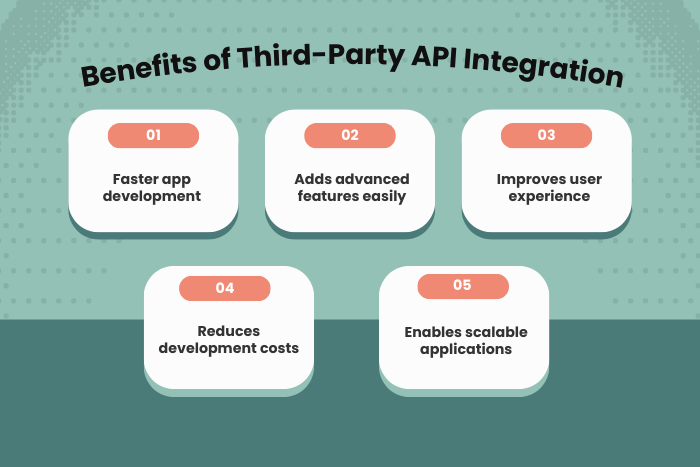
Faster Development
APIs allow developers to integrate ready-made services instead of building complex systems from scratch.Enhanced Application Features
Applications can include advanced capabilities such as payment processing, maps, authentication, messaging, and analytics.Scalability and Flexibility
Third-party APIs allow applications to scale without significant infrastructure changes.Improved User Experience
Features like real-time notifications, social login, and location services enhance usability.Cost Efficiency
Businesses save time and development resources by leveraging existing APIs.Access to Specialized Services
APIs provide access to industry-leading services such as payment gateways, AI tools, and cloud storage.
With strategic API integrations, businesses can deliver feature-rich applications while focusing development efforts on core product innovation.
Types of Solutions to Integrate Third-Party APIs in App
Different types of APIs can be integrated into applications depending on the business requirements and product functionality.
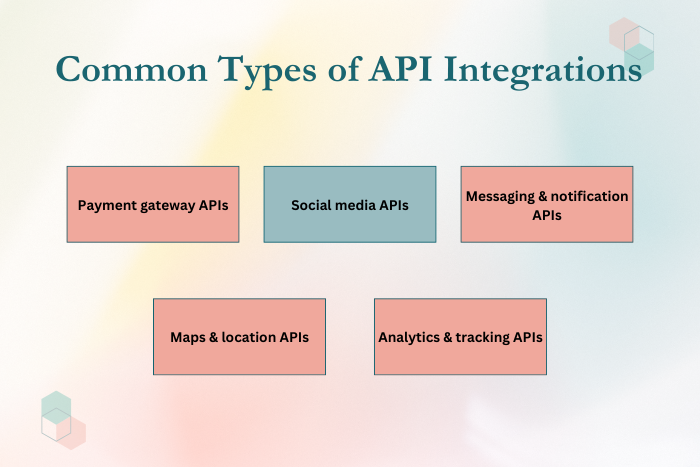
Payment Gateway APIs
Payment APIs allow applications to process online transactions securely. Examples include integrations for credit cards, digital wallets, and subscription billing systems.Social Media APIs
Social APIs enable login authentication, content sharing, and social engagement within applications.Messaging and Communication APIs
Messaging APIs power SMS notifications, email alerts, push notifications, and in-app messaging features.Maps and Location APIs
Location-based services such as route tracking, delivery management, and geolocation are enabled using map APIs.Analytics and Tracking APIs
Analytics APIs provide insights into user behavior, app performance, and marketing campaign effectiveness.Cloud Storage APIs
These APIs enable secure file storage, data synchronization, and document management across applications.AI and Machine Learning APIs
AI APIs allow apps to integrate features such as chatbots, voice recognition, image analysis, and predictive analytics.Authentication and Security APIs
Authentication APIs enable secure login systems including OAuth authentication, single sign-on (SSO), and multi-factor authentication.
These integrations help developers rapidly expand application functionality while maintaining reliability and performance.
Key Features of Third-Party API Integration
A well-implemented API integration system provides several key features that improve application performance and flexibility.
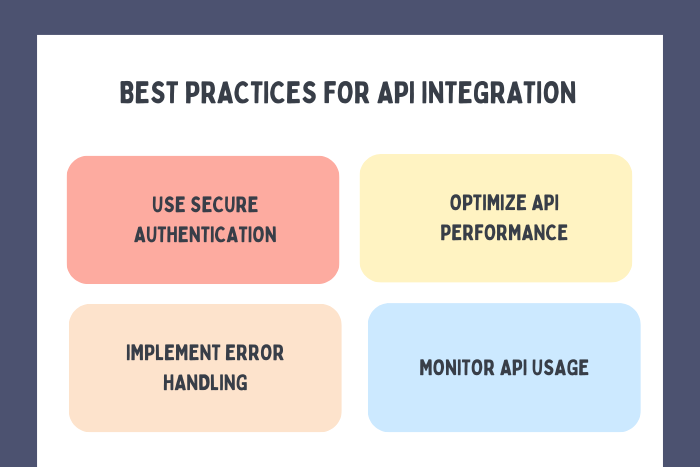
Secure authentication using OAuth, API keys, and token-based access
Seamless communication between applications and external services
Real-time data synchronization across platforms
Scalable architecture supporting multiple integrations
Error handling and automated retry mechanisms
Performance optimization for faster API response times
Comprehensive logging and monitoring systems
Version management for API updates and changes
These features ensure that applications remain secure, scalable, and capable of handling high volumes of data and user interactions.
Development Process to Integrate Third-Party APIs in App
Integrating APIs into an application requires a structured development workflow to ensure security, performance, and reliability.
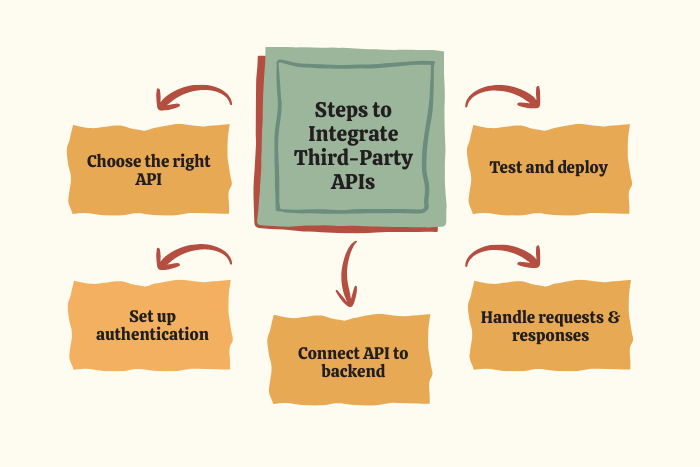
Requirement Analysis
Identify the services or functionalities that need third-party API integration such as payments, maps, messaging, or analytics.API Selection and Evaluation
Choose reliable API providers based on documentation quality, security standards, performance, and pricing.API Authentication Setup
Configure authentication methods such as API keys, OAuth tokens, or JWT for secure access.Integration and Development
Implement API endpoints within the application backend and connect them with frontend features.Request and Response Handling
Manage API calls, parse responses, and ensure proper data flow between systems.Error Handling and Rate Limit Management
Implement retry logic, fallback mechanisms, and monitoring for API usage limits.Testing and Quality Assurance
Perform functional testing, load testing, and security validation to ensure smooth API interactions.Deployment and Monitoring
Deploy the integrated application and continuously monitor API performance, uptime, and security.
This systematic approach ensures stable and secure API integrations within your application ecosystem.
Technology Stack for API Integration
Successful third-party API integration depends on a reliable technology stack that supports secure communication and scalable infrastructure.
Backend Technologies: Node.js, Python, Java, PHP, .NET
Frontend Technologies: React.js, Angular, Vue.js
Mobile Development: Swift, Kotlin, Flutter, React Native
API Protocols: REST APIs, GraphQL, SOAP
Authentication Systems: OAuth 2.0, JWT, API Keys
Databases: PostgreSQL, MongoDB, MySQL, Redis
Cloud Platforms: AWS, Google Cloud Platform, Microsoft Azure
API Management Tools: API gateways, rate limiting tools, monitoring systems
DevOps Tools: Docker, Kubernetes, CI/CD pipelines, GitHub Actions
This modern technology stack ensures secure, scalable, and high-performance API integrations.
Cost Factors to Integrate Third-Party APIs in App
The cost of integrating third-party APIs into your application depends on several technical and business factors.
Number of APIs being integrated
Complexity of integration logic
Authentication and security requirements
API usage pricing or subscription models
Custom middleware development
Performance optimization requirements
Testing and monitoring infrastructure
Ongoing maintenance and updates
Some APIs offer free tiers with usage limits, while others require subscription fees or pay-per-request pricing. Proper planning ensures efficient cost management for long-term integrations.
Latest Trends in Third-Party API Integration
API integration continues to evolve with modern cloud architectures and digital ecosystems.
Some major trends include:
API-first application development strategies
Microservices architecture powered by APIs
Serverless API integrations using cloud functions
AI and machine learning APIs integrated into apps
GraphQL APIs for more efficient data queries
API gateways for improved security and performance
Low-code and no-code API integration platforms
Real-time APIs for messaging, streaming, and collaboration tools
These innovations allow businesses to build highly connected applications with faster development cycles.
Why Choose Us for Third-Party API Integration?
Choosing the right development partner ensures that your API integrations are secure, scalable, and optimized for long-term performance. Our team specializes in building robust integration architectures that seamlessly connect your applications with external services.
Here’s why businesses trust us for API integration solutions:
Expert API Integration Developers – Skilled in integrating complex APIs across web, mobile, and enterprise systems.
Secure Integration Architecture – Implementation of OAuth authentication, encryption protocols, and security best practices.
Scalable Backend Systems – Designed to handle high traffic, multiple integrations, and real-time data processing.
Performance-Optimized API Calls – Efficient request handling, caching strategies, and latency optimization.
Reliable Monitoring and Logging – Continuous monitoring to ensure uptime and error-free integrations.
Cloud-Ready Infrastructure – Seamless integration with AWS, Google Cloud, and Azure environments.
Flexible Integration Strategies – Support for REST APIs, GraphQL APIs, and microservices architecture.
Long-Term Maintenance Support – API updates, version management, and performance optimization.
We help businesses build powerful, connected applications that leverage the full potential of third-party services.
Ready to integrate powerful third-party APIs into your application?
Let our experts build secure and scalable API integrations for your product.
Contact us today for a free consultation and customized integration strategy.
Key Points :
- Third-party APIs add powerful features like payments, messaging, maps, and analytics to applications
- API integration speeds up development by using existing services instead of building features from scratch.
- Apps become more scalable and flexible when connected with external APIs.
- Common API integrations include payment, social media, messaging, analytics, and authentication services.
- The integration process includes API selection, authentication, development, testing, and deployment.
- Technologies like Node.js, Python, and cloud platforms support modern API integration.
- API-first and microservices architectures are key trends in modern app development.
FAQ's
Yes, most modern applications integrate third-party APIs to add functionality such as payments, messaging, analytics, and authentication.
A third-party API is an interface provided by an external service that allows your application to access its features or data.
Yes, when implemented properly using authentication methods like OAuth, API keys, encryption, and secure protocols.
Simple API integrations can take a few days, while complex integrations involving multiple APIs may require several weeks.
Properly optimized API integrations do not slow down applications. Caching, asynchronous processing, and efficient request handling improve performance.
Yes, modern applications often integrate multiple APIs to support different services and functionalities.
Yes, we offer full API integration services including development, testing, monitoring, updates, and ongoing maintenance.