




Explore features of a successful DevOps strategy including CI/CD, automation, collaboration, monitoring, and scalable infrastructure.
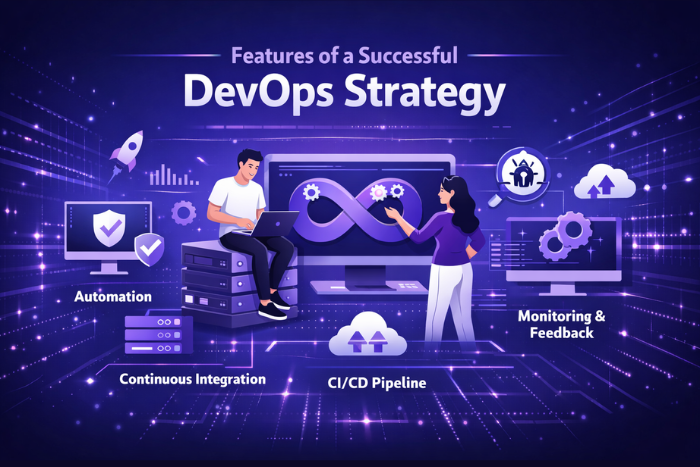
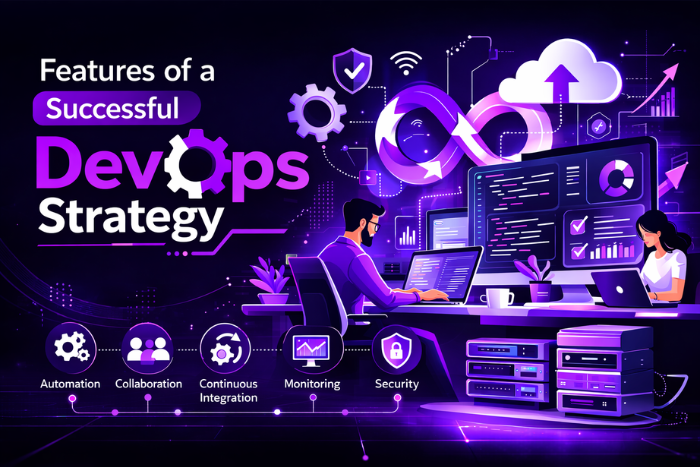
Features of a Successful DevOps Strategy
In modern software development, organizations must deliver applications faster while maintaining high quality and reliability. Traditional development and operations models often create delays, communication gaps, and deployment challenges. This is where DevOps plays a critical role. Understanding the features of a successful DevOps strategy helps organizations streamline development processes, improve collaboration, and deliver software efficiently.
DevOps is a cultural and technical approach that integrates software development (Dev) and IT operations (Ops) into a unified workflow. It focuses on automation, continuous integration, continuous delivery, and monitoring to ensure rapid and reliable software releases. Instead of operating in isolated departments, development and operations teams collaborate throughout the entire software lifecycle.
A successful DevOps strategy emphasizes automation, scalable infrastructure, continuous feedback, and strong collaboration between teams. By adopting these principles, businesses can accelerate product delivery, improve software stability, and respond quickly to market demands.
Whether building web applications, mobile apps, or enterprise platforms, implementing DevOps practices enables organizations to innovate faster while maintaining operational efficiency and security.
Why Features of a Successful DevOps Strategy Are Important
DevOps has become a crucial framework for organizations seeking to improve software delivery speed and reliability. Its practices help teams automate repetitive tasks, reduce manual errors, and ensure smooth collaboration between development and operations teams.
Here are several reasons why the features of a successful DevOps strategy are important:
Faster Software Delivery
Continuous integration and deployment pipelines accelerate release cycles.Improved Collaboration
Developers, operations teams, and stakeholders work together more efficiently.Higher Software Reliability
Automated testing and monitoring reduce production errors.Scalable Infrastructure Management
Cloud-native technologies allow systems to scale easily.Improved Security and Compliance
DevSecOps practices integrate security throughout the development lifecycle.Better Customer Experience
Frequent updates and faster bug fixes improve product quality.
These benefits help organizations stay competitive in fast-changing digital environments.
Types of Successful DevOps Strategy Solutions
DevOps strategies can be implemented in different ways depending on business goals and infrastructure requirements.
CI/CD Pipeline Implementation
Automated pipelines that manage code integration, testing, and deployment.Cloud-Based DevOps Solutions
DevOps processes integrated with cloud infrastructure.DevSecOps Implementation
Integrating security practices directly into the DevOps workflow.Infrastructure as Code (IaC)
Managing infrastructure through automated scripts and configuration files.Microservices DevOps Architecture
Deploying applications as independent services for scalability.Monitoring and Observability Solutions
Tracking system performance and identifying issues proactively.
These solutions help organizations create efficient and scalable DevOps environments.
Key Features of a Successful DevOps Strategy
A strong DevOps strategy includes several essential features that improve collaboration, efficiency, and system reliability.
Continuous Integration (CI)
Developers frequently integrate code into a shared repository.Continuous Delivery and Deployment (CD)
Automated pipelines deploy updates quickly and safely.Infrastructure as Code (IaC)
Infrastructure configurations managed through code for consistency.Automation of Development Processes
Reducing manual tasks through automated workflows.Monitoring and Logging Systems
Real-time monitoring of system performance and application health.Collaboration Between Development and Operations Teams
Breaking down traditional silos to improve communication.Scalable Cloud Infrastructure
Cloud environments that adapt to changing workloads.Security Integration (DevSecOps)
Embedding security practices into every stage of development.Continuous Feedback and Improvement
Using analytics and user feedback to refine applications.
These features ensure that DevOps environments support rapid and reliable software delivery.
DevOps Development Process
Implementing a successful DevOps strategy involves a structured workflow that integrates development and operations processes.
Planning and Requirement Analysis
Define project goals, infrastructure needs, and development workflows.Code Development and Version Control
Developers write code and store it in version control systems.Continuous Integration
Automated tools test and integrate new code changes.Automated Testing and Quality Assurance
Ensure application stability through automated testing.Continuous Deployment
Deliver software updates through automated deployment pipelines.Monitoring and Logging
Track application performance and system health.Feedback and Optimization
Analyze performance data and improve development processes.Maintenance and Continuous Improvement
Release updates and enhancements based on feedback.
This process allows teams to deliver software quickly while maintaining reliability and security.
Technology Stack for DevOps
DevOps strategies rely on various tools and technologies that support automation, collaboration, and deployment.
Version Control Systems: Git, GitHub, GitLab
CI/CD Tools: Jenkins, GitHub Actions, CircleCI
Containerization Platforms: Docker, Kubernetes
Infrastructure as Code Tools: Terraform, AWS CloudFormation
Monitoring Tools: Prometheus, Grafana, Datadog
Cloud Platforms: AWS, Google Cloud Platform, Microsoft Azure
Collaboration Tools: Slack, Microsoft Teams
These technologies enable teams to automate workflows and maintain efficient development environments.
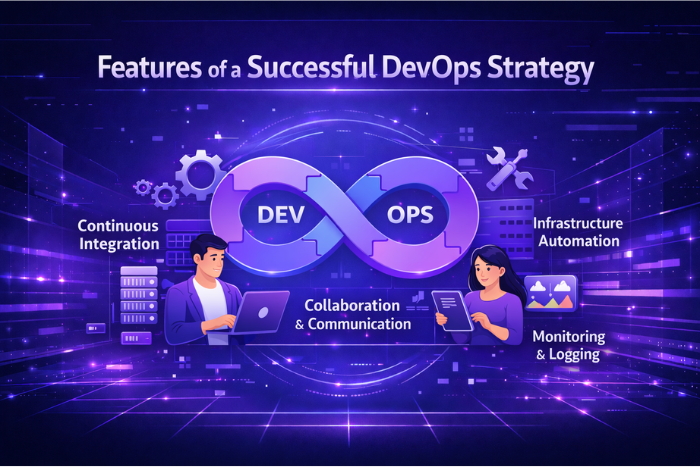

Cost Factors in DevOps Implementation
Several factors influence the cost of implementing a DevOps strategy.
Infrastructure and cloud service costs
DevOps tool licensing and implementation
Team training and skill development
Automation and CI/CD pipeline setup
Security and compliance integration
Monitoring and analytics solutions
Ongoing maintenance and updates
Although DevOps implementation requires investment, it often reduces long-term operational costs by improving efficiency.
Latest Trends in DevOps
DevOps continues to evolve as new technologies transform software development practices.
Key trends shaping modern DevOps strategies include:
AI-Powered DevOps Automation
Artificial intelligence tools that optimize deployment pipelines.DevSecOps Integration
Security integrated into development workflows.GitOps Workflow Management
Using Git repositories as the central control system for infrastructure.Serverless DevOps Architecture
Running applications without managing servers.Observability Platforms
Advanced monitoring systems that analyze system performance.Platform Engineering
Building internal platforms that simplify developer workflows.
These trends demonstrate how DevOps is evolving to support modern software development environments.
Why Choose Us for DevOps Implementation?
Selecting the right DevOps partner is crucial for building scalable and efficient development environments. Our team helps organizations implement modern DevOps strategies that accelerate software delivery and improve operational efficiency.
Here’s why businesses choose our DevOps services:
Experienced DevOps Engineers – Skilled professionals with expertise in modern DevOps tools.
Automation-Focused Development Pipelines – Reducing manual work through CI/CD automation.
Secure and Scalable Infrastructure – Cloud-native systems built for reliability.
Seamless Integration with Existing Systems – DevOps workflows adapted to your technology stack.
Continuous Monitoring and Optimization – Ensuring performance and stability.
End-to-End DevOps Implementation – From planning to deployment and maintenance.
We help organizations transform their development processes and deliver software faster.
Ready to implement a powerful DevOps strategy for your organization?
Let our experts design automated pipelines and scalable infrastructure for your development teams.
Contact us today for a free consultation and DevOps implementation plan.
Key Points :
- A successful DevOps strategy includes continuous integration (CI) and continuous delivery (CD) to automate software testing and deployment.
- Automation of development, testing, and deployment processes helps reduce errors and improve efficiency.
- Collaboration between development and operations teams improves communication and accelerates software delivery.
- Infrastructure as Code (IaC) allows teams to manage and scale infrastructure using automated scripts.
- Continuous monitoring and logging help track application performance and identify issues quickly.
- Integrating security practices (DevSecOps) ensures software is secure throughout the development lifecycle.
FAQ's
Key features include automation, continuous integration, continuous delivery, monitoring, infrastructure as code, and team collaboration.
DevOps is a development approach that combines software development and IT operations to improve collaboration and automation.
Common DevOps tools include Jenkins, Docker, Kubernetes, GitHub, Terraform, and Prometheus.
CI/CD pipelines automate testing and deployment, enabling faster and more reliable software delivery.
Infrastructure as Code (IaC) manages infrastructure using configuration files and automated scripts.
DevOps improves quality through automated testing, continuous monitoring, and rapid feedback loops.
Yes, DevOps is widely used in cloud environments to manage scalable infrastructure and automated deployments.