
Learn how to develop an app for AR/VR with our complete guide. Explore process, cost, features, and trends for immersive app development.
How Do I Develop an App for AR/VR?
Augmented Reality (AR) and Virtual Reality (VR) technologies are revolutionizing digital experiences across industries. From immersive gaming and virtual shopping to industrial simulations and medical training, AR/VR applications are redefining how users interact with digital environments. Businesses are increasingly asking: How do I develop an app for AR/VR?
Developing an AR/VR app involves combining advanced 3D modeling, spatial computing, motion tracking, and real-time rendering technologies into a seamless and interactive experience. It requires strategic planning, specialized development tools, high-performance architecture, and user-centric design principles.
Our AR/VR app development services help businesses conceptualize, design, build, and deploy immersive applications tailored to their industry needs. Whether you are building a mobile AR app, VR training simulation, metaverse platform, or enterprise visualization tool, we provide end-to-end solutions that transform ideas into powerful immersive experiences.
Why This AR/VR App Development Service Is Important
AR/VR applications create highly engaging and interactive user experiences that go beyond traditional mobile and web interfaces. Businesses investing in immersive technology gain competitive advantages through innovation and enhanced engagement.
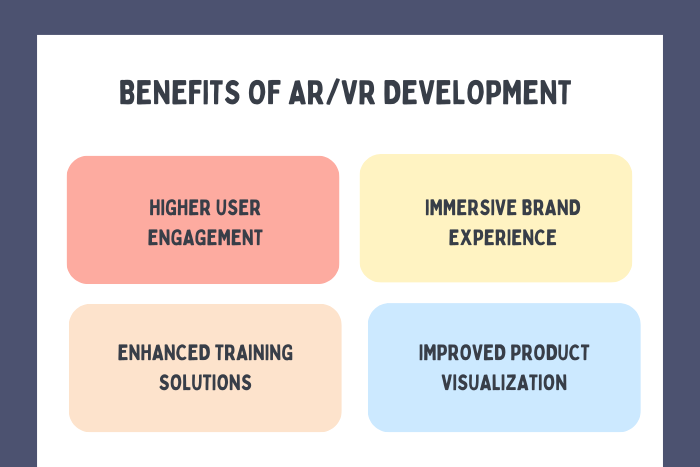
Key benefits include:
Higher user engagement and retention
Enhanced training and simulation capabilities
Improved product visualization and sales
Remote collaboration and virtual experiences
Real-time interaction with digital objects
Brand differentiation through immersive storytelling
As industries embrace digital transformation, AR/VR app development services enable organizations to future-proof their digital strategies.
Types of AR/VR App Development Solutions
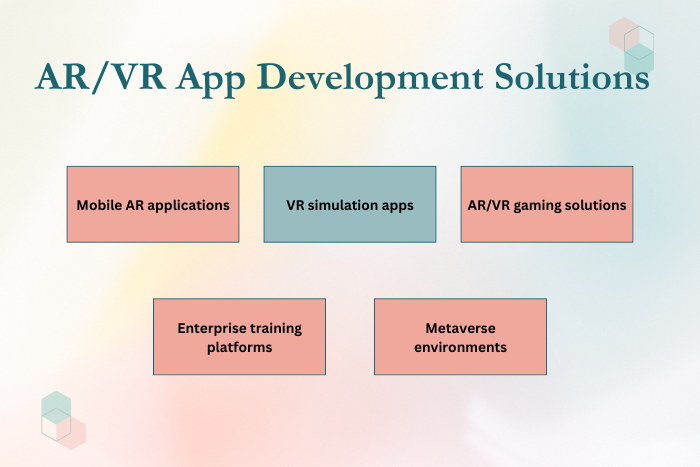
We offer comprehensive immersive solutions to develop an app for AR/VR across industries:
Mobile AR Application Development – AR-based mobile apps for iOS and Android devices.
Virtual Reality (VR) App Development – Fully immersive VR applications for headsets and simulation platforms.
AR/VR Game Development – Interactive 3D gaming experiences using immersive technologies.
Enterprise AR/VR Solutions – Training simulations, industrial visualization, and remote assistance tools.
Location-Based AR Applications – Geo-enabled AR experiences for retail, tourism, and real estate.
Metaverse & Virtual Environment Development – Interactive 3D environments and collaborative virtual platforms.
Wearable AR/VR Development – Applications for smart glasses and head-mounted displays.
Key Features of AR/VR Applications
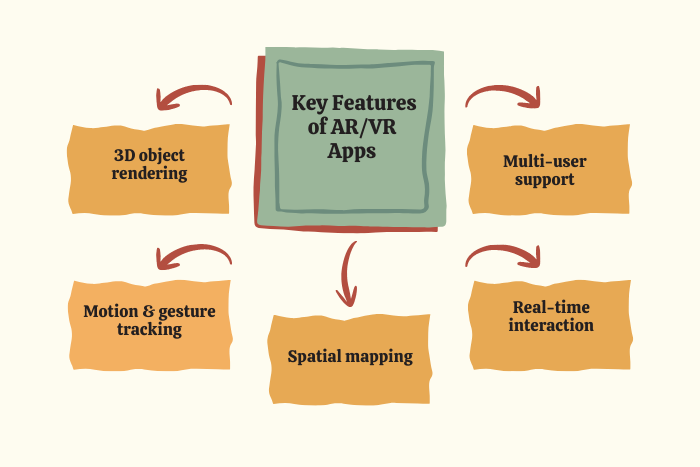
High-performing AR/VR apps include advanced immersive capabilities:
3D object rendering and modeling
Real-time motion tracking
Gesture and voice recognition
Spatial mapping and environment detection
Multi-user interaction support
AI-powered object recognition
High-performance graphics optimization
Cross-platform compatibility
Interactive UI/UX design for immersive environments
These features ensure realistic, engaging, and responsive experiences.
Development Process
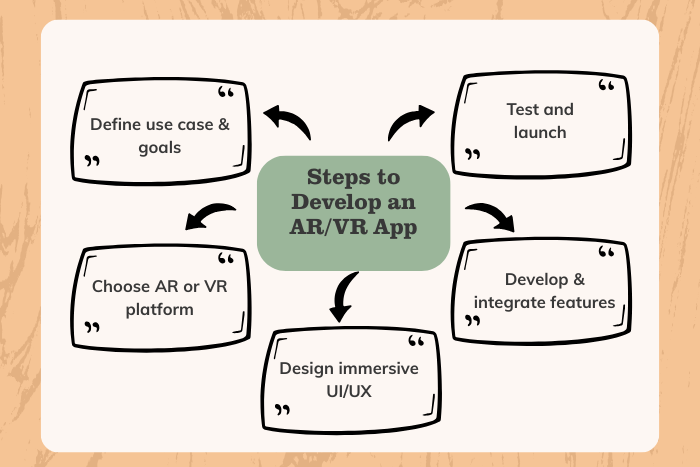
We follow the development process below to develop an app for AR/VR:
Requirement Analysis & Conceptualization – Define business goals, target audience, and immersive use cases.
Technology Selection & Platform Planning – Choose AR or VR platforms, development tools, and hardware compatibility.
UI/UX Design & 3D Prototyping – Create wireframes, immersive interaction models, and 3D asset designs.
Core Development & Integration – Implement AR/VR features, rendering engines, and backend integration.
Testing & Performance Optimization – Conduct device compatibility testing, performance tuning, and usability evaluation.
Deployment & Store Submission – Launch on app stores or VR platforms with optimized build configurations.
Post-Launch Support & Updates – Provide ongoing maintenance, performance monitoring, and feature enhancements.
Technology Stack
We leverage industry-leading tools and frameworks for AR/VR development:
AR Platforms: ARKit, ARCore, Vuforia
VR Platforms: Oculus SDK, HTC Vive SDK, SteamVR
Game Engines: Unity 3D, Unreal Engine
Programming Languages: C#, C++, Java, Swift
3D Modeling Tools: Blender, Maya, 3ds Max
Cloud & Backend: AWS, Firebase, Node.js
AI Integration: TensorFlow, OpenCV
Cost Factors for AR/VR App Development
The cost to develop an app for AR/VR solution depends on:
Complexity of 3D modeling and rendering
Type of platform (mobile AR vs VR headset)
Number of interactive features
Multi-user or multiplayer capabilities
AI and object recognition integration
Device compatibility requirements
Security and cloud infrastructure needs
Simple AR applications may require moderate budgets, while advanced VR simulations or metaverse platforms demand larger investments.
Latest Trends in AR/VR App Development (2025)
AR/VR continues to evolve rapidly with cutting-edge innovations:
AI-powered immersive experiences
5G-enabled real-time rendering
Spatial computing and digital twins
Mixed Reality (MR) integration
AR commerce and virtual try-on solutions
Immersive remote collaboration tools
Wearable AR glasses advancements
Metaverse business ecosystems
Businesses adopting these trends position themselves as digital leaders.
Why Choose Us for AR/VR App Development?
We combine immersive design expertise with advanced technical capabilities to develop an app for AR/VR solutions.
Experienced AR/VR developers and 3D specialists
End-to-end immersive application development
Expertise in Unity, Unreal, ARKit, and ARCore
High-performance rendering optimization
Secure and scalable backend architecture
Agile development methodology
Transparent communication and milestone tracking
Dedicated post-launch support
Ready to build your immersive AR/VR application?
Contact us today to discuss your AR/VR app development project.
Let’s transform your vision into a powerful immersive experience.
Key Points :
- Complete guide explaining how to develop an app for AR/VR with step-by-step development process.
- Covers AR and VR app development solutions including mobile AR, VR simulations, and metaverse platforms.
- Highlights essential AR/VR features such as 3D rendering, motion tracking, spatial mapping, and gesture recognition.
- Details the full development lifecycle from concept planning to deployment and post-launch support.
- Explains technology stack including Unity, Unreal Engine, ARKit, ARCore, and VR SDKs.
- Breaks down AR/VR app development cost factors based on platform, 3D assets, and feature complexity.
- Conversion-focused insights helping businesses build scalable, immersive, and future-ready AR/VR applications.
FAQ's
To develop an app for AR/VR, start by defining your use case, selecting the right platform, designing immersive interactions, and partnering with experienced AR/VR developers.
Depending on complexity, it can take 3–8 months including design and testing.
Gaming, healthcare, retail, education, real estate, manufacturing, and entertainment.
AR overlays digital content onto the real world, while VR creates a fully immersive virtual environment.
Costs vary based on platform, 3D assets, features, and integrations.
Yes, AI enhances object recognition, voice commands, and personalization.
Yes, mobile AR apps work on iOS and Android devices.
Yes, we offer maintenance, performance optimization, and feature updates.