Learn how to develop an app for chatbots with features, tech stack, costs, and process. Build scalable AI chatbot apps for web and mobile.
How Do I Develop an App for Chatbots?
If you’re asking, “How do I develop an app for chatbots?”, you’re likely planning to leverage AI-powered conversational technology to improve customer engagement, automate support, or drive sales. Chatbot apps are no longer limited to simple scripted responses — modern AI chatbot applications use natural language processing (NLP), machine learning (ML), and generative AI models to deliver intelligent, human-like conversations across web and mobile platforms.
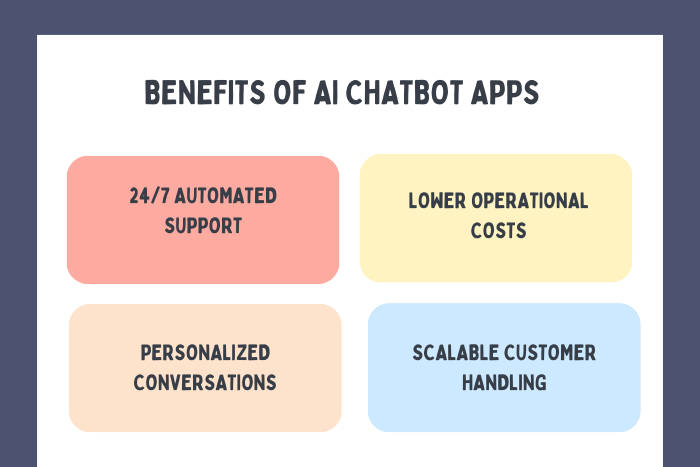
Businesses across healthcare, fintech, retail, education, and SaaS are investing in chatbot app development to provide 24/7 support, reduce operational costs, and personalize user experiences at scale. However, building a chatbot app requires more than integrating a language model. It involves selecting the right AI architecture, designing conversation flows, ensuring data security, and building scalable infrastructure.
This comprehensive guide explains how to develop an app for chatbots step-by-step — including solution types, features, development process, technology stack, cost factors, and emerging trends — so you can build a powerful, future-ready AI chatbot solution.
Why This Chatbot App Development Service Is Important
Developing an AI chatbot app delivers measurable business value:
24/7 Automated Customer Support – Reduce response time and improve user satisfaction.
Cost Efficiency – Minimize dependency on large support teams.
Lead Qualification & Sales Automation – Convert visitors into customers automatically.
Personalized Conversations – Deliver tailored responses using AI insights.
Operational Scalability – Handle thousands of conversations simultaneously.
Data-Driven Insights – Gain analytics on user behavior and intent.
Whether you’re building a customer service chatbot, AI virtual assistant, or enterprise conversational AI solution, a professionally developed chatbot app ensures reliability, scalability, and long-term ROI.
Types of Chatbot App Development Solutions
When planning how to develop an app for chatbots, choosing the right solution model is critical. Common chatbot app development solutions include:
Conversational AI Chatbots – Intelligent bots powered by NLP and ML that understand natural language and maintain contextual conversations.
Generative AI Chatbot Apps – Advanced chatbot applications using large language models (LLMs) to generate human-like responses dynamically.
Hybrid Chatbots – A combination of rule-based flows and AI-driven responses for improved accuracy and control.
Transactional (Task-Oriented) Chatbots – Designed to perform specific actions such as booking appointments, processing orders, or handling payments.
Voice-Enabled Chatbot Apps – Integrated with speech recognition and text-to-speech for voice-based interactions.
Multichannel & Omnichannel Chatbots – Deployable across websites, mobile apps, WhatsApp, Messenger, Slack, and other platforms.
Enterprise AI Chatbots – Custom chatbot systems integrated with CRM, ERP, and internal business tools.
Selecting the right chatbot architecture depends on your business goals, target audience, and integration requirements.
Key Features to Develop an App for Chatbots
A high-performing chatbot app must include intelligent, scalable, and secure capabilities:
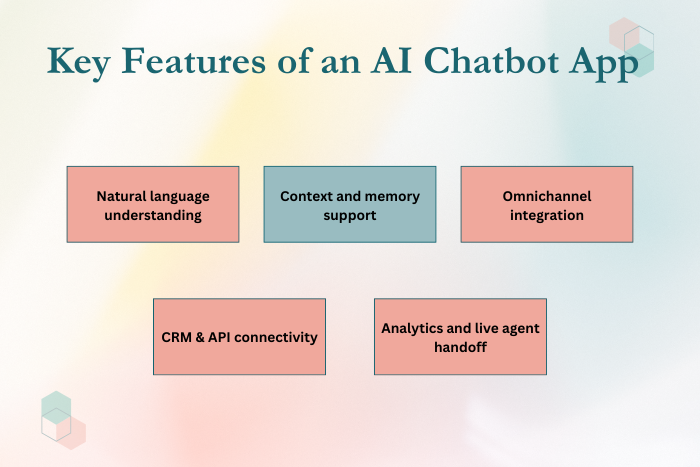
Natural Language Understanding (NLU) – Interprets user intent accurately.
Context Awareness – Maintains conversation flow and remembers prior inputs.
Intent Recognition & Entity Extraction – Identifies keywords and relevant data points.
Multilingual Support – Enables global accessibility.
Omnichannel Deployment – Works across web, mobile, and messaging apps.
CRM & API Integration – Syncs with third-party tools and business systems.
AI Learning & Feedback Loop – Continuously improves from user interactions.
Analytics Dashboard – Tracks engagement, response accuracy, and KPIs.
Human Escalation Mechanism – Routes complex queries to live agents.
Data Security & Compliance – Ensures encrypted communication and GDPR compliance.
A feature-rich chatbot app improves customer experience while ensuring operational efficiency.
Development Process
Building a chatbot application requires a structured and agile development approach:
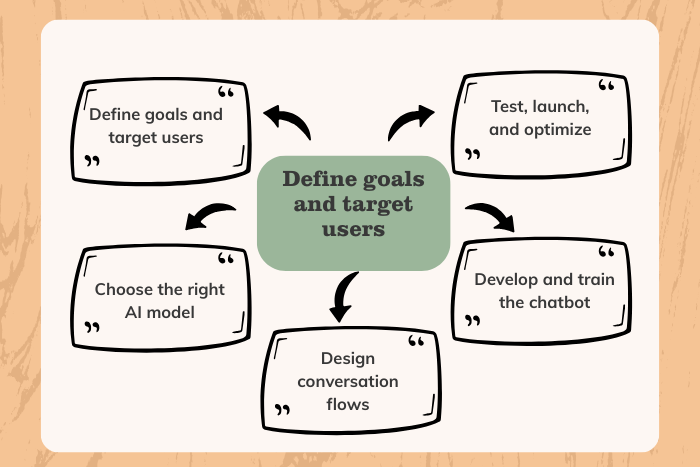
Define Business Goals & Use Cases
Identify the chatbot’s purpose — customer support, sales automation, internal assistance, or lead generation.Choose the Right Chatbot Model
Decide between rule-based, AI-driven, or generative AI chatbot architecture.Design Conversation Flows & UX
Map user journeys, conversational scenarios, and fallback responses.Select the Technology Stack
Choose NLP frameworks, backend technologies, and hosting platforms.Develop & Train the AI Model
Train the chatbot using datasets, intents, and sample queries.Integration with APIs & Systems
Connect with CRM, payment gateways, ERP systems, or databases.Testing & Quality Assurance
Conduct functional, performance, and security testing.Deployment & Platform Launch
Deploy across web, mobile apps, or messaging platforms.Monitoring & Continuous Optimization
Analyze chatbot performance and refine conversation models.
An iterative, agile methodology ensures ongoing improvement and faster go-to-market.
Technology Stack for Chatbot App Development
Choosing the right AI and development tools directly impacts chatbot performance and scalability.
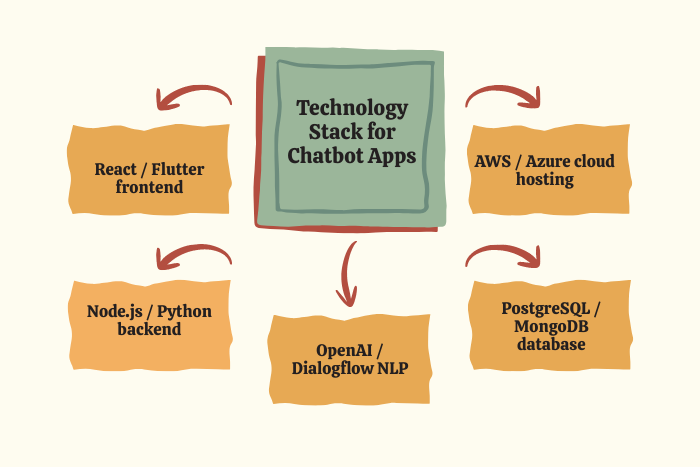
- Frontend (Web & Mobile Apps):
React.js, Angular, Vue.js, Flutter, React Native - Backend Technologies:
Node.js, Python (FastAPI, Django), .NET Core - AI & NLP Frameworks:
OpenAI API, Dialogflow, Microsoft Bot Framework, Rasa - Machine Learning Libraries:
TensorFlow, PyTorch, Scikit-learn - Databases:
PostgreSQL, MongoDB, Redis - Cloud & Hosting:
AWS, Microsoft Azure, Google Cloud Platform - DevOps & Deployment:
Docker, Kubernetes, CI/CD pipelines
Selecting scalable cloud-native infrastructure ensures real-time performance and high availability.
Cost Factors to Develop an App for Chatbots
The cost to develop an AI chatbot app depends on multiple variables:
Chatbot complexity (rule-based vs generative AI)
Number of supported platforms (web, iOS, Android, messaging apps)
AI model training requirements
Third-party integrations
Custom UI/UX design
Security & compliance requirements
Multilingual capabilities
Ongoing maintenance and AI retraining
A simple chatbot MVP costs significantly less than a fully integrated enterprise-grade AI chatbot platform. Clear project scoping and phased development reduce financial risk.
Latest Trends in AI Chatbot App Development
The chatbot ecosystem is evolving rapidly. Key trends include:
Generative AI Integration – LLM-powered conversational experiences.
Emotion & Sentiment Detection – AI-driven emotional intelligence.
Voice & Multimodal Interaction – Combining text, voice, and visuals.
AI Copilots for Businesses – Internal productivity assistants.
Hyper-Personalization – Context-aware responses using behavioral data.
Secure AI & Private LLMs – Enterprise-level data protection.
Low-Code AI Chatbot Builders with Custom AI Layers
Adopting emerging technologies ensures competitive advantage and long-term scalability.
Why Choose Us to Develop Your AI Chatbot App?
Developing a secure, intelligent chatbot app requires AI expertise, scalable architecture, and deep industry knowledge. We provide end-to-end chatbot app development services tailored to your business needs.
Here’s why businesses partner with us:
AI-First Architecture – Built using advanced NLP and generative AI models.
Custom Conversation Design – Human-centered UX for natural engagement.
Enterprise-Grade Security – Data encryption and compliance-ready solutions.
Scalable Cloud Deployment – Designed to handle high conversation volumes.
Agile & Transparent Workflow – Milestone-based delivery with regular updates.
Post-Launch Optimization – Continuous AI training and performance improvements.
We don’t just build chatbot apps — we create intelligent digital assistants that drive measurable business results.
Ready to build your AI-powered chatbot app?
Let’s turn your chatbot idea into a scalable, intelligent solution.
Contact us today for a free consultation and project estimate.
Key Points :
- Learn how to develop an app for chatbots with a step-by-step AI chatbot development process.
- Discover essential features like NLP, context awareness, CRM integration, and omnichannel deployment.
- Understand the complete technology stack required for scalable AI chatbot app development.
- Analyze key cost factors affecting chatbot app development for startups and enterprises.
- Compare rule-based vs AI-powered chatbot applications to choose the right solution.
- Learn how to build secure, scalable, high-performance chatbot apps for web and mobile.
FAQ's
Start by defining your chatbot’s purpose, choose the right AI model, design conversation flows, select a technology stack, develop and train the chatbot, test thoroughly, and deploy across platforms.
Rule-based chatbots follow predefined scripts, while AI chatbots use NLP and machine learning to understand and respond dynamically.
An MVP chatbot app may take 6–10 weeks, while a fully integrated enterprise AI chatbot can take 3–6 months.
Popular technologies include Python, Node.js, Dialogflow, Rasa, OpenAI API, TensorFlow, and cloud platforms like AWS or Azure.
Costs vary based on complexity, integrations, supported platforms, and AI capabilities. Advanced generative AI chatbots require higher investment.
Yes. Modern chatbot apps can integrate seamlessly with CRM, ERP, payment gateways, and other enterprise tools.
When built with proper encryption, authentication, and compliance standards (such as GDPR), chatbot apps are highly secure.
Yes. We offer continuous monitoring, AI model retraining, performance tuning, and feature enhancements after deployment.