Learn how to develop an app for event management with features, tech stack, costs, and step-by-step process. Build scalable, engaging event apps today.
How Do I Develop an App for Event Management?
If you’re asking, “How do I develop an app for event management?”, you’re likely looking to streamline event planning, improve attendee engagement, and digitize operations. Event management apps have transformed how conferences, corporate events, festivals, trade shows, and community gatherings are organized. From ticket booking and agenda scheduling to live notifications and analytics dashboards, mobile event apps enhance both organizer efficiency and attendee experience.
Developing an event management app requires strategic planning, scalable backend architecture, real-time communication systems, secure payment integration, and user-friendly design. Whether you’re building an app for a single large-scale conference or a multi-event SaaS platform, the right development approach ensures performance, reliability, and long-term growth.
In this complete guide, we explain how to develop an app for event management step by step — covering solution types, must-have features, development process, technology stack, cost factors, and emerging trends — so you can build a powerful and future-ready event platform.
Why Event Management App Development Is Important
The events industry has become increasingly digital, and attendees now expect seamless mobile experiences. A dedicated event app offers significant operational and strategic advantages:
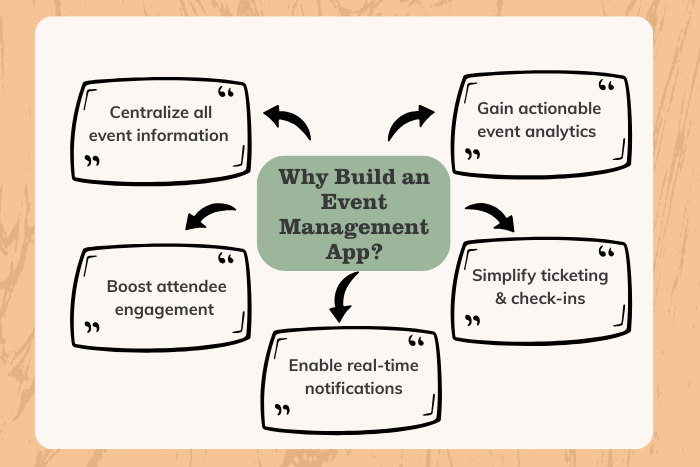
Centralizes event information in one digital hub
Improves attendee engagement with real-time updates
Enables instant communication through push notifications
Simplifies ticketing and payment processing
Provides analytics for better event planning decisions
Reduces manual coordination and paperwork
Enhances networking through chat and interaction tools
Event management apps also support hybrid and virtual events, expanding audience reach beyond physical venues. For organizers, sponsors, and participants alike, a well-built event app drives efficiency, engagement, and revenue.
Types of Event Management Application Solutions
When considering how to develop an app for event management, identifying the right solution model is essential.
Conference & Corporate Event Apps
Designed for large conferences, business summits, and corporate meetings with agenda management and speaker profiles.Ticketed & Entertainment Event Apps
Focused on concerts, festivals, and exhibitions with ticket booking and QR-based check-ins.Hybrid & Virtual Event Platforms
Integrated live streaming, virtual booths, chat rooms, and digital networking features.Multi-Event SaaS Platforms
Cloud-based platforms that allow organizers to manage multiple events from a single dashboard.Community & Educational Event Apps
Designed for workshops, training programs, and nonprofit events with interactive engagement tools.Internal Enterprise Event Solutions
Used for internal corporate training, employee engagement programs, and internal conferences.
Choosing the correct model determines the feature set, architecture, and monetization strategy.
Key Features of an Event Management App
To build a competitive and scalable event management app, these core features are essential:
User registration and profile management
Event listing and detailed information pages
Smart agenda and session scheduling
Push notifications and real-time alerts
Interactive venue maps and navigation
Ticket booking and secure payment integration
QR-based check-in and badge scanning
Live polling, Q&A, and chat modules
Sponsor and exhibitor showcase sections
Feedback and rating system
Organizer analytics dashboard
CMS for real-time content updates
A well-designed event app balances performance, usability, and scalability while ensuring secure transactions and data protection.
Development Process
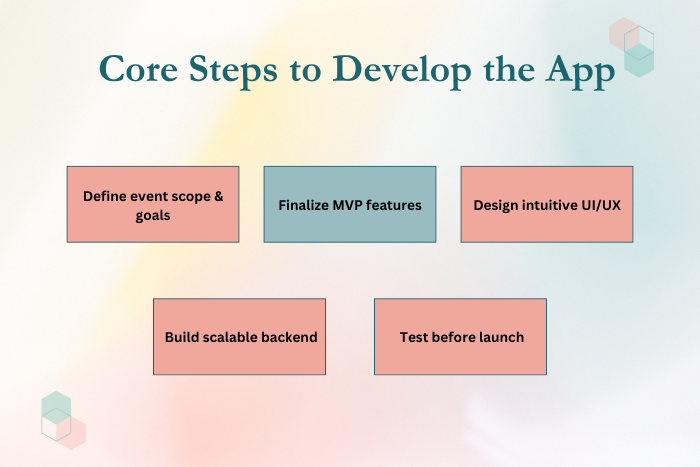
To successfully develop an event management app, follow this structured process:
Define Event Scope & Business Model
Identify your target audience, event type, revenue model, and monetization strategy.Conduct Market & User Research
Analyze competitors and gather insights to finalize core functionalities.Finalize Feature Set & MVP Strategy
Prioritize must-have features for initial launch and define expansion roadmap.UI/UX Design & Wireframing
Create intuitive interfaces optimized for real-world event usage.Backend Architecture Planning
Build scalable infrastructure to support real-time notifications and large attendee volumes.Mobile App Development (iOS & Android)
Develop native or cross-platform apps with optimized performance.API & Third-Party Integrations
Integrate payment gateways, maps, live streaming tools, and marketing platforms.Testing & Quality Assurance
Perform functional, performance, and security testing.Deployment & Post-Launch Optimization
Launch on app stores and continuously monitor performance and engagement.
An agile methodology ensures flexibility and faster iteration cycles.
Technology Stack for Event Management App Development
Choosing the right technology stack ensures scalability and reliability.
Front-End (Mobile): React Native, Flutter, Swift (iOS), Kotlin (Android)
Back-End: Node.js, Django, .NET Core
Databases: PostgreSQL, MongoDB
Real-Time Communication: WebSockets, Firebase
Cloud Infrastructure: AWS, Microsoft Azure, Google Cloud Platform
Payment Gateways: Stripe, PayPal, Razorpay
Live Streaming: WebRTC, third-party streaming APIs
DevOps: Docker, Kubernetes, CI/CD pipelines
Security: OAuth 2.0, JWT authentication, SSL encryption
Cloud-native architecture allows the platform to handle traffic spikes during peak event times.


Cost Factors in Event Management App Development
The cost of developing an event management app depends on several factors:
App complexity and feature set
Native vs cross-platform development
Real-time engagement features
Ticketing and payment integrations
Live streaming implementation
UI/UX customization
Backend scalability requirements
Maintenance and support plans
A basic MVP event app may require moderate investment, while a full-featured enterprise event platform with hybrid capabilities demands a larger budget. Clear project scope definition ensures accurate cost estimation.
Latest Trends in Event Management Application Development
The event technology landscape continues to evolve with innovation:
AI-powered attendee matchmaking
Personalized event recommendations
Hybrid and virtual event integration
Contactless check-in systems
AR/VR event experiences
Data-driven event analytics
Gamification features for engagement
Blockchain-based ticket authentication
Integrating emerging technologies enhances engagement and future-proofs your event platform.
Why Choose Us to Develop Your Event Management App?
Developing a scalable and engaging event management app requires technical expertise and industry understanding. We provide end-to-end event app development services tailored to your business goals.
Here’s why clients choose us:
Scalable Architecture from Day One – Designed to handle thousands of attendees.
Real-Time Engagement Expertise – Push notifications, live chats, and instant updates.
Secure Ticketing & Payments – Encrypted transactions and fraud protection.
User-Centric UI/UX Design – Seamless navigation and intuitive interactions.
Cloud-Native Deployment – Reliable infrastructure with auto-scaling capabilities.
Agile & Transparent Workflow – Milestone-based delivery and continuous communication.
Post-Launch Support & Optimization – Ongoing improvements and performance monitoring.
We don’t just build apps — we build digital event ecosystems that increase engagement, streamline operations, and maximize revenue.
Ready to develop your event management app?
Let’s build a scalable and engaging platform tailored to your event needs.
Contact us today for a free consultation and project estimate.
Key Points :
- Step-by-step guide to developing an event management app, from market research to deployment and scaling.
- Comprehensive feature breakdown including ticketing, agenda scheduling, push notifications, live chat, and analytics dashboards.
- Scalable architecture planning for conferences, hybrid events, corporate meetings, and multi-event SaaS platforms.
- Secure payment and check-in integration with QR codes, encrypted transactions, and real-time validation.
- Clear cost and timeline insights for MVP apps versus full-featured enterprise event platforms.
- Conversion-focused development approach emphasizing user engagement, scalability, performance optimization, and post-launch support.
FAQ's
To develop an app for event management from scratch, first start with market research, define your event type and business model, finalize features, design UI/UX, build backend infrastructure, develop mobile apps, test thoroughly, and launch with a scaling plan.
An MVP can take 3–4 months, while a full-featured platform may take 6–9 months depending on complexity.
Core features include registration, agenda scheduling, ticketing, notifications, live engagement tools, and analytics dashboards.
Yes. Modern event apps integrate live streaming, virtual networking, and digital booths.
Costs vary based on features, integrations, and scalability requirements.
React Native or Flutter for frontend and Node.js or Django for backend are commonly used scalable solutions.
Yes. Revenue models include ticket sales, sponsorship placements, subscription plans, and premium features.
Yes. We offer performance monitoring, feature updates, scaling support, and security enhancements for long-term success.