Learn how to develop an app for healthcare professionals with features, compliance, tech stack, costs, and secure healthcare app solutions.
How Do I Develop an App for Healthcare Professionals?
If you’re asking, “How do I develop an app for healthcare professionals?”, you’re likely aiming to build a secure, compliant, and high-performing digital solution for doctors, nurses, medical staff, clinics, or hospitals. Healthcare app development is more complex than traditional mobile app development due to strict regulatory requirements, patient data protection laws, and the need for seamless integration with medical systems such as EHRs and telemedicine platforms.
Healthcare professionals rely on mobile and web applications for patient management, appointment scheduling, remote consultations, diagnostics, e-prescriptions, clinical communication, and real-time data access. A well-developed healthcare app improves workflow efficiency, enhances patient care, reduces administrative burden, and supports data-driven medical decisions.
Developing an app for healthcare professionals requires careful planning, HIPAA/GDPR compliance, robust security architecture, and scalable cloud infrastructure. This guide covers healthcare app development services, solution types, must-have features, development processes, technology stack, cost factors, and latest trends to help you build a reliable medical application.
Why Healthcare App Development Services Are Important
Healthcare digital transformation is accelerating globally. Medical professionals need secure, fast, and interoperable systems to manage patient data and clinical workflows efficiently.
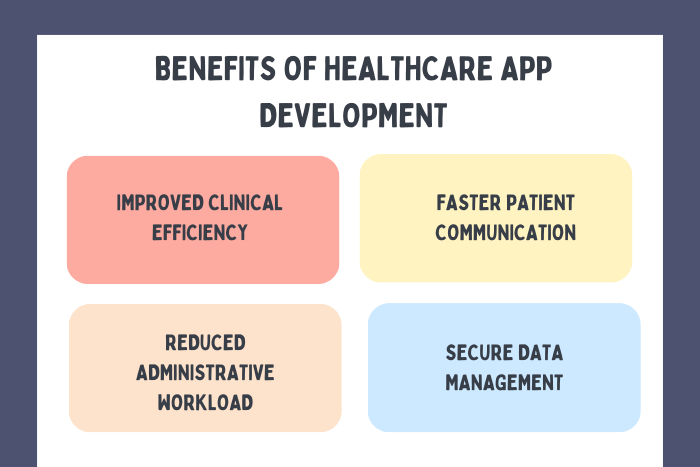
Professional healthcare app development ensures:
Improved Clinical Efficiency – Streamlined scheduling, documentation, and communication.
Secure Patient Data Handling – Compliance with HIPAA, GDPR, and other regulations.
Remote Care & Telemedicine Support – Virtual consultations and monitoring.
Real-Time Data Access – Immediate access to medical records and diagnostics.
Reduced Administrative Costs – Automated workflows and digital documentation.
Enhanced Patient Outcomes – Faster communication and informed decision-making.
Without proper compliance and architecture, healthcare apps can expose organizations to legal risks and data breaches. That’s why specialized healthcare app development services are essential.
Types of Solutions to Develop an App for Healthcare Professionals
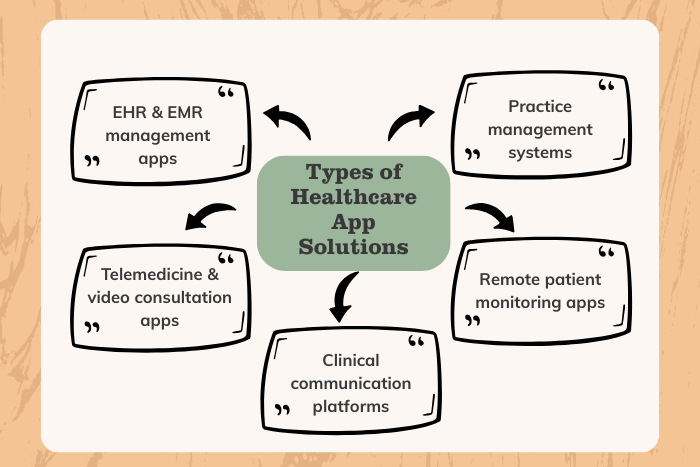
When planning how to develop an app for healthcare professionals, it’s important to identify the right solution type:
Electronic Health Record (EHR) Apps – Secure patient record management systems integrated with hospital databases.
Telemedicine & Virtual Consultation Apps – Video consultations, e-prescriptions, and remote diagnostics.
Clinical Communication Apps – Secure messaging platforms for doctors and medical teams.
Appointment Scheduling & Practice Management Apps – Automated scheduling, reminders, and billing.
Remote Patient Monitoring (RPM) Apps – IoT-integrated solutions for tracking vital signs.
Medical Reference & Knowledge Apps – Clinical databases and decision-support systems.
Prescription & e-Pharmacy Apps – Digital prescription management systems.
Healthcare Analytics & Reporting Apps – Data-driven insights for clinical performance tracking.
Each solution requires different levels of integration, compliance, and infrastructure planning.
Key Features to Develop an App for Healthcare Professionals
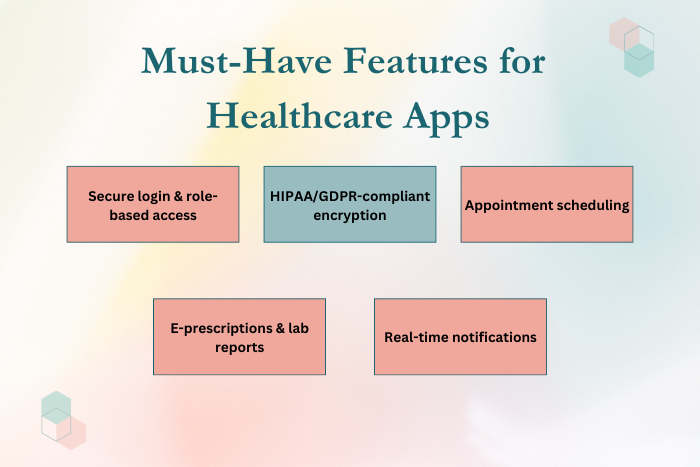
A secure and efficient healthcare app should include:
Secure user authentication & role-based access
HIPAA/GDPR-compliant data encryption
Patient record management
Appointment scheduling system
Secure messaging & video conferencing
E-prescription functionality
Lab report integration
Real-time notifications
Audit trails & activity logs
Offline data access
Multi-device compatibility
Integration with EHR/EMR systems
Analytics & reporting dashboards
Security, reliability, and usability are critical pillars in healthcare app development.
Healthcare App Development Process
Developing a medical app requires a structured and compliance-focused process:
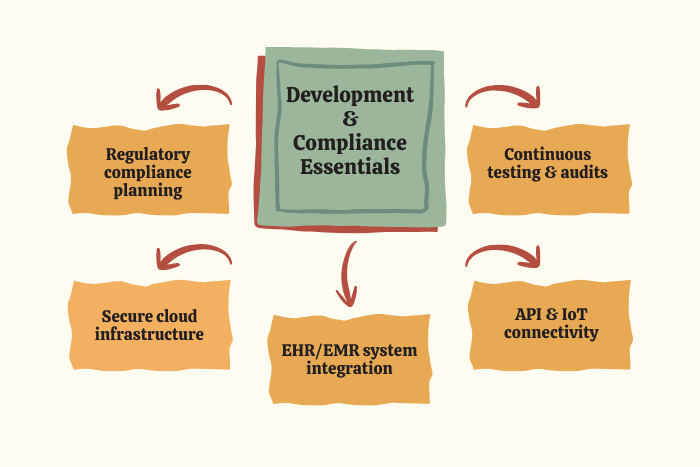
Requirement Analysis & Regulatory Research
Define user roles, clinical needs, and applicable healthcare regulations.Compliance Planning (HIPAA/GDPR/FDA if applicable)
Implement data protection and legal standards.Architecture Design
Design scalable, secure cloud-based infrastructure.UI/UX Design for Medical Workflows
Create intuitive dashboards optimized for healthcare professionals.Backend & Frontend Development
Develop secure APIs and responsive interfaces.Integration with Medical Systems
Connect EHR, EMR, billing, and laboratory systems.Testing & Quality Assurance
Conduct functional, security, compliance, and performance testing.Deployment & Cloud Configuration
Securely deploy on compliant hosting environments.Maintenance & Continuous Updates
Regular updates, compliance audits, and performance optimization.
Healthcare app development demands precision, especially regarding data security and compliance.
Technology Stack for Healthcare App Development
Selecting the right technology stack ensures performance and compliance.
- Frontend:
React Native, Flutter, Swift (iOS), Kotlin (Android) - Backend:
Node.js, Python (Django/FastAPI), .NET Core - Database:
PostgreSQL, MongoDB, Firebase (secure configurations) - Cloud & Hosting:
AWS (HIPAA-compliant), Microsoft Azure Healthcare, Google Cloud Healthcare API - Security & Compliance:
OAuth 2.0, SSL/TLS encryption, End-to-end encryption, Multi-factor authentication - Video & Telemedicine:
WebRTC, Twilio API - IoT Integration:
FHIR APIs, HL7 standards
Using healthcare-compliant cloud services ensures data protection and regulatory adherence.
Cost Factors to Develop an App for Healthcare Professionals
The cost to develop an app for healthcare professionals depends on:
App complexity and number of features
Compliance and regulatory requirements
Telemedicine and video integration
IoT or wearable device connectivity
Third-party integrations (EHR, billing systems)
Platform choice (iOS, Android, Web)
Security architecture requirements
Ongoing maintenance and audits
A basic healthcare MVP may cost significantly less than a fully integrated hospital management system.
Latest Trends in Healthcare App Development
The healthcare technology landscape is evolving rapidly. Key trends include:
AI-Powered Diagnostics & Decision Support
Remote Patient Monitoring with IoT Devices
Blockchain for Secure Medical Records
Voice-Enabled Clinical Assistants
Predictive Healthcare Analytics
Cloud-Based Interoperability Systems
AR/VR in Medical Training
Wearable Health Data Integration
Adopting innovative technologies enhances patient care and operational efficiency.
Why Choose Us for Healthcare App Development?
Healthcare app development requires deep domain knowledge, compliance expertise, and secure architecture design. We deliver end-to-end healthcare app development services tailored to medical professionals and healthcare organizations.
Here’s why clients trust us:
Compliance-First Development Approach
HIPAA & GDPR-Ready Infrastructure
Scalable Cloud Architecture
Secure API & Data Encryption Implementation
Healthcare Workflow Optimization Expertise
Agile & Transparent Project Management
Ongoing Compliance Monitoring & Support
We don’t just build apps — we develop secure digital healthcare ecosystems that improve efficiency and patient outcomes.
Ready to develop a secure healthcare app for professionals?
Let’s transform your healthcare idea into a compliant, scalable digital solution.
Contact us today for a free consultation and project estimate.
Key Points :
- Learn how to develop an app for healthcare professionals with secure, compliant architecture.
- Explore different healthcare app solutions including EHR, telemedicine, and remote monitoring apps.
- Understand HIPAA and GDPR compliance requirements for medical app development.
- Discover essential features like secure messaging, e-prescriptions, and patient record management.
- Identify key cost factors affecting healthcare mobile app development.
- Stay updated with trends like AI diagnostics, IoT integration, and blockchain in healthcare apps.
FAQ's
Start with requirement analysis, ensure regulatory compliance, design secure architecture, develop and test the app, then deploy on a compliant cloud infrastructure.
Common regulations include HIPAA (USA), GDPR (EU), and local healthcare data protection laws.
Depending on complexity, development may take 4–9 months for a fully compliant solution.
Popular technologies include React Native, Node.js, AWS Healthcare services, and FHIR APIs.
Costs vary based on features, integrations, compliance requirements, and platform choice.
Yes, secure video consultation and e-prescription systems can be integrated.
Yes, using HL7 and FHIR APIs for interoperability.
Yes, we offer ongoing maintenance, updates, and compliance audits to ensure long-term security and reliability.