


Learn how to develop a real estate app with features, technology stack, cost factors, and development process for property listing and real estate platforms.
How Do I Develop an App for Real Estate Industry?
The real estate industry has rapidly embraced digital transformation, with mobile applications becoming a powerful tool for property buyers, sellers, investors, and agents. If you’re wondering how do I develop an app for real estate industry, the answer involves combining property data, advanced search features, secure communication, and user-friendly interfaces to create an efficient property marketplace.
Modern real estate applications allow users to browse property listings, compare prices, view locations on maps, communicate with agents, and even schedule virtual tours. These apps streamline the entire property search and transaction process while improving accessibility for both buyers and sellers.
Real estate businesses, property agencies, and investors are increasingly investing in mobile apps to enhance customer engagement, generate leads, and automate property management tasks. From listing platforms and property management systems to investment apps and mortgage calculators, real estate applications offer a wide range of solutions.
Building a real estate app requires strategic planning, a strong technology stack, and integration with mapping systems, payment gateways, and communication tools. In this guide, we will explore how to develop a real estate app, including the types of solutions available, key features, development process, technology stack, cost factors, and emerging trends shaping the real estate technology ecosystem.
Why Real Estate App Development is Important
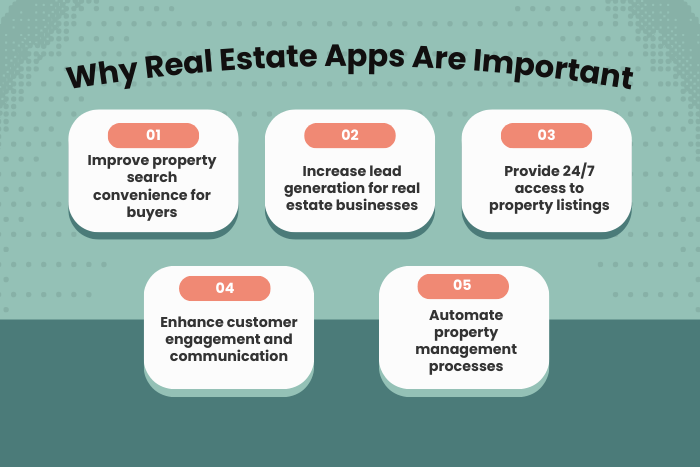
The real estate market is highly competitive, and digital platforms are transforming the way people search for and purchase properties. Real estate apps provide businesses with a powerful way to reach potential buyers and streamline property transactions.
Key reasons real estate app development is important include:
Increasing Online Property Searches
Most property buyers now search for homes and investments online through mobile apps.Improved Customer Convenience
Users can explore properties anytime without visiting multiple locations.Enhanced Lead Generation
Real estate apps help agents and companies generate qualified leads efficiently.Better Property Visualization
Features like images, videos, and virtual tours improve user engagement.Automated Real Estate Operations
Property management, communication, and scheduling can be automated through apps.Expanded Market Reach
Businesses can connect with buyers and investors from different regions.
By investing in real estate app development, businesses can improve customer engagement and streamline property management processes.
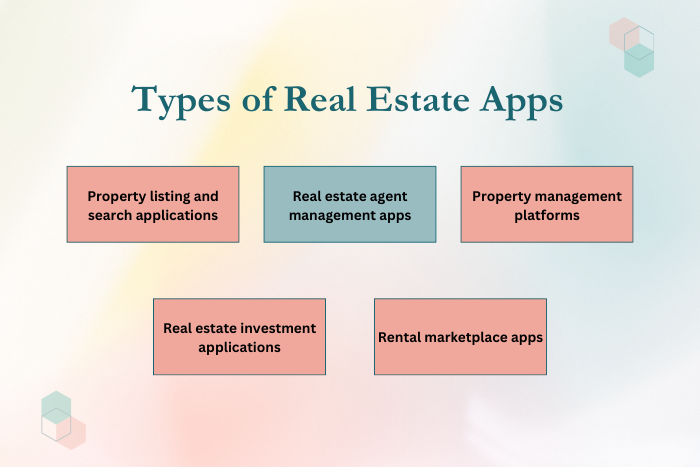
Types of Solutions to Develop an App for the Real Estate Industry
Real estate apps can serve various purposes depending on the needs of businesses and users.
Property Listing and Search Applications
Apps that allow users to browse property listings, filter by price or location, and explore available properties.Real Estate Agent Applications
Platforms designed for agents to manage listings, communicate with clients, and track leads.Property Management Applications
Apps used by landlords and property managers to manage tenants, payments, and maintenance tasks.Real Estate Investment Platforms
Applications that help investors analyze property markets and invest in real estate opportunities.Mortgage Calculator Applications
Tools that help users estimate loan payments and financing options.Commercial Real Estate Platforms
Apps designed for commercial property listings and business property management.Rental Marketplace Applications
Platforms that connect landlords and tenants for rental property listings.Home Design and Renovation Apps
Apps that help homeowners visualize renovations and interior designs.
These solutions provide businesses with flexible tools for managing different aspects of the real estate industry.
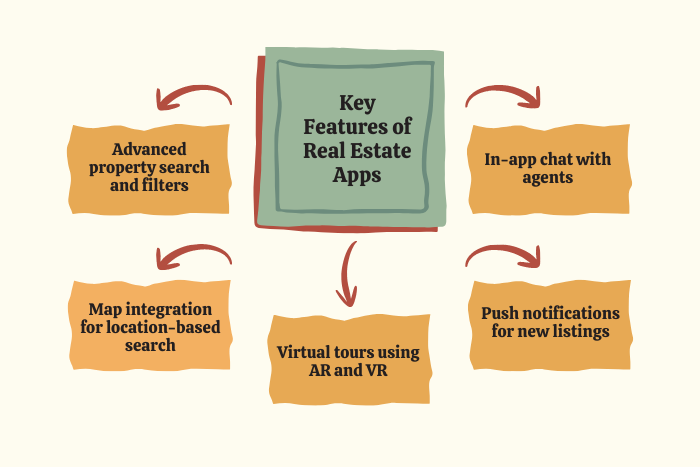
Key Features of Real Estate Applications
A successful real estate app must include features that make property discovery simple and engaging.
Important features include:
Easy user registration and profile management
Advanced property search with filters
Map-based property browsing and geolocation services
Detailed property listings with photos and videos
Push notifications for new property listings
Mortgage calculators and price estimators
Virtual property tours using AR and VR
Secure messaging and communication with agents
Appointment scheduling for property visits
Saved favorites and property comparisons
Real-time market insights and analytics
Secure payment and booking options
Admin dashboard for managing listings
These features enhance the overall user experience while helping businesses manage property listings efficiently.
Real Estate App Development Process
Developing a real estate application requires a well-structured process to ensure scalability and functionality.
Market Research and Business Planning
Identify target users, competitors, and key property features.Define Features and Business Model
Decide the app’s functionalities, monetization strategy, and user roles.UI/UX Design
Create intuitive property browsing interfaces and navigation systems.Technology Stack Selection
Choose frameworks, programming languages, and cloud infrastructure.Backend Development
Build secure servers, APIs, and databases for property data.Frontend and Mobile Development
Develop user-friendly interfaces for Android, iOS, or web platforms.Integration with Third-Party Services
Integrate maps, payment gateways, and messaging systems.Testing and Quality Assurance
Perform usability, performance, and security testing.App Deployment
Launch the app on app stores or web platforms.Maintenance and Feature Updates
Continuously improve the app with new features and updates.
Following this process ensures that the application meets user expectations and industry standards.
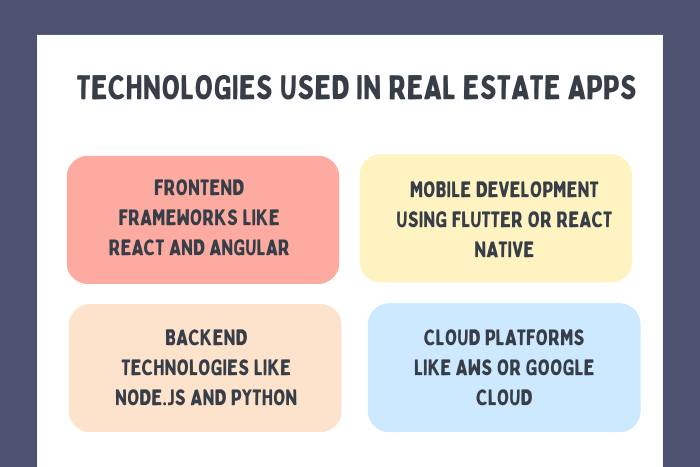
Technology Stack Used to Develop an App for the Real Estate Industry
The technology stack used for real estate applications must support large data volumes and advanced search capabilities.
Frontend Technologies: React.js, Angular, Vue.js, HTML5, CSS3
Mobile Development: Flutter, React Native, Swift, Kotlin
Backend Technologies: Node.js, Python, Java, .NET
Databases: PostgreSQL, MySQL, MongoDB, Firebase
Cloud Platforms: AWS, Microsoft Azure, Google Cloud Platform
Mapping APIs: Google Maps API, Mapbox
Payment Integrations: Stripe, PayPal, Razorpay
DevOps Tools: Docker, Kubernetes, CI/CD pipelines
These technologies help create scalable and high-performance real estate platforms.
Cost Factors to Develop an App for the Real Estate Industry
The cost of developing a real estate application depends on several technical and business factors.
Key cost factors include:
Application complexity and number of features
Platform selection (Android, iOS, or web)
UI/UX design and interactive elements
Integration with third-party APIs
Real-time messaging and notification systems
Use of advanced technologies like AR/VR
Development team size and location
Maintenance and infrastructure costs
A simple property listing app may cost less, while complex real estate platforms with advanced features require higher investment.
Latest Trends in Real Estate App Development
Technology continues to reshape the real estate industry through new digital innovations.
Key trends include:
Artificial Intelligence for property recommendations
AR and VR for virtual property tours
Big data analytics for real estate insights
Blockchain for secure property transactions
IoT integration for smart home solutions
AI chatbots for customer support
Cloud-based property management systems
Mobile-first real estate platforms
These innovations are making property transactions faster, more transparent, and more efficient.
Why Choose Us for Real Estate App Development?
Choosing the right development partner is essential for building a scalable and feature-rich real estate application. Our team combines industry expertise with modern technology to create powerful real estate solutions.
Here’s why businesses trust us:
Expertise in PropTech Solutions
We build advanced real estate platforms for agencies, investors, and property managers.User-Centric App Design
Our apps focus on intuitive property browsing and smooth navigation.Scalable Architecture
Applications are designed to handle large property databases and high user traffic.Advanced Feature Integration
We integrate AI, AR/VR, and real-time communication tools.Secure and Reliable Platforms
Strong security protocols protect user data and transactions.Cross-Platform Development
Real estate apps work seamlessly on Android, iOS, and web platforms.Agile Development Process
Transparent workflow and milestone-based project delivery.Long-Term Support and Maintenance
Continuous improvements and updates after launch.
Ready to build a powerful real estate application?
Let our experts develop a scalable property platform tailored to your business.
Contact us today for a free consultation and project estimate.
Key Points :
- Real estate app development helps businesses manage property listings, connect with buyers, and automate property transactions.
- Common real estate apps include property listing platforms, rental marketplaces, property management apps, and investment tools.
- Key features include advanced property search filters, map integration, virtual tours, push notifications, and in-app messaging.
- Technologies used include React, Flutter, Node.js, cloud platforms, and Google Maps APIs.
- Development costs depend on app complexity, features, platform choice, and third-party integrations.
- Modern trends include AI property recommendations, AR/VR virtual tours, blockchain transactions, and smart property analytics.
FAQ's
A real estate app is a digital platform that allows users to browse property listings, contact agents, and manage property transactions.
Development time depends on complexity but typically ranges from a few months for basic apps to longer for advanced platforms.
Common features include property search filters, map views, messaging systems, virtual tours, and mortgage calculators.
Yes, many real estate apps integrate secure payment gateways for bookings and transactions.
Technologies such as React, Flutter, Node.js, cloud platforms, and mapping APIs are commonly used.
Yes. Many modern real estate apps use AR and VR technologies for virtual property tours.
Real estate apps improve property discovery, generate leads, and streamline property management processes.