Learn how to develop an app for wearables including smartwatches and fitness bands. Explore features, tech stack, costs, and development process.
How Do I Develop an App for Wearables?
If you’re asking, “How do I develop an app for wearables?”, you’re exploring one of the fastest-growing segments of mobile technology. Wearable devices such as smartwatches, fitness trackers, smart glasses, and health-monitoring bands are transforming how users interact with digital products. Unlike traditional mobile apps, wearable apps require optimized design, real-time data synchronization, battery efficiency, and seamless cross-device integration.
Wearable app development focuses on creating lightweight, glanceable, and context-aware applications that deliver quick interactions and real-time insights. Whether you’re building a health monitoring app, fitness tracking solution, IoT-connected device interface, or enterprise wearable application, the approach differs significantly from standard mobile development.
This comprehensive guide explains how to develop an app for wearables — covering use cases, features, development steps, technology stack, cost factors, and emerging trends — so you can build scalable and high-performance wearable applications.
Why Wearable App Development Is Important
Wearable technology is reshaping user engagement and real-time interaction.
Here’s why investing in wearable app development matters:
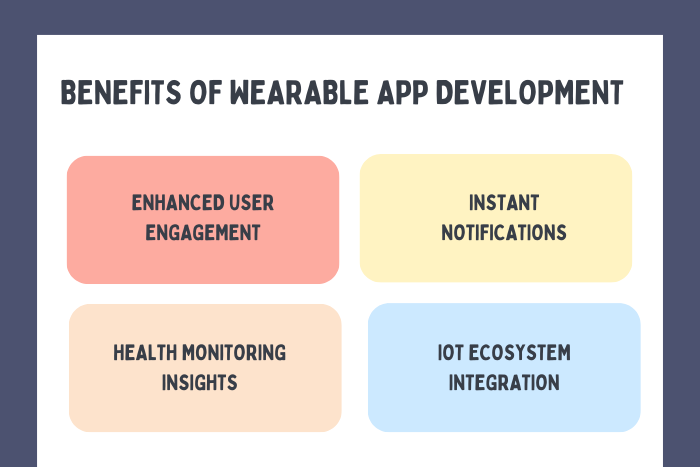
Enhances real-time user engagement
Enables health and fitness monitoring
Improves convenience and accessibility
Supports IoT ecosystem integration
Provides instant notifications and alerts
Delivers personalized, context-aware experiences
Opens new revenue opportunities
Strengthens brand innovation
Businesses across healthcare, fintech, retail, logistics, and fitness are leveraging wearable apps to improve customer experience and operational efficiency.
Types of Solutions to Develop an App for Wearables
Different wearable devices require different development approaches.
Smartwatch Apps
Applications built for Wear OS and watchOS devices.Fitness Tracker Apps
Health, activity, and biometric tracking apps.Healthcare Wearable Apps
Remote patient monitoring and medical tracking solutions.Enterprise Wearable Apps
Workforce tracking, logistics monitoring, and industrial IoT integration.AR/VR Head-Mounted Applications
Immersive wearable experiences for training, gaming, and retail.Connected IoT Wearable Apps
Apps integrated with smart devices and sensors.
Selecting the right wearable category depends on your target audience and business goals.
Key Features of Wearable Applications
Wearable apps must prioritize performance, usability, and efficiency.
Core features include:
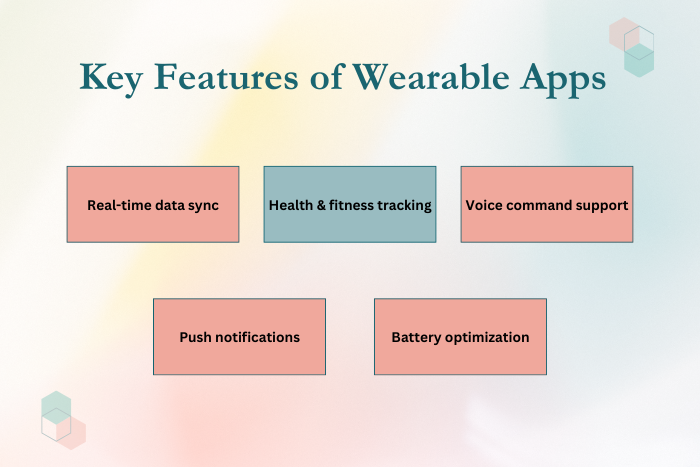
Real-time data synchronization
Health and biometric tracking
Glanceable UI design
Voice command integration
Gesture-based navigation
Push notifications and alerts
Offline functionality
Battery optimization
Secure data encryption
Cross-device synchronization with smartphones
Minimalist design and fast performance are essential due to limited screen space.
Development Process
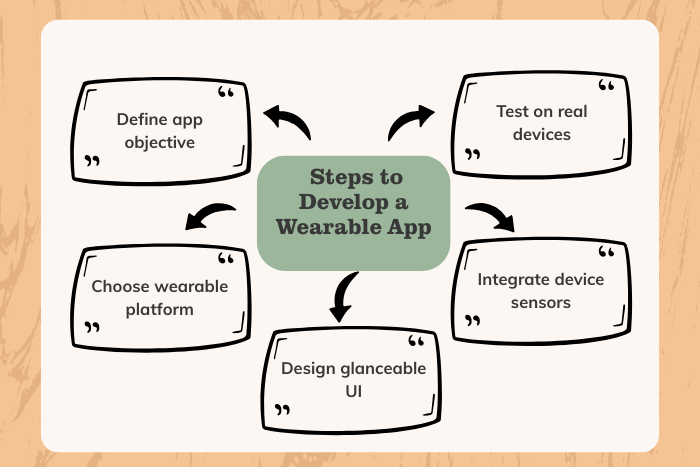
Define App Objectives
Identify target users, device type, and key functionalities.Market & Competitor Research
Analyze wearable market trends and user expectations.Choose Platform (Wear OS, watchOS, etc.)
Select the appropriate operating system based on target audience.Design Wearable-Specific UI/UX
Focus on minimal interactions, clear visuals, and quick usability.Select Technology Stack
Choose backend systems, APIs, and integration tools.Develop Core Features & Device Integration
Build real-time tracking, IoT connectivity, and data sync capabilities.Testing on Emulator & Physical Devices
Test performance, battery efficiency, and device compatibility.Launch & Continuous Optimization
Monitor performance and update based on user feedback.
Wearable development requires specialized architecture planning and testing strategies.
Technology Stack to Develop an App for Wearables
Modern wearable apps rely on advanced tools and frameworks.
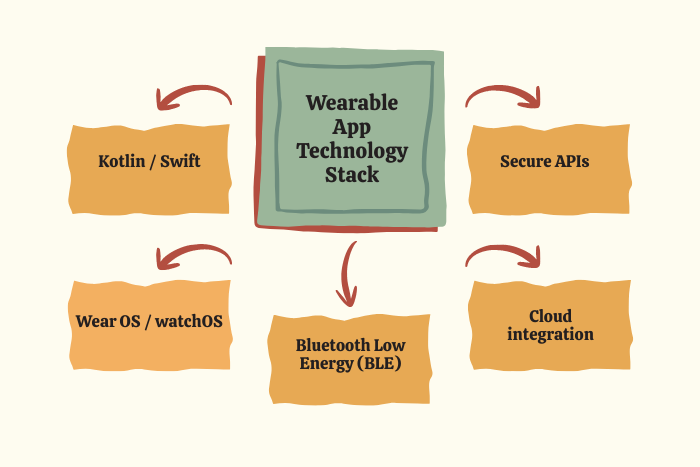
Wear OS Development: Kotlin, Java, Android Studio
watchOS Development: Swift, Xcode
Cross-Platform: Flutter, React Native
Backend Technologies: Node.js, Django, .NET Core
IoT Integration: MQTT, Bluetooth Low Energy (BLE)
Cloud Services: AWS IoT, Azure IoT Hub
Database Systems: Firebase, MongoDB
Security Protocols: TLS encryption, OAuth 2.0
The chosen tech stack should ensure seamless device communication and scalability.
Cost Factors to Develop an App for Wearables
Development costs depend on:
App complexity and feature set
Device compatibility requirements
Health or biometric data integration
Cross-device synchronization
UI/UX customization
Backend infrastructure
Security and compliance requirements
Testing on multiple wearable devices
Basic wearable apps cost less, while healthcare or IoT-integrated solutions require higher investment.
Latest Trends in Wearable App Development
Wearable technology continues evolving rapidly.
Key trends include:
AI-powered health analytics
Real-time biometric monitoring
Integration with smart home ecosystems
Edge computing for wearable devices
Advanced fitness tracking algorithms
AR-enabled wearable experiences
5G-enabled wearable connectivity
Enhanced battery optimization techniques
These innovations are redefining wearable user experiences in 2025.
Why Choose Us for Wearable App Development?
Building wearable apps requires expertise in hardware integration, UX optimization, and real-time data systems.
Here’s why businesses choose us:
Platform-Specific Expertise – Wear OS and watchOS specialization.
IoT & Device Integration Experience – Seamless sensor and Bluetooth connectivity.
Security-First Development – Data encryption and compliance standards.
Battery & Performance Optimization – Efficient, lightweight applications.
Cross-Platform Capabilities – Unified development approach.
Long-Term Support & Scaling – Continuous improvement and monitoring.
We don’t just build wearable apps, we create intelligent, connected ecosystems.
Ready to build a wearable app that stands out?
Let’s develop a high-performance wearable solution tailored to your needs.
Contact us today for a free consultation.
Key Points :
- Complete guide explaining how to develop an app for wearables including smartwatches and fitness devices.
- Covers platforms like Wear OS and watchOS with device-specific development strategies.
- Highlights essential features such as real-time data sync, health tracking, and battery optimization.
- Explains the wearable app development process from planning to launch.
- Details the recommended technology stack including Kotlin, Swift, BLE, and cloud integration.
- Breaks down cost factors based on complexity, device compatibility, and IoT integration.
- Conversion-focused insights helping businesses build scalable, secure, and future-ready wearable applications.
FAQ's
Wear OS (Android-based) and watchOS (Apple Watch) are the most common platforms.
Wearable apps require minimal UI, battery efficiency, and real-time data synchronization.
Simple apps may take 6–8 weeks, while complex IoT-based solutions take longer.
Yes. Most wearable apps sync with companion mobile apps.
Yes, when implemented with encryption, secure APIs, and authentication protocols.
Healthcare, fitness, logistics, retail, and enterprise sectors benefit significantly.
Yes, especially for real-time tracking and cloud synchronization.