

Learn how to develop an on-demand app with features, tech stack, cost factors, and process. Build scalable, real-time on-demand solutions today.
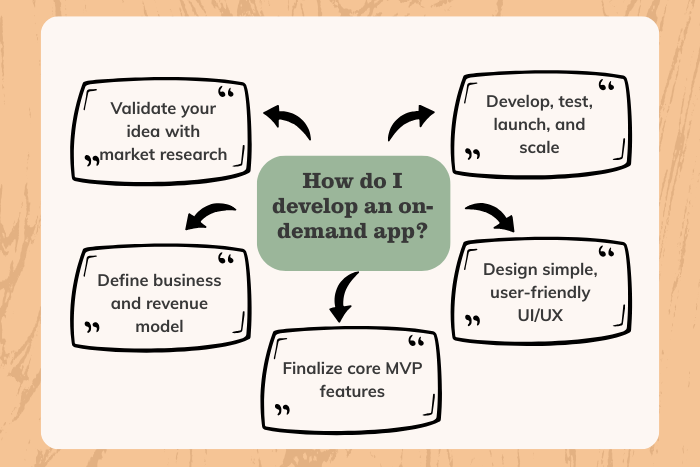
How Do I Develop an On-Demand App?
If you’re asking, “How do I develop an on-demand app?” you’re likely exploring a fast-growing digital business model that connects users with services in real time. On-demand apps have transformed industries such as ride-sharing, food delivery, healthcare, logistics, beauty services, and home maintenance by offering instant access to products or professionals through mobile platforms.
Developing an on-demand app requires more than just coding a mobile interface. It involves strategic planning, selecting the right business model, building scalable backend architecture, integrating real-time tracking, enabling secure payments, and ensuring a seamless user experience. Whether you are a startup launching a new marketplace platform or an established enterprise digitizing your services, the right development approach can determine long-term success.
This comprehensive guide explains how to develop an on-demand app step by step — covering features, technologies, development processes, costs, and industry trends — so you can confidently turn your idea into a scalable and profitable digital solution.
Why Developing an On-Demand App Is Important
The demand for instant services continues to rise as consumers expect speed, convenience, and personalization. Businesses that offer on-demand mobile applications gain significant competitive advantages:
Real-time service delivery increases customer satisfaction
Digital automation reduces operational overhead
Data-driven insights improve service optimization
Scalable architecture supports rapid growth
Wider customer reach expands market opportunities
On-demand platforms also create dual-sided ecosystems — serving both customers and service providers — making them powerful revenue-generating models. Whether you’re building a ride-hailing app, a grocery delivery platform, or a healthcare booking solution, investing in professional on-demand app development ensures reliability, security, and long-term scalability.
Types of On-Demand App Development Solutions
When planning how to develop an on-demand app, choosing the right model is critical. Below are the most common types of on-demand solutions:
Marketplace-Based On-Demand Apps
Multi-vendor platforms connecting service providers with customers (e.g., ride-sharing, home services, tutoring).Aggregator Apps
Platforms that aggregate multiple service providers under one brand for simplified booking and payments.Single-Service Provider Apps
Apps designed for businesses offering their own services directly to customers (e.g., salon chains, delivery companies).Subscription-Based On-Demand Apps
Recurring revenue models offering scheduled or unlimited services for members.Hyperlocal On-Demand Apps
Apps targeting specific geographic regions with localized services and delivery.Enterprise On-Demand Solutions
Custom platforms built for internal operations such as logistics, fleet management, or workforce allocation.
Each model requires different backend architecture, payment systems, and user flows. Identifying your target audience and revenue model is the first step toward successful app development.
Key Features of an On-Demand App
To build a competitive and scalable on-demand app, essential features must be integrated across user panels:
User App Features
Simple registration and profile management
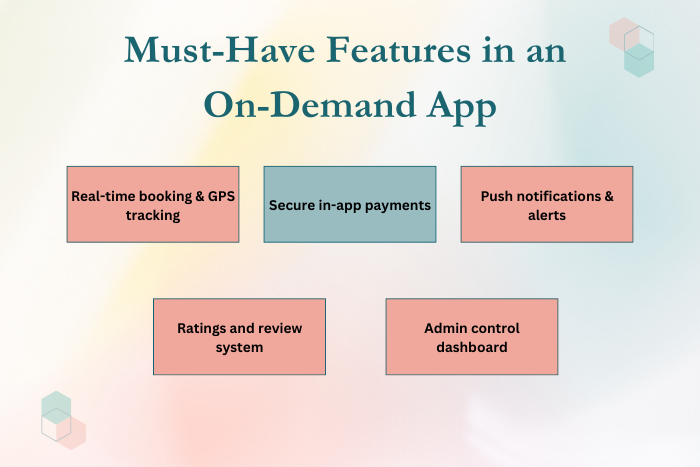
Real-time booking and scheduling
Live tracking with GPS integration
Secure in-app payments
Push notifications
Ratings and reviews
Order history and support chat
Service Provider App Features
Profile and availability management
Accept/reject requests
Earnings dashboard
Real-time navigation
Performance tracking
Admin Panel Features
User and provider management
Commission and revenue control
Analytics dashboard
Dispute resolution system
Marketing and promotional tools
A successful on-demand app must balance usability, speed, and reliability while ensuring secure data handling and seamless communication between users and providers.
Development Process
If you’re wondering how to develop an on-demand app efficiently, following a structured process ensures predictable outcomes:
Market Research & Business Analysis
Validate your idea, identify competitors, define your target audience, and finalize your monetization model.Requirement Planning & Feature Finalization
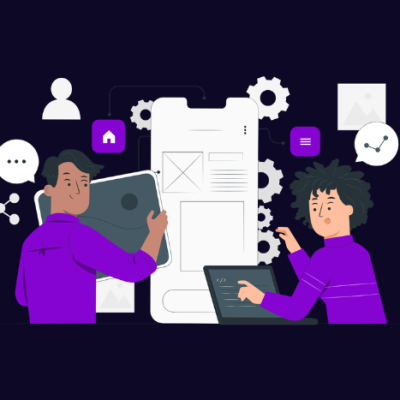
Define MVP features, create user flow diagrams, and prioritize core functionalities.UI/UX Design
Design intuitive interfaces for customers, service providers, and admin panels to ensure seamless interactions.Backend Architecture Design
Build scalable infrastructure that supports real-time requests, data processing, and secure transactions.Mobile App Development (iOS & Android)
Develop native or cross-platform applications optimized for performance.API & Third-Party Integrations
Integrate payment gateways, maps, chat systems, and notification services.Testing & Quality Assurance
Conduct functional, security, performance, and load testing to ensure stability.Deployment & Launch
Publish apps to app stores and configure cloud infrastructure.Post-Launch Maintenance & Scaling
Monitor performance, fix bugs, release updates, and scale infrastructure as the user base grows.
An agile development methodology ensures faster iterations and continuous improvements.
Technology Stack for On-Demand App Development
Choosing the right technology stack directly impacts scalability and performance.
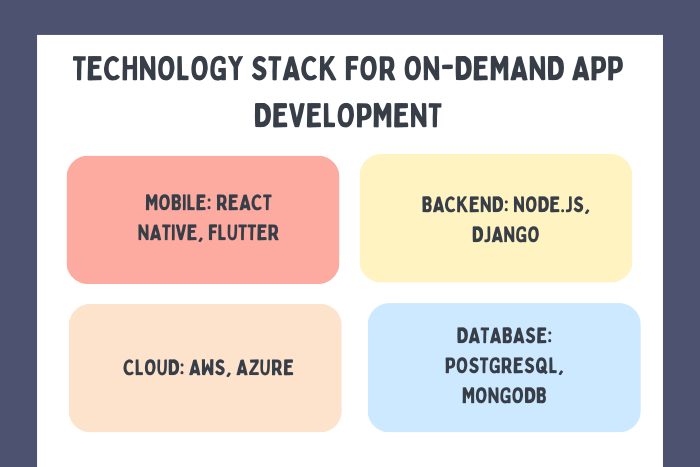
Front-End (Mobile Apps): React Native, Flutter, Swift (iOS), Kotlin (Android)
Back-End: Node.js, Django, Ruby on Rails, .NET Core
Databases: PostgreSQL, MongoDB, MySQL
Real-Time Communication: WebSockets, Firebase
Cloud & Hosting: AWS, Microsoft Azure, Google Cloud Platform
Payments Integration: Stripe, PayPal, Razorpay
Maps & Tracking: Google Maps API
DevOps: Docker, Kubernetes, CI/CD pipelines
Selecting scalable and cloud-native technologies ensures your app can handle growing traffic without downtime.
Cost Factors in On-Demand Application Development
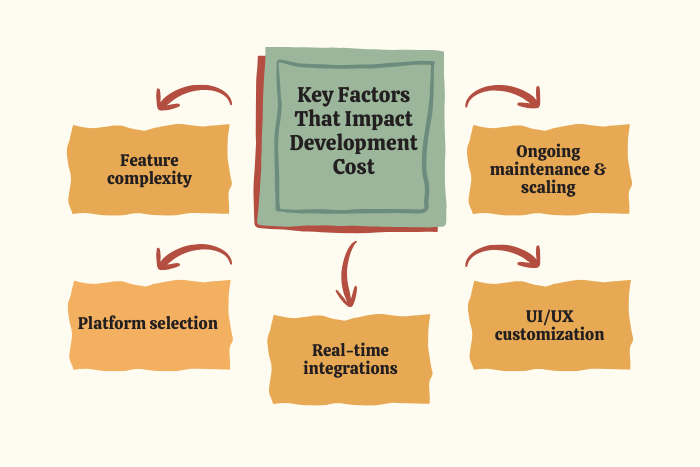
The cost of developing an on-demand app depends on multiple factors:
App complexity and feature set
Platform choice (iOS, Android, or both)
Real-time tracking and geolocation features
Payment gateway integrations
UI/UX design customization
Backend infrastructure and scalability requirements
Third-party API integrations
Ongoing maintenance and updates
A basic MVP may cost significantly less than a fully featured enterprise-level marketplace app. For accurate estimation, businesses should define project scope, timeline, and scalability requirements.
Latest Trends in On-Demand App Development
The on-demand economy continues evolving with technological advancements. Key trends include:
AI-powered recommendations and dynamic pricing
Blockchain-based secure transactions
Voice-enabled bookings
IoT-enabled service tracking
Predictive analytics for demand forecasting
Super app ecosystems integrating multiple services
Sustainable and eco-friendly delivery models
Integrating emerging technologies enhances competitive advantage and improves operational efficiency.
Why Choose Us to Develop Your On-Demand App?
Developing an on-demand platform requires expertise in scalable architecture, real-time systems, security, and user-centric design. We provide end-to-end on-demand app development services tailored to your business objectives.
Here’s why clients partner with us:
Scalable Architecture from Day One – Built to handle thousands of concurrent users.
Real-Time System Expertise – Seamless GPS tracking, live updates, and instant notifications.
Security-First Development – Encrypted transactions, secure authentication, and data protection.
Custom UI/UX Design – Intuitive interfaces that maximize engagement.
Agile & Transparent Workflow – Milestone-based development with consistent reporting.
Cloud-Native Deployment – Reliable hosting with auto-scaling capabilities.
Ongoing Support & Optimization – Continuous performance improvements post-launch.
We don’t just build apps , we build scalable digital ecosystems designed for growth and profitability.
Ready to develop your on-demand app?
Let’s transform your idea into a high-performance digital platform.
Contact us today for a free consultation and project estimate.
Key Points :
- On-demand app development starts with market research and clear business model planning.
- A scalable backend and real-time architecture are essential for smooth performance.
- Core features include live tracking, secure payments, push notifications, and ratings.
- Development involves UI/UX design, API integration, testing, and cloud deployment.
- Popular tech stack includes Node.js, React Native, Flutter, and AWS.
- AI-powered recommendations and predictive analytics are growing trends.
- Post-launch maintenance and scalability planning ensure long-term success.
FAQ's
Develop an on demand app , start with market research, define your business model, finalize features, design UI/UX, build backend architecture, develop mobile apps, test thoroughly, and launch with a scaling strategy.
An MVP can take 3–4 months, while a fully featured marketplace app may take 6–9 months depending on complexity.
Popular choices include React Native or Flutter for frontend and Node.js or Django for backend with cloud hosting on AWS or Azure.
Costs vary based on features, platforms, integrations, and scalability needs. A simple app costs less than a complex multi-vendor marketplace.
Yes. Multi-service or “super apps” can integrate food delivery, ride-sharing, and other services within a single platform.
Revenue models include commission per transaction, subscription plans, service fees, surge pricing, and advertisements.
Yes. Building a Minimum Viable Product helps validate your concept, reduce risk, and optimize features based on user feedback.
Yes. We offer maintenance, performance optimization, scaling solutions, and security updates to ensure long-term success.