



Learn how to ensure app scalability with architecture, cloud, microservices, load balancing, and performance optimization strategies.
How Do I Ensure App Scalability?
If you’re asking, “How do I ensure app scalability?”, you’re thinking ahead — and that’s critical for long-term digital success. Scalability determines whether your application can handle increasing users, traffic spikes, data growth, and expanding feature sets without performance degradation or downtime.
Many apps fail not because of poor ideas, but because their architecture cannot handle rapid growth. Whether you’re building a startup MVP, SaaS platform, enterprise system, eCommerce app, or high-traffic marketplace, scalability must be embedded into the application architecture from day one.
App scalability involves designing flexible infrastructure, optimizing databases, implementing caching mechanisms, leveraging cloud-native environments, and adopting microservices or modular architectures. It also requires continuous monitoring, performance testing, and cost optimization strategies.
In this guide, we’ll break down how to ensure app scalability through proper planning, architecture design, technology stack selection, infrastructure management, and future-ready development practices.
Why App Scalability Is Important
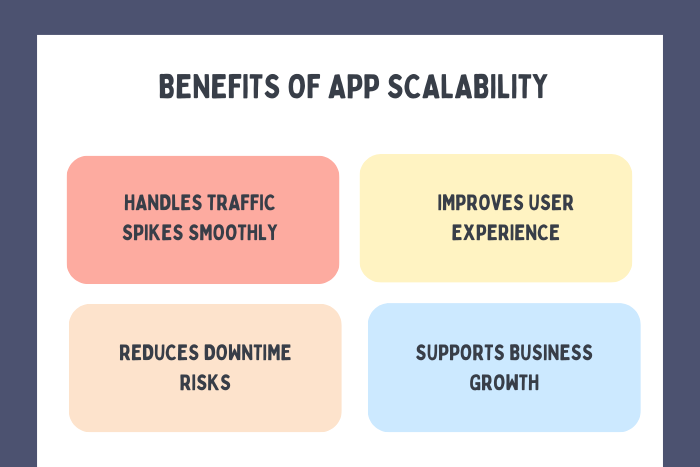
Scalable applications are critical for business growth and operational stability. Without scalability planning, apps may crash during traffic spikes, experience slow response times, or incur excessive infrastructure costs.
Ensuring app scalability helps:
Maintain consistent performance under heavy load
Prevent downtime during user growth
Improve user experience and retention
Support global expansion
Optimize infrastructure costs
Enable faster feature rollouts
Increase business valuation
Scalability is not just about handling more users — it’s about sustaining reliability, speed, and efficiency as your application evolves.
Types of Scalability Solutions
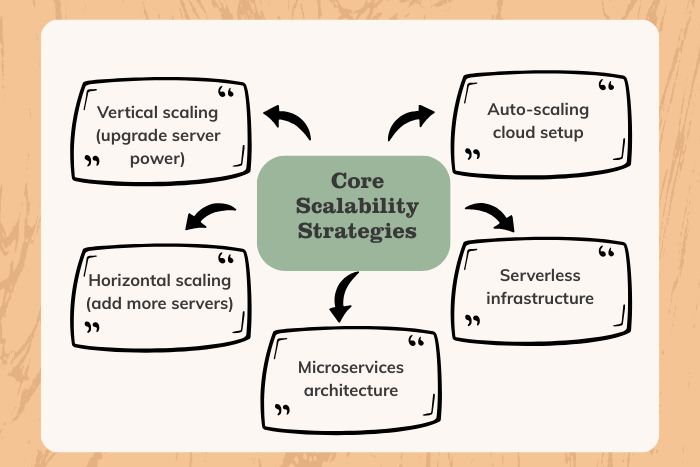
When evaluating how to ensure app scalability, you should understand the primary scaling models:
Vertical Scaling (Scaling Up) – Increasing server capacity (CPU, RAM, storage) to handle higher load.
Horizontal Scaling (Scaling Out) – Adding more servers to distribute traffic efficiently.
Microservices Architecture – Breaking applications into independent services for flexible scaling.
Serverless Architecture – Leveraging cloud-managed infrastructure that auto-scales based on usage.
Database Scaling – Sharding, replication, and read-write separation for large data handling.
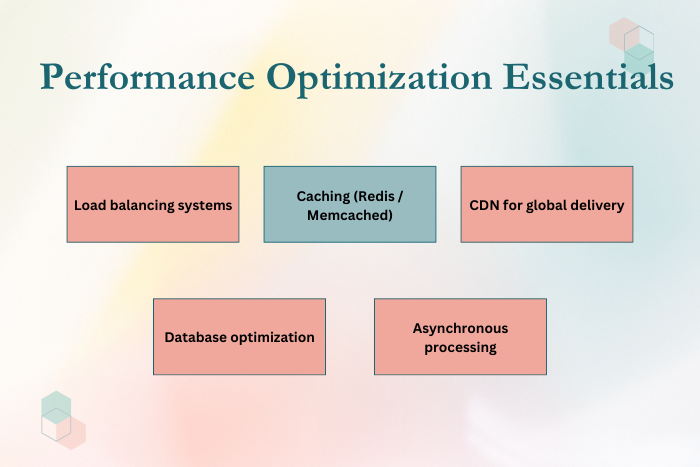
Content Delivery Networks (CDNs) – Distributing static content globally to reduce latency.
Auto-Scaling Infrastructure – Dynamic resource allocation based on traffic demand.
Choosing the right scaling model depends on your application type, expected growth, and budget.
Key Features of a Scalable Application
A scalable application architecture includes:
Modular or microservices-based structure
Load balancing mechanisms
Efficient database indexing and optimization
Caching systems (Redis, Memcached)
Asynchronous processing and queue management
Stateless application design
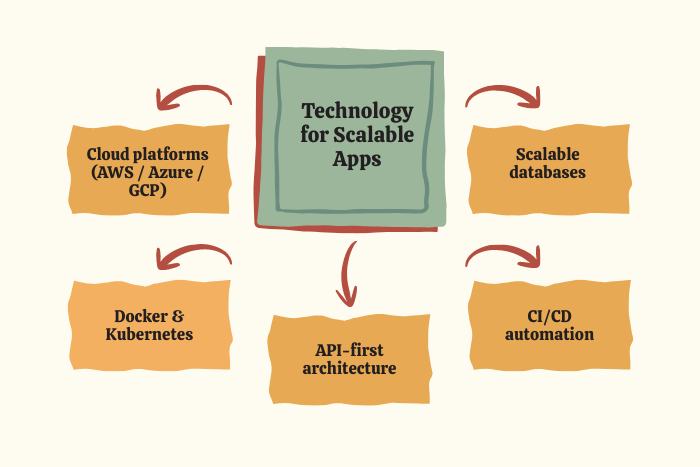
API-first architecture
Cloud-native deployment
Monitoring & observability tools
Automated CI/CD pipelines
These features ensure your app can grow without reengineering the entire system.
App Scalability Development Process
Ensuring scalability requires a structured approach:
Scalability Assessment & Planning
Define expected traffic growth, user base expansion, and performance goals.Choose Scalable Architecture
Select between monolithic optimization, microservices, or serverless models.Design Efficient Database Strategy
Implement indexing, replication, or sharding.Implement Load Balancing & Caching
Distribute traffic and reduce database pressure.Cloud Infrastructure Setup
Use auto-scaling groups and container orchestration.Performance & Load Testing
Simulate high-traffic scenarios.Continuous Monitoring & Optimization
Use observability tools to detect bottlenecks.Automate Scaling Policies
Configure dynamic resource allocation.
Scalability is an ongoing process, not a one-time setup.
Technology Stack for Scalable App Development
Choosing scalable technologies is critical.
- Frontend:
React.js, Angular, Vue.js, Flutter, React Native - Backend:
Node.js, Java Spring Boot, .NET Core, Python - Database:
PostgreSQL, MySQL, MongoDB, Cassandra - Cloud Platforms:
AWS, Microsoft Azure, Google Cloud - Containerization & Orchestration:
Docker, Kubernetes - Caching & Messaging:
Redis, RabbitMQ, Apache Kafka - Monitoring Tools:
Prometheus, Grafana, New Relic
Cloud-native and container-based environments enable rapid scaling with minimal downtime.
Cost Factors in App Scalability
Ensuring scalability affects cost in several ways:
Cloud hosting and infrastructure
Load balancers and CDN services
Database optimization & storage scaling
DevOps implementation
Monitoring and observability tools
Scalability testing
Engineering expertise
Microservices architecture complexity
While scalable systems may increase initial investment, they reduce long-term risks and downtime-related losses.
Latest Trends in App Scalability
Modern scalability strategies include:
Cloud-Native Architecture
Kubernetes-Based Auto Scaling
Serverless Computing
Edge Computing Integration
AI-Based Traffic Prediction
Event-Driven Architecture
Zero-Downtime Deployment
Observability & Real-Time Monitoring
Adopting modern DevOps and cloud practices ensures flexible and future-proof scalability.
Why Choose Us for Scalable App Development?
Ensuring scalability requires technical expertise, architectural precision, and proactive monitoring. Our team specializes in building high-performance, scalable applications tailored to business growth strategies.
Here’s why clients trust us:
Architecture-first scalability planning
Cloud-native development expertise
Microservices & containerization specialists
Advanced performance testing
Cost-efficient infrastructure optimization
Continuous monitoring & support
We don’t just build apps — we design scalable digital ecosystems that grow with your business.
Ready to future-proof your application?
Let’s build a scalable, high-performance system designed for growth.
Contact us today for a free scalability consultation.
Key Points :
- Learn how to ensure app scalability with cloud-native and microservices architecture.
- Understand vertical vs horizontal scaling strategies for handling traffic growth.
- Discover the role of load balancing, caching, and CDN in performance optimization.
- Explore scalable technology stacks including Kubernetes, Docker, and auto-scaling cloud services.
- Identify key cost factors involved in building and maintaining scalable applications.
- Implement performance testing and monitoring tools to prevent bottlenecks and downtime.
FAQ's
Plan scalable architecture, use cloud infrastructure, implement load balancing, and conduct performance testing early.
Vertical scaling increases server capacity, while horizontal scaling adds more servers to distribute load.
Not always, but it significantly improves flexibility and independent scaling of services.
Cloud platforms offer auto-scaling and elastic infrastructure based on demand.
Costs vary depending on architecture complexity, infrastructure, and performance requirements.
Data bottlenecks, unoptimized architecture, security risks, and infrastructure limitations.
Regularly — especially before major launches or feature updates.