

Learn how to handle app updates and maintenance for mobile and web apps. Discover best practices, costs, tools, and strategies for long-term app success.

How Do I Handle App Updates and Maintenance?
Launching an application is only the beginning of its lifecycle. To ensure long-term success, businesses must continuously manage performance, security, user experience, and compatibility. If you’re wondering “How do I handle app updates and maintenance?”, the answer lies in implementing a structured maintenance strategy that keeps your application stable, secure, and relevant in an evolving digital environment.
Application maintenance involves regular updates, bug fixes, security patches, performance optimization, feature improvements, and compatibility updates with new operating systems and devices. Without proper maintenance, even the most innovative applications can quickly become outdated, vulnerable to security threats, or incompatible with modern technologies.
For businesses operating in competitive digital markets, consistent app updates are essential for maintaining user engagement and satisfaction. App stores like Google Play and Apple App Store also require compliance with evolving policies and platform requirements, making maintenance a critical part of product management.
A well-managed update and maintenance strategy helps businesses protect their application investments while continuously improving the product. Whether you operate a startup MVP, enterprise platform, SaaS product, or mobile application, ongoing maintenance ensures that your app remains secure, reliable, and aligned with user expectations.
Why App Updates and Maintenance Are Important
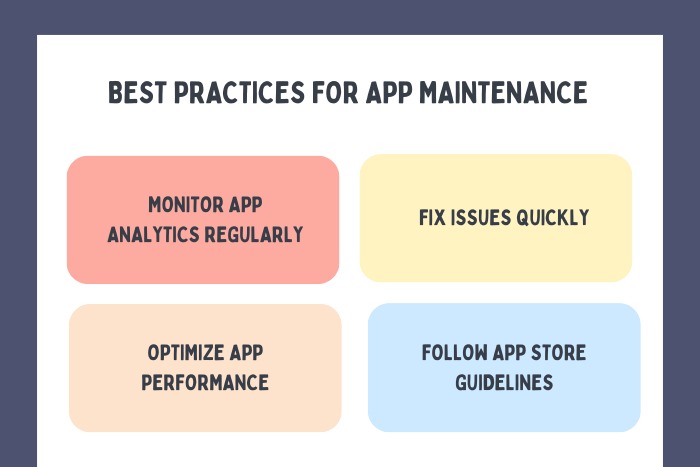
Regular app maintenance is essential to ensure optimal performance, security, and user satisfaction. Applications operate in dynamic environments where operating systems, devices, security standards, and user expectations constantly evolve.
Here are the main reasons why app updates and maintenance are important:
Improved Performance
Continuous updates help optimize speed, responsiveness, and overall application stability.Bug Fixes and Issue Resolution
Maintenance ensures that errors, crashes, and technical issues are identified and fixed quickly.Security Protection
Regular security updates protect user data and prevent vulnerabilities or cyber threats.Compatibility with New Devices and OS Updates
Apps must remain compatible with updated operating systems, browsers, and hardware.Better User Experience
Updating features and improving design keeps users engaged and satisfied.Compliance with App Store Guidelines
App stores frequently update their policies and requirements, making regular updates necessary.
Without ongoing maintenance, applications risk losing users, damaging brand reputation, and becoming vulnerable to security issues.
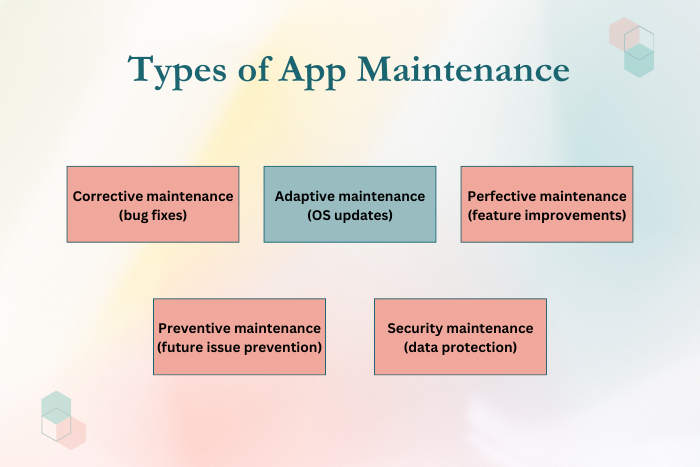
Types of App Updates and Maintenance Solutions
Different types of maintenance are required throughout an application’s lifecycle to keep it running smoothly.
Corrective Maintenance
Fixing bugs, crashes, and system errors that affect application performance.Adaptive Maintenance
Updating the application to remain compatible with new operating systems, devices, and technologies.Perfective Maintenance
Improving application features, design, and functionality based on user feedback and analytics.Preventive Maintenance
Identifying potential technical issues before they impact the application.Security Updates
Implementing patches and updates to protect against vulnerabilities and cyber threats.Performance Optimization
Enhancing application speed, server performance, and database efficiency.Feature Enhancements
Introducing new functionalities that improve user engagement and business value.
These maintenance solutions ensure that applications remain competitive and functional over time.
Key Features of Professional App Maintenance Services
Professional app maintenance services provide structured solutions that keep applications stable, secure, and scalable.
Key features include:
Continuous monitoring of application performance
Regular bug fixes and stability improvements
Security patch management and vulnerability protection
OS and device compatibility updates
Performance optimization and database tuning
Feature updates and UI/UX improvements
API integration updates and third-party service maintenance
Automated testing and quality assurance
These features ensure that applications remain reliable while supporting growing user demands.
App Updates and Maintenance Development Process
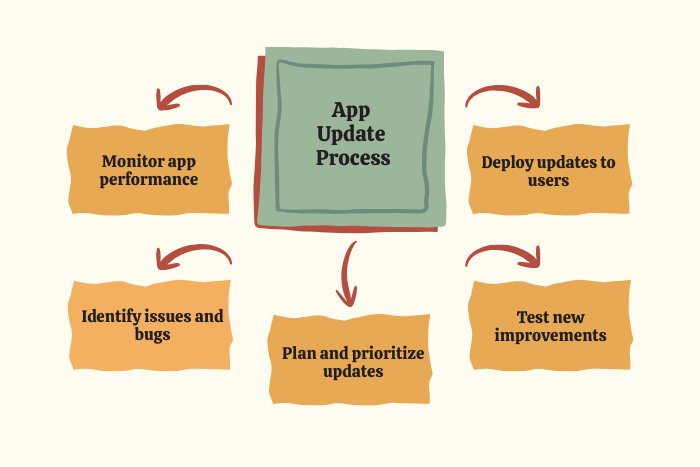
Handling app updates and maintenance requires a systematic development process that ensures stability and efficiency.
Application Performance Monitoring
Continuous monitoring helps identify performance issues, crashes, and user behavior patterns.Issue Identification and Analysis
Developers analyze bug reports, system logs, and user feedback to determine problems.Update Planning and Prioritization
Critical updates such as security patches are prioritized over minor improvements.Development and Implementation
Developers fix bugs, improve performance, and add new features.Testing and Quality Assurance
Updates undergo functional testing, regression testing, and security checks.App Store Compliance and Submission
Updates are prepared according to app store guidelines before deployment.Deployment and Monitoring
The updated version is released and monitored for stability and performance.
This structured workflow ensures smooth updates without disrupting user experience.
Technology Stack for App Maintenance
Efficient app maintenance requires modern tools and technologies to monitor performance, automate testing, and manage updates.
Mobile Technologies: Swift, Kotlin, Flutter, React Native
Backend Technologies: Node.js, Python, Java, .NET
Frontend Technologies: React.js, Angular, Vue.js
Databases: PostgreSQL, MySQL, MongoDB, Firebase
Cloud Platforms: AWS, Microsoft Azure, Google Cloud Platform
Monitoring Tools: New Relic, Datadog, Firebase Crashlytics
DevOps Tools: Docker, Kubernetes, Jenkins, GitHub Actions
Security Tools: OAuth, JWT authentication, SSL encryption
Using a modern technology stack ensures faster updates, improved reliability, and better performance monitoring.
Cost Factors in App Updates and Maintenance
The cost of maintaining and updating an application varies depending on several factors.
Application complexity and architecture
Frequency of updates and releases
Bug fixing and performance optimization requirements
Security monitoring and vulnerability patches
Third-party API updates and integrations
Cloud hosting and infrastructure costs
Development team size and support level
Typically, annual maintenance costs range between 15% and 25% of the original development cost, depending on the scope of updates and technical requirements.
Proper planning helps businesses allocate the right resources for long-term application maintenance.
Latest Trends in App Maintenance and Updates
The landscape of app maintenance continues to evolve as new technologies and development practices emerge.
Key trends include:
DevOps and CI/CD automation for faster updates
AI-powered monitoring and predictive maintenance
Cloud-native application management
Automated testing frameworks for faster bug detection
Microservices architecture enabling modular updates
Real-time performance monitoring tools
Security-first development practices
User feedback-driven feature improvements
These trends allow development teams to manage updates more efficiently while improving application reliability.
Why Choose Us for App Updates and Maintenance?
Choosing the right development partner ensures that your application remains secure, scalable, and competitive. Our app maintenance services focus on long-term stability, performance optimization, and continuous improvement.
Here’s why businesses trust us for app maintenance solutions:
Dedicated Maintenance Experts – Skilled developers and engineers managing your updates and improvements.
Proactive Monitoring and Support – Continuous monitoring to detect issues before they affect users.
Security-First Approach – Implementation of industry-standard security protocols and vulnerability management.
Performance Optimization – Regular improvements to ensure fast and responsive applications.
App Store Compliance Management – Ensuring your app meets evolving Google Play and Apple App Store requirements.
Scalable Infrastructure Support – Cloud-based systems designed for growth and high traffic.
Agile Update Strategy – Rapid deployment of updates with minimal downtime.
Long-Term Product Evolution – Continuous feature enhancements based on analytics and user feedback.
We help businesses maintain high-performing applications that grow with their users and technology trends.
Need help managing your app updates and maintenance?
Let our experts ensure your application stays secure, fast, and future-ready.
Contact us today for a free consultation and customized maintenance plan.
Key Points :
- Regular app updates improve performance and ensure smooth functionality across devices and operating systems.
- App maintenance includes bug fixes, security patches, and feature enhancements to keep the application reliable.
- Monitoring tools and analytics help identify issues early and improve overall app stability.
- Compatibility updates are required when new OS versions, devices, or frameworks are released.
- Security updates protect user data and prevent vulnerabilities or cyber threats.
- Continuous improvements based on user feedback help increase engagement and satisfaction.
- Ongoing maintenance ensures long-term scalability and app success.
FAQ's
By implementing regular monitoring, bug fixes, security updates, performance optimization, and feature improvements through a structured maintenance strategy.
Most applications are updated every few weeks or months depending on bug fixes, feature releases, and security requirements.
App maintenance ensures performance optimization, security protection, compatibility updates, and improved user experience.
Apps require corrective, adaptive, perfective, and preventive maintenance throughout their lifecycle.
Monitoring tools like Firebase Crashlytics, New Relic, and DevOps platforms help manage updates and performance.
Yes, regular updates introduce new features, fix issues, and improve performance, which keeps users engaged.
Yes, we provide complete app maintenance services including monitoring, updates, security patches, and performance optimization.