
Learn how to integrate ads in a mobile app using AdMob and other ad networks. Increase app revenue with banner, interstitial, native, and rewarded ads.

How Do I Integrate Ads in a Mobile App?
Mobile applications often rely on advertising as a primary revenue source. Developers and businesses frequently ask how do I integrate ads in a mobile app to monetize their products effectively. Mobile ad integration allows applications to display advertisements within the interface and generate income based on impressions, clicks, or user engagement.
Most modern apps use advertising platforms such as Google AdMob, Meta Audience Network, or other mobile ad networks. These platforms provide software development kits (SDKs) that allow developers to integrate ads into Android, iOS, or cross-platform applications. After integration, different ad formats can be displayed within the app, including banner ads, interstitial ads, native ads, and rewarded video ads.
Successful ad integration requires more than simply adding an SDK. Developers must choose the right ad formats, position them correctly within the app interface, and ensure the ads do not interrupt the user experience. A well-implemented advertising strategy helps developers generate sustainable revenue while maintaining user engagement.
This guide explains how to integrate ads in a mobile app, including ad formats, development steps, technology stack, cost considerations, and modern mobile advertising trends.
Why Mobile App Ad Integration is Important
Advertising plays a major role in the mobile app economy. Many applications are offered for free, and advertising provides the revenue needed to support development and maintenance.
Key benefits of mobile app advertising include:
Revenue Generation for Free Apps
Developers can monetize apps without charging users for downloads.Scalable Monetization Model
Revenue grows as the number of users and ad impressions increases.Multiple Advertising Formats
Apps can display banner, native, interstitial, or rewarded ads.Improved User Engagement
Rewarded ads encourage users to interact with advertisements voluntarily.Analytics and Performance Tracking
Advertising platforms provide detailed metrics to measure ad performance.
A well-planned ad strategy supports long-term app sustainability and growth.
Types of Solutions to Integrate Ads in a Mobile App
Different advertising formats are available for mobile apps. Each format serves a specific purpose depending on the app’s design and user behavior.
Banner Ads
Small advertisements placed at the top or bottom of the screen. Common in news, productivity, and utility apps.Interstitial Ads
Full-screen ads that appear during transitions, such as between levels in a game.Native Ads
Ads designed to match the layout and design of the application.Rewarded Video Ads
Users watch a short video to receive rewards such as in-app currency or premium features.App Open Ads
Ads displayed when the user launches or returns to the application.Playable Ads
Interactive ads that allow users to test a game before installing it.
Choosing the right ad format depends on the application type and user experience strategy.
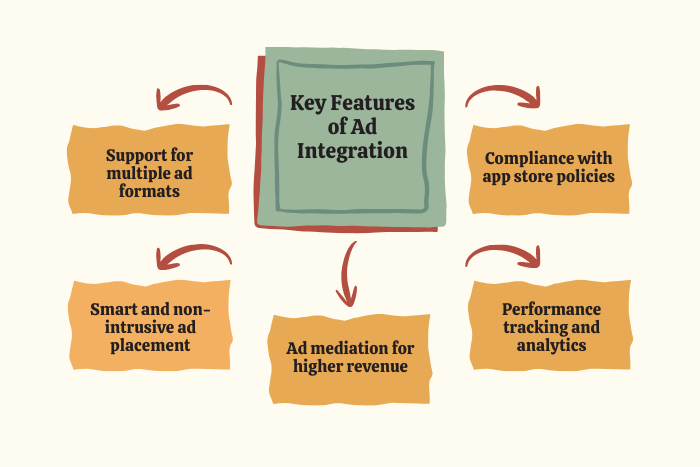
Key Features of Mobile App Ad Integration
Mobile ad integration solutions include several important capabilities that improve monetization performance.
Integration with major ad networks such as AdMob and Meta Audience Network
Support for multiple ad formats including banner and rewarded ads
Advanced ad mediation to maximize revenue from multiple networks
Targeted advertising based on user demographics and behavior
Real-time analytics and revenue tracking
Secure ad delivery and fraud prevention
Compatibility with Android, iOS, and cross-platform frameworks
Optimized loading for better application performance
These features allow developers to monetize applications without affecting usability.
Development Process
Requirement Analysis
Identify the app’s monetization goals and select suitable advertising networks.Ad Network Setup
Create developer accounts and configure ad units within the advertising platform.SDK Integration
Add the ad network SDK to the mobile application and configure required permissions.Ad Placement Planning
Determine where ads will appear inside the application interface.Testing and Validation
Test ad loading, display behavior, and user interaction.Deployment
Release the updated application through the app store.Performance Monitoring
Analyze ad performance metrics and user behavior.Optimization
Adjust ad formats and placements to improve revenue and user experience.
Technology Stack used to Integrate Ads in a Mobile App
Ad Networks: Google AdMob, Meta Audience Network, Unity Ads, AppLovin
Mobile Platforms: Android, iOS
Programming Languages: Kotlin, Java, Swift, Dart, JavaScript
Cross-Platform Frameworks: Flutter, React Native, Xamarin
Analytics Tools: Firebase Analytics, Google Analytics
Backend Technologies: Node.js, Python, PHP
Databases: Firebase, PostgreSQL, MongoDB
DevOps Tools: Docker, GitHub Actions, CI/CD pipelines
Security: SSL encryption, OAuth authentication, privacy compliance frameworks
Cost Factors to Integrate Ads in a Mobile App
Several factors influence the cost of integrating advertising in a mobile application.
Complexity of the application architecture
Number of advertising formats implemented
Integration with multiple ad networks
Custom UI adjustments for native advertisements
Development and testing time
Compliance with app store policies
Analytics and reporting tools
Maintenance and updates
Most apps recover integration costs through advertising revenue over time.
Latest Trends in Mobile App Advertising
Mobile advertising continues to evolve with new technologies and user behavior patterns.
Important trends include:
Growth of rewarded advertising in gaming apps
AI-based ad targeting and personalization
Programmatic mobile advertising and real-time bidding
Privacy-focused advertising frameworks
Contextual advertising replacing traditional tracking
Interactive and playable ads for better engagement
Advanced ad mediation platforms
Integration with analytics and user behavior tracking tools
These trends improve monetization efficiency while maintaining user trust.
Why Choose Us for Mobile App Ad Integration?
Integrating ads into an application requires technical expertise and a clear monetization strategy. Our development team specializes in mobile app monetization solutions that balance revenue generation and user experience.
Key advantages of working with us include:
Expert Ad SDK Integration – Experience with major ad networks and monetization platforms.
Strategic Ad Placement – Ad positioning designed to maximize visibility without disrupting usability.
Multi-Network Monetization – Integration with multiple ad providers for improved fill rates.
Performance Optimization – Lightweight implementation to maintain app speed.
Analytics-Driven Improvements – Continuous monitoring of ad revenue and engagement metrics.
Compliance with Platform Policies – Ad integration aligned with Google Play and App Store guidelines.
Scalable Monetization Solutions – Strategies that grow with your user base.
End-to-End Support – From planning and integration to testing and optimization.
Ready to monetize your mobile app with ads?
Let our experts implement high-performance ad integration.
Contact us today for a free consultation and monetization strategy.
Key Points :
- Integrate ads in a mobile app using ad networks like Google AdMob, Unity Ads, or Facebook Audience Network.
- Popular ad formats include banner, interstitial, native, rewarded, and video ads.
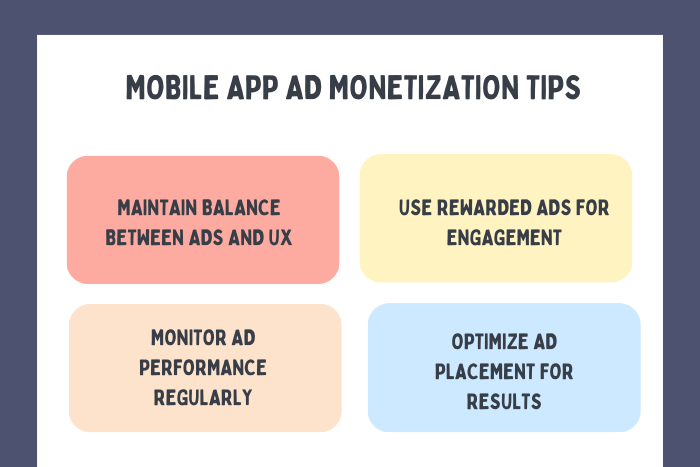
- Strategic ad placement helps maximize revenue while maintaining a good user experience.
- Ad mediation platforms increase revenue by connecting multiple ad networks.
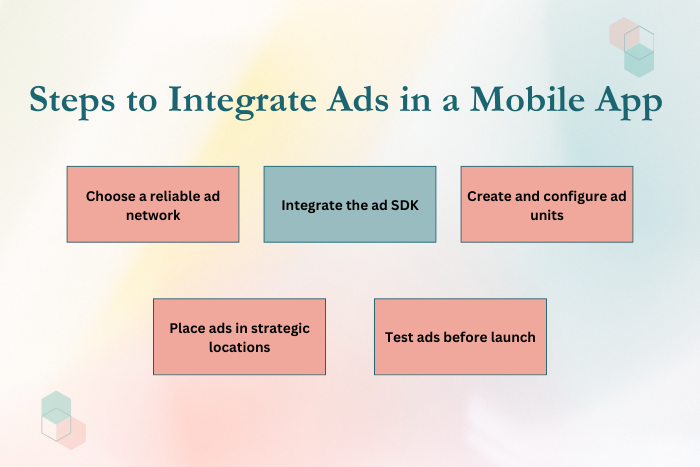
- Ad SDK integration and ad unit configuration are essential steps in the ad implementation process.
- Analytics and performance tracking help optimize ad engagement and monetization.
FAQ's
Ads can be integrated by adding an advertising SDK such as Google AdMob, creating ad units, and displaying ads within the app interface.
Google AdMob is one of the most popular ad networks, but others like Unity Ads, Facebook Audience Network, and AppLovin are also widely used.
Common formats include banner ads, interstitial ads, rewarded ads, native ads, and video ads.
If implemented correctly with optimized loading and caching, ads should have minimal impact on app performance.
Rewarded ads often generate higher engagement and revenue because users voluntarily interact with them.
Yes, frameworks like Flutter and React Native support ad integration using SDK plugins.
Revenue depends on factors like app traffic, user engagement, ad format, and geographic audience.
Yes, both platforms support in-app advertising as long as developers follow their respective app store policies.