Learn how to integrate AI in your app with machine learning, chatbots, predictive analytics, and automation to build smarter and more intelligent applications.
How Do I Integrate AI in My App?
Artificial Intelligence (AI) is transforming the way modern applications operate. From personalized recommendations and smart chatbots to predictive analytics and automated workflows, AI-powered features are helping businesses deliver smarter digital experiences. Many businesses and developers now ask an important question: how do I integrate AI in my app?
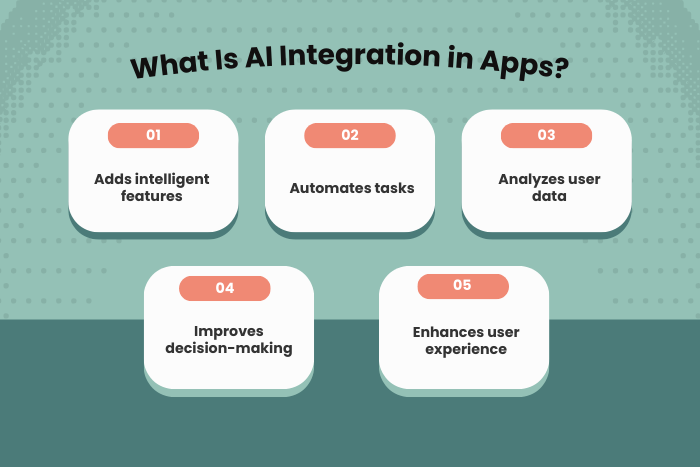
Integrating AI into an application allows it to analyze data, learn from user behavior, and make intelligent decisions. AI-powered apps can automate tasks, improve user engagement, and provide real-time insights. For example, e-commerce platforms use AI to recommend products, healthcare apps use AI for diagnosis support, and finance apps use AI for fraud detection.
The process of integrating AI in an app involves selecting the right AI model, collecting and preparing data, building intelligent algorithms, and integrating them into mobile or web applications. Developers can also use AI platforms and APIs to add advanced capabilities without building models from scratch.
Businesses that adopt AI-powered applications gain a competitive advantage by improving efficiency, enhancing user experience, and unlocking new data-driven opportunities.
In this guide, we will explain how AI can be integrated into your app, including development solutions, features, technologies, cost factors, and the latest trends in AI-powered application development.
Why AI Integration Is Important for Apps
AI integration enables applications to perform tasks that normally require human intelligence. It allows apps to learn from data, recognize patterns, and make predictions.
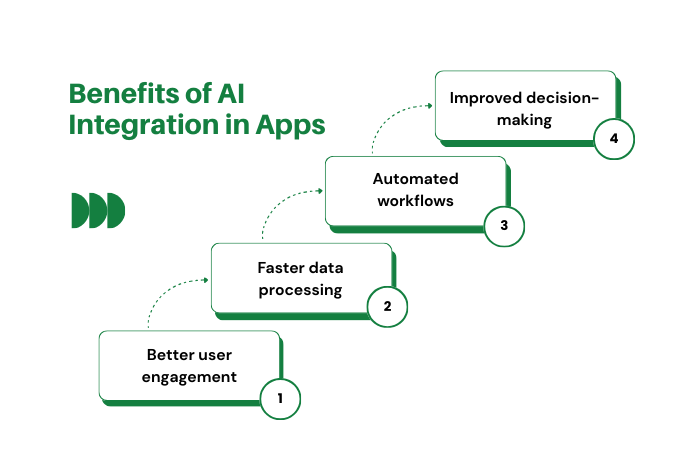
Key benefits of integrating AI in apps include:
Personalized User Experiences
AI analyzes user behavior to deliver personalized recommendations and content.Automation of Repetitive Tasks
AI-powered automation reduces manual work and increases productivity.Improved Decision Making
AI models analyze large datasets and generate actionable insights.Enhanced Customer Support
AI chatbots provide instant responses to user queries.Fraud Detection and Security
AI systems detect unusual patterns and potential threats.Better Data Analysis
AI helps businesses understand trends and user behavior.
By integrating AI, businesses can build intelligent applications that adapt and evolve with user needs.
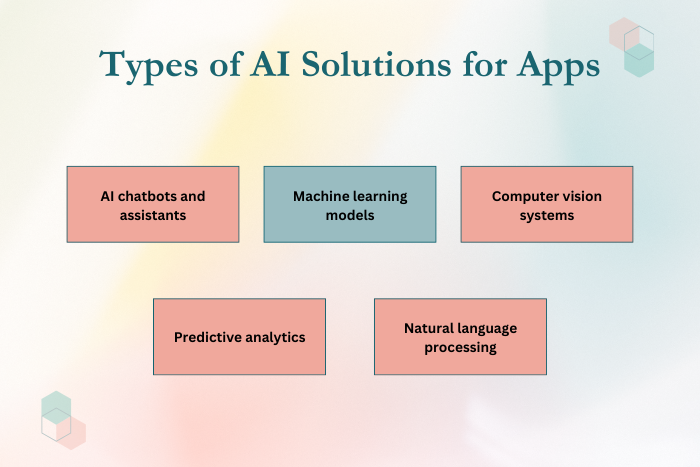
Types of Solutions to Integrate AI in Your App
There are several ways developers can integrate AI into an app depending on the app’s goals and functionality.
AI Chatbot Solutions
AI chatbots provide automated customer support and interaction.
Customer service automation
Virtual assistants
24/7 user support
Machine Learning Solutions
Machine learning models help apps analyze data and make predictions.
Predictive analytics
Recommendation engines
Behavior analysis
Natural Language Processing (NLP) Solutions
NLP enables apps to understand and process human language.
Voice assistants
Text analysis
Sentiment analysis
Computer Vision Solutions
Computer vision allows apps to recognize images and objects.
Facial recognition
Image classification
Object detection
AI-Powered Automation Solutions
AI can automate workflows and business processes.
Smart notifications
Automated decision systems
Process automation
These solutions allow developers to integrate intelligent features into modern applications.
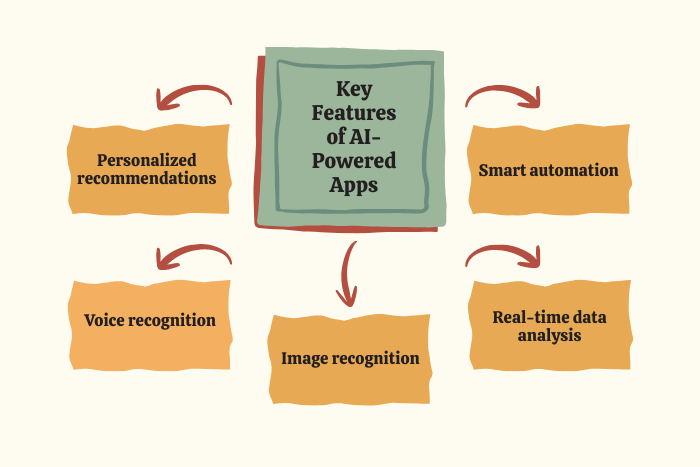
Key Features of AI-Powered Applications
Applications that integrate AI include several advanced capabilities that enhance functionality and user experience.
Key features include:
Personalized recommendations
AI-powered chatbots and assistants
Real-time data analysis
Voice recognition capabilities
Image and object recognition
Predictive analytics and forecasting
Automated decision-making systems
Smart notifications and alerts
These features help applications become more intelligent and responsive to user behavior.
AI Integration Development Process
Integrate AI into an app requires a structured development approach that ensures accurate results and reliable performance.
Define AI Objectives
Identify what AI functionality your application needs, such as recommendations, chatbots, or analytics.
Collect and Prepare Data
Gather datasets required to train AI models and ensure data quality.
Select AI Tools and Platforms
Choose AI frameworks or cloud platforms suitable for the application.
Choose the Right AI Model
Select machine learning models or deep learning algorithms.
Train and Validate the Model
Train the AI system using data and evaluate accuracy.
Integrate the AI Model into the App
Connect the AI model with the application’s backend and frontend systems.
Test AI Features
Ensure the AI functionality works correctly across different scenarios.
Deploy and Monitor Performance
Launch the app and monitor AI performance continuously.
Update and Improve AI Models
AI systems improve over time through data updates and model retraining.
This process ensures that AI features are accurate, scalable, and reliable.
Technology Stack for AI App Integration
AI app development involves a combination of machine learning frameworks, cloud platforms, and development tools.
Programming Languages: Python, Java, JavaScript, R
AI Frameworks: TensorFlow, PyTorch, Keras
Natural Language Processing: spaCy, NLTK, OpenAI APIs
Computer Vision Libraries: OpenCV, TensorFlow Vision
Mobile Frameworks: Flutter, React Native, Swift, Kotlin
Cloud Platforms: AWS AI, Google Cloud AI, Microsoft Azure AI
Databases: MongoDB, PostgreSQL, Firebase
AI APIs: OpenAI API, Google ML Kit, Amazon Rekognition
Using the right technology stack ensures seamless AI integration into mobile or web applications.
Cost Factors in AI App Integration
The cost of integrating AI into an application depends on several factors related to development complexity and infrastructure.
Important cost factors include to integrate AI into an app:
Complexity of AI features
Data collection and training datasets
Development of custom AI models
Cloud computing and processing costs
Integration with existing systems
Security and compliance requirements
AI maintenance and model updates
Applications with advanced AI features such as computer vision or deep learning require more resources and higher development costs.
Latest Trends in AI-Powered App Development
AI technology is evolving rapidly, introducing new opportunities for app development.
Key trends include:
Generative AI for content creation
AI-powered virtual assistants
Edge AI for faster processing on devices
AI-driven personalization engines
Voice-based interfaces and assistants
AI-powered cybersecurity systems
Automated machine learning (AutoML)
These innovations are making AI integration easier and more powerful for modern applications.
Why Choose Us for AI App Development?
Integrating AI into an application requires expertise in machine learning, data science, and software development.
Here’s why businesses choose our development team:
Experienced AI Developers
Our team specializes in AI-powered application development.Custom AI Solutions
We build AI models tailored to your business needs.Advanced Technology Integration
We integrate AI with mobile apps, web platforms, and cloud systems.Scalable AI Architecture
Our solutions support large datasets and high-performance processing.Secure and Reliable Systems
We implement strong data security and privacy protections.Continuous Optimization and Updates
We improve AI models based on user behavior and performance metrics.
Want to build an intelligent application powered by AI?
Our experts can help you integrate AI in your app with advanced technologies.
Contact us today to discuss your project and start building smarter apps.
Key Points :
- AI integration allows apps to analyze data, learn patterns, and automate tasks.
- Businesses can integrate AI in apps using machine learning models and AI APIs.
- AI helps apps deliver personalized user experiences and smarter automation.
- Technologies like TensorFlow, PyTorch, and cloud AI platforms support AI development.
- AI-powered apps can process voice, text, and image data for intelligent insights.
- AI integration improves efficiency, decision-making, and customer engagement.
- Modern apps use AI to create innovative and data-driven digital experiences.
FAQ's
Yes. AI features can be integrated into existing applications using APIs, machine learning models, or cloud AI platforms.
Common features include chatbots, recommendation systems, voice recognition, image recognition, and predictive analytics.
AI models perform better with large datasets, but pre-trained models can also be used for many applications.
Industries such as healthcare, finance, retail, logistics, and education widely use AI applications.
Costs vary depending on AI models, data requirements, and cloud infrastructure.
Some AI features can run offline using on-device machine learning models.
Machine learning is a subset of AI that enables systems to learn from data and improve over time.