


How Do I Integrate Chat Feature in an App? Complete Guide
Learn how to integrate a chat feature in an app with real-time messaging, APIs, development process, technology stack, and best practices.
How Do I Integrate Chat Feature in an App?
Real-time communication has become an essential feature in modern mobile and web applications. Businesses often ask how do I integrate chat feature in an app because messaging capabilities significantly improve user engagement, customer support, and collaboration. Whether it’s a social media platform, marketplace, gaming app, fintech platform, or customer service application, in-app chat enables users to communicate instantly without leaving the application.
Integrating chat functionality involves building a messaging system that supports real-time communication between users. This system typically includes features like instant messaging, notifications, media sharing, typing indicators, message history, and secure data transmission. Developers can implement chat functionality either by building it from scratch or by integrating third-party chat APIs and SDKs.
A well-designed chat feature enhances the overall user experience, improves customer satisfaction, and increases retention rates. Businesses use in-app messaging for customer support, buyer-seller communication, team collaboration, and community interactions.
In this guide, we will explore how to integrate chat features into an application, including types of chat solutions, essential features, development processes, technology stacks, cost factors, and emerging trends shaping modern real-time communication platforms.
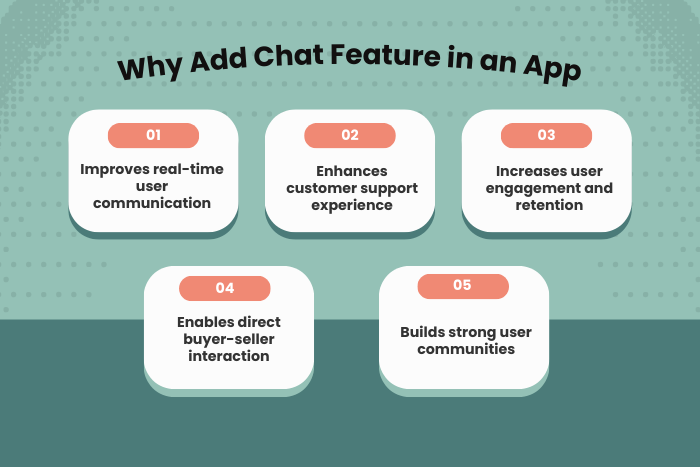
Why Integrating Chat Features in Apps is Important
Adding chat functionality to an application provides several advantages for both businesses and users. Real-time communication simplifies interactions and helps users resolve queries quickly.
Key benefits include:
Enhanced User Engagement
Messaging features encourage users to interact more frequently within the app.Improved Customer Support
Businesses can provide instant assistance through in-app messaging.Better Collaboration and Communication
Chat features enable seamless communication between users, teams, and service providers.Higher User Retention
Real-time communication increases the time users spend on the platform.Convenient Buyer-Seller Interaction
Marketplaces and eCommerce apps benefit from direct messaging between buyers and sellers.Community Building
Social platforms and gaming apps can create communities through chat channels and group conversations.
By integrating chat features, businesses can deliver faster communication and stronger user relationships.
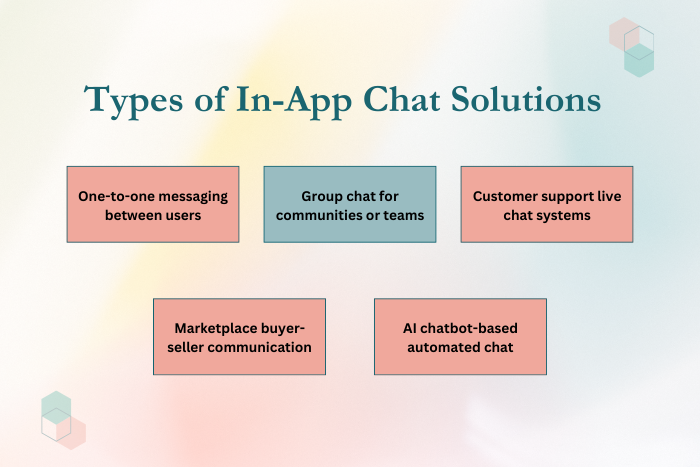
Types of Solutions to Integrate Chat Feature in an App
Different applications require different messaging capabilities depending on the use case.
One-to-One Messaging
Direct messaging between two users, commonly used in social networking apps and marketplaces.Group Chat Systems
Multiple users can communicate in shared chat rooms or channels.Customer Support Chat
Businesses provide real-time assistance through in-app messaging systems.Community Chat Platforms
Forums or discussion-based chat environments where users interact in communities.Voice and Video Messaging Integration
Advanced chat systems support voice calls, video calls, and voice notes.AI Chatbots and Automated Messaging
Chatbots provide automated responses to user queries.Live Event or Streaming Chat
Messaging features used during live broadcasts or streaming events.Enterprise Collaboration Chat
Messaging platforms designed for team communication and workplace collaboration.
Each of these solutions can be integrated depending on the business requirements of the application.
Key Features of In-App Chat Systems
A successful chat feature must provide reliable communication, security, and user-friendly interfaces.
Important features include:
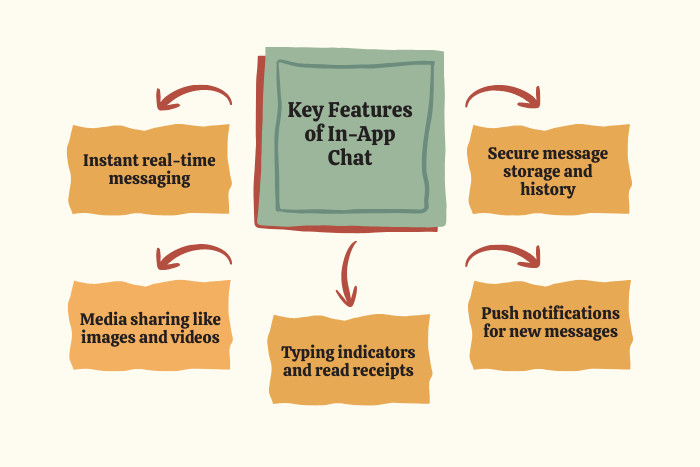
Real-time messaging with instant delivery
Message history and cloud storage
Typing indicators and read receipts
Media sharing including images, videos, and documents
Push notifications for new messages
Group chat functionality
User presence indicators (online/offline status)
Message reactions and emoji support
Message search functionality
End-to-end encryption for secure communication
Content moderation tools and spam filters
User blocking and reporting options
Voice and video calling support
These features ensure a smooth communication experience for users.
Step-by-Step Process to Integrate Chat Feature in an App
Integrating chat functionality requires a structured development approach.
Requirement Analysis
Identify the chat features required for the application and define user interactions.Choose the Chat Architecture
Decide whether to build the messaging system from scratch or use third-party chat APIs.Design User Interface
Create intuitive chat interfaces with message threads and conversation views.Backend Infrastructure Setup
Implement servers capable of handling real-time messaging and user connections.Real-Time Communication Integration
Use technologies like WebSockets or messaging protocols to enable instant communication.Database and Message Storage Implementation
Store chat history securely and ensure efficient data retrieval.Security Implementation
Add encryption, authentication systems, and data protection measures.Testing and Quality Assurance
Test messaging speed, reliability, and security.Deployment and Launch
Deploy chat features within the application environment.Maintenance and Performance Monitoring
Continuously monitor performance and add new features.
This process ensures the chat system is scalable and reliable.
Technology Stack for In-App Chat Development
The technology stack plays a crucial role in supporting real-time communication and scalability.
Frontend Technologies: React.js, Angular, Vue.js
Mobile Frameworks: Flutter, React Native, Swift, Kotlin
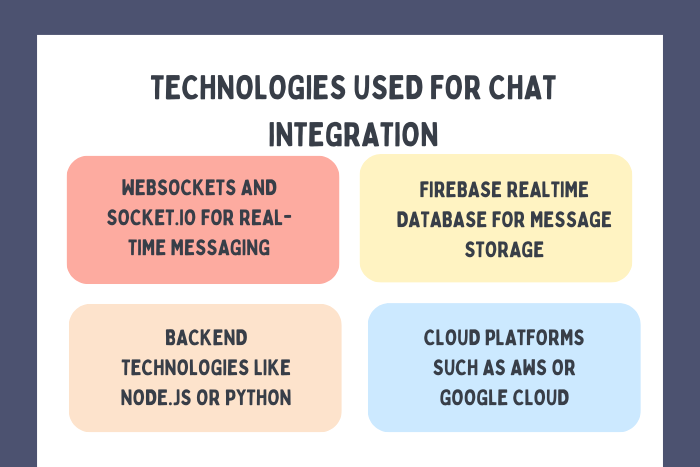
Backend Technologies: Node.js, Python, Java, Go
Real-Time Messaging Protocols: WebSockets, MQTT, Socket.IO
Databases: MongoDB, PostgreSQL, Firebase Realtime Database
Cloud Platforms: AWS, Google Cloud Platform, Microsoft Azure
Push Notification Services: Firebase Cloud Messaging (FCM), Apple Push Notification Service (APNs)
Third-Party Chat APIs: Stream, Sendbird, CometChat, Twilio
DevOps Tools: Docker, Kubernetes, CI/CD pipelines
These technologies help developers build reliable and scalable messaging systems.
Cost Factors in Chat Feature Integration
The cost of integrating chat functionality depends on several factors.
Key cost factors include:
Complexity of the messaging system
Number of chat features implemented
Use of third-party APIs or custom development
Real-time infrastructure requirements
Security and encryption implementation
Voice and video communication features
Database storage and cloud infrastructure
Maintenance and scalability requirements
Using third-party chat APIs may reduce development time, while custom chat solutions provide greater flexibility.
Latest Trends When You Integrate Chat Feature in an App
Modern messaging platforms are evolving rapidly with new technologies.
Key trends include:
AI-powered chatbots for automated customer support
End-to-end encrypted messaging systems
Real-time translation for multilingual conversations
Voice messaging and video call integration
Augmented reality communication features
Advanced moderation tools for community safety
Omnichannel messaging platforms
AI-driven sentiment analysis in chat systems
These trends are shaping the future of digital communication within apps.
Why Choose Us for Chat Feature Integration?
Integrating chat functionality requires expertise in real-time systems, scalable architecture, and secure communication protocols. Our development team specializes in building advanced messaging systems that deliver seamless communication experiences.
Here’s why businesses trust us:
Expertise in Real-Time Communication Systems
We build scalable chat platforms for mobile and web applications.Advanced Messaging Architecture
Our chat systems support millions of concurrent users.Secure Communication Frameworks
We implement encryption and secure authentication protocols.Customizable Chat Solutions
Messaging features can be tailored to different business models.Integration with Third-Party APIs
We integrate leading chat platforms to accelerate development.Cross-Platform Messaging Support
Chat systems work seamlessly across Android, iOS, and web platforms.Performance Optimization
Real-time systems are optimized for speed and reliability.Long-Term Support and Maintenance
Continuous updates ensure improved messaging performance.
Ready to integrate a powerful chat feature into your app?
Let our experts build a scalable real-time messaging solution for your platform.
Contact us today for a free consultation and project estimate.
Key Points :
- Integrating chat features in apps enables real-time communication between users, improving engagement and user experience.
- Common chat solutions include one-to-one messaging, group chats, customer support chat, and community chat systems.
- Key chat features include instant messaging, media sharing, push notifications, typing indicators, and message history.
- Technologies like WebSockets, Socket.IO, Firebase, and real-time databases power real-time messaging systems.
- Chat integration costs depend on system complexity, features, infrastructure, and use of third-party APIs.
- Emerging trends include AI chatbots, voice and video messaging, real-time translation, and secure encrypted communication.
FAQ's
An in-app chat feature allows users to communicate with each other in real time within a mobile or web application.
Developers can either build a custom messaging system or integrate third-party chat APIs and SDKs.
Technologies such as WebSockets, Socket.IO, Firebase, and real-time databases are commonly used.
Yes, modern chat systems use encryption and secure authentication to protect user data.
Yes. Most chat systems allow users to send images, videos, documents, and voice messages.
Costs depend on the complexity of the system, infrastructure, and features included.
Yes. Many messaging platforms support integrated voice and video communication.
Third-party APIs provide faster implementation, while custom solutions offer greater flexibility and control.