
Learn how to integrate voice assistant in an app using AI, NLP, and speech recognition technologies with key features, development steps, and tools.
How Do I Integrate Voice Assistant in an App?
Voice assistant technology has transformed the way users interact with digital applications. Instead of navigating through menus or typing commands, users can now control apps using voice instructions. This shift toward conversational interfaces has led many businesses to explore how do I integrate voice assistant in an app to improve accessibility, efficiency, and user engagement.
Voice assistants powered by artificial intelligence (AI), natural language processing (NLP), and speech recognition enable apps to understand spoken commands and respond intelligently. Popular voice assistants like Siri, Google Assistant, and Amazon Alexa have already demonstrated how voice-driven interactions can enhance everyday tasks such as searching information, booking services, controlling smart devices, and managing schedules.
Integrating voice assistants into mobile and web applications allows businesses to deliver hands-free experiences and personalized interactions. These capabilities are particularly valuable in industries such as eCommerce, travel, healthcare, smart home automation, and customer support.
In this guide, we explore how to integrate voice assistants into apps, including development strategies, types of voice assistant solutions, key features, technology stacks, cost factors, and the latest trends shaping voice-enabled applications.
Why Voice Assistant Integration Is Important
Voice-enabled applications are becoming increasingly popular as users look for faster and more convenient ways to interact with digital services. Integrating voice assistants into apps can significantly improve usability and accessibility.
Key benefits include:
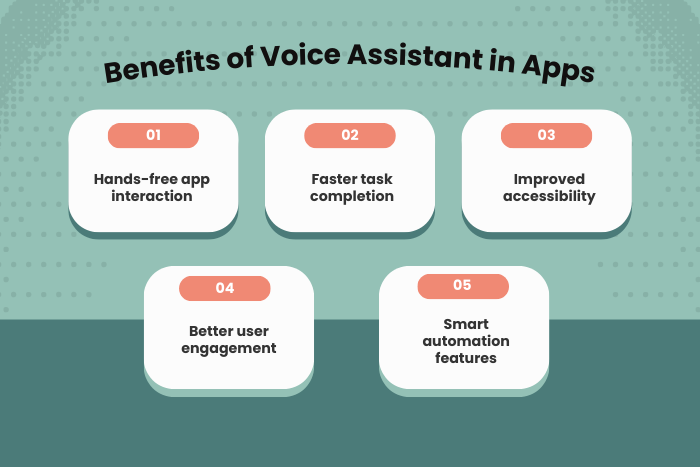
Hands-Free Interaction
Users can interact with apps without touching their devices.Improved Accessibility
Voice assistants help people with disabilities navigate applications more easily.Faster User Experience
Voice commands reduce the time required to perform tasks.Enhanced Customer Engagement
Conversational interfaces create more natural user interactions.Smart Automation
Voice assistants can automate tasks such as scheduling, searching, and notifications.
Businesses that implement voice technology can provide innovative user experiences while staying competitive in the evolving digital landscape.
Types of Solutions to Integrate Voice Assistant in an App
Different voice assistant technologies can be integrated into mobile and web applications depending on business requirements.
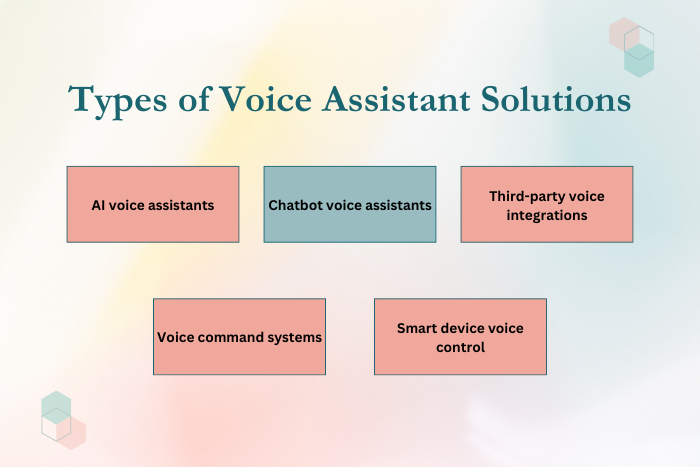
AI Voice Assistant Integration
Custom AI-powered assistants capable of understanding and responding to user commands.Third-Party Voice Assistant Integration
Integration with existing platforms such as Google Assistant, Amazon Alexa, or Apple Siri.Voice Command Control Systems
Apps that respond to specific commands for navigation and functionality.Conversational Chatbot Voice Assistants
AI chatbots enhanced with voice capabilities for customer service.Smart Device Voice Integration
Apps connected to IoT devices such as smart homes and wearables.Multilingual Voice Assistants
Assistants capable of understanding multiple languages for global users.
These solutions help businesses create voice-enabled applications tailored to their users’ needs.
Key Features of Voice Assistant Apps
Successful voice-enabled applications include features that improve interaction accuracy and user convenience.
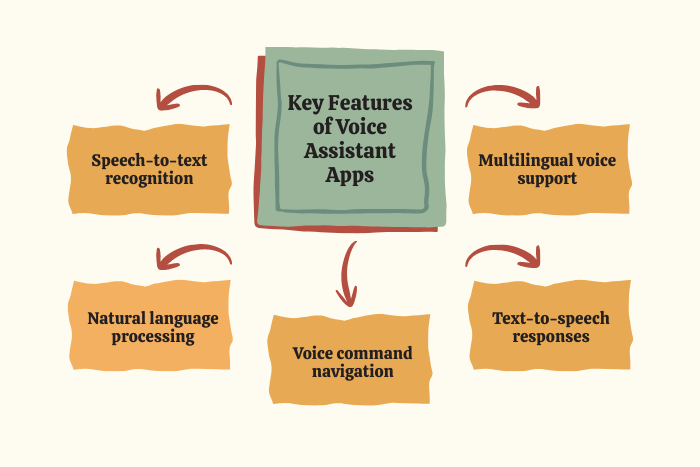
Speech Recognition
Converts spoken language into text that the app can process.Natural Language Processing (NLP)
Enables the app to understand user intent and respond appropriately.Voice Command Navigation
Allows users to navigate app features using spoken instructions.Text-to-Speech Response
Converts app responses into natural-sounding voice outputs.Contextual Understanding
Allows assistants to remember previous commands during conversations.Personalized Voice Experiences
AI adapts responses based on user preferences and behavior.Multilingual Support
Supports voice commands in multiple languages.Integration with Third-Party APIs
Connects voice assistants with other services and platforms.
These features ensure voice assistants deliver smooth and intuitive interactions.
Development Process to Integrate Voice Assistant in an App
Developing a voice-enabled application requires a structured development approach.
Define Use Cases and User Needs
Identify how voice commands will enhance the app’s functionality.Select Voice Technology Platforms
Choose suitable AI and speech recognition tools.Design Conversational User Interfaces (VUI)
Plan natural dialogue flows and voice interactions.Develop Speech Recognition Systems
Implement voice input processing and command recognition.Integrate APIs and AI Models
Connect the app with NLP engines and voice processing services.Testing and Voice Command Optimization
Ensure accurate speech recognition across accents and environments.Deployment and Integration
Launch the app with voice assistant capabilities.Continuous Learning and Improvement
Improve performance using machine learning and user feedback.
This development workflow ensures reliable voice assistant functionality.
Technology Stack for Voice Assistant Integration
Modern voice assistant apps rely on advanced AI and speech technologies.
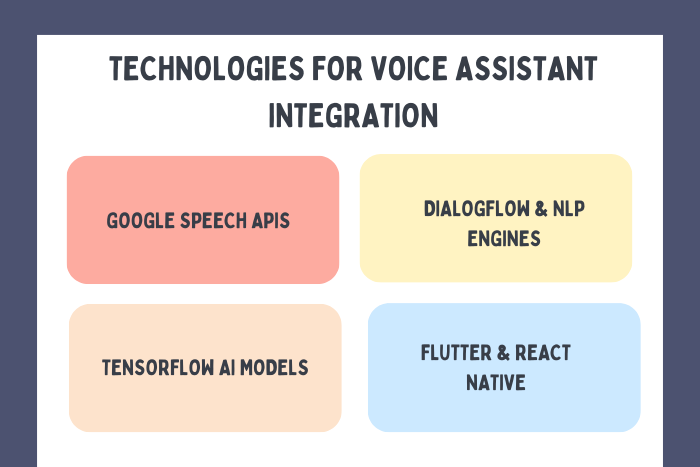
Speech Recognition Technologies: Google Speech-to-Text, Amazon Transcribe
Natural Language Processing (NLP): Dialogflow, IBM Watson, Microsoft LUIS
AI Frameworks: TensorFlow, PyTorch
Mobile Development: Swift, Kotlin, Java, Dart
Cross-Platform Frameworks: Flutter, React Native
Backend Technologies: Node.js, Python, Java
Cloud Platforms: AWS, Google Cloud Platform, Microsoft Azure
Voice Assistant Platforms: Google Assistant SDK, Amazon Alexa Skills Kit, Apple SiriKit
These technologies enable accurate voice recognition and intelligent responses.
Cost Factors in Voice Assistant Integration
The cost of integrating voice assistants into apps depends on several variables.
Complexity of Voice Features
Advanced conversational AI increases development costs.AI and NLP Model Training
Custom AI models require additional resources and data.Platform Integration
Supporting multiple voice platforms increases development scope.Voice Interface Design
Designing conversational flows requires specialized expertise.Testing and Optimization
Voice recognition must be tested across languages and accents.Cloud Infrastructure
AI processing and speech recognition require scalable cloud resources.
Businesses should evaluate these factors when planning voice assistant integration projects.
Latest Trends in Voice Assistant Technology
Voice technology continues to evolve with new innovations improving conversational experiences.
AI-Powered Conversational Interfaces
Assistants capable of understanding complex user requests.Multimodal Interfaces
Combining voice interaction with visual UI elements.Voice Commerce (V-Commerce)
Users can make purchases using voice commands.Emotion Detection in Voice AI
Systems that analyze voice tone and emotional cues.Offline Voice Processing
Voice assistants functioning without internet connectivity.Smart Device Ecosystem Integration
Voice assistants controlling IoT devices and smart homes.
These trends are shaping the future of voice-enabled applications.
Why Choose Us for Voice Assistant App Development?
Integrating voice assistants into applications requires expertise in artificial intelligence, natural language processing, and user experience design. Our development team specializes in building intelligent voice-enabled solutions that enhance user interaction.
Here’s why businesses choose us:
Expertise in AI and Voice Technologies – Advanced experience in speech recognition and conversational AI.
Custom Voice Assistant Development – Tailored solutions designed for specific business needs.
Seamless Platform Integration – Integration with popular voice platforms like Google Assistant and Alexa.
Scalable Cloud Architecture – Reliable infrastructure for handling voice data and AI processing.
User-Centered Voice Interface Design – Natural and intuitive voice interactions.
Agile Development Approach – Efficient development with continuous improvement cycles.
End-to-End Development Support – From strategy and design to deployment and maintenance.
We help businesses build voice-enabled applications that deliver smarter and more engaging digital experiences.
Ready to add voice assistant capabilities to your app?
Let our experts build intelligent voice-driven features for your application.
Contact us today for a free consultation and development estimate.
Key Points :
- Voice assistants enable hands-free interaction in mobile apps using AI, speech recognition, and natural language processing (NLP).
- Apps can integrate popular voice platforms like Google Assistant, Amazon Alexa, and Apple Siri.
- Key features include voice commands, speech-to-text processing, text-to-speech responses, and contextual conversation support.
- Voice assistant integration requires APIs, AI frameworks, cloud services, and NLP engines.
- Development involves use case planning, voice interface design, API integration, testing, and deployment.
- Latest trends include AI conversational assistants, voice commerce, multilingual voice support, and smart device integration.
FAQ's
Voice assistants can be integrated using AI technologies such as speech recognition, natural language processing, and voice assistant APIs.
Popular platforms include Google Assistant, Amazon Alexa, Apple Siri, and custom AI voice assistants.
Technologies include NLP engines, speech recognition systems, machine learning models, and cloud-based AI services.
Some voice assistants support limited offline functionality depending on the technology used.
Yes, secure voice processing and encryption technologies protect user data.
Development time depends on the complexity of the voice assistant and the features required.
Yes, modern voice AI platforms support multilingual voice recognition and responses.