

Discover important features of a healthcare app including telemedicine, appointment scheduling, EHR integration, and secure patient data management.
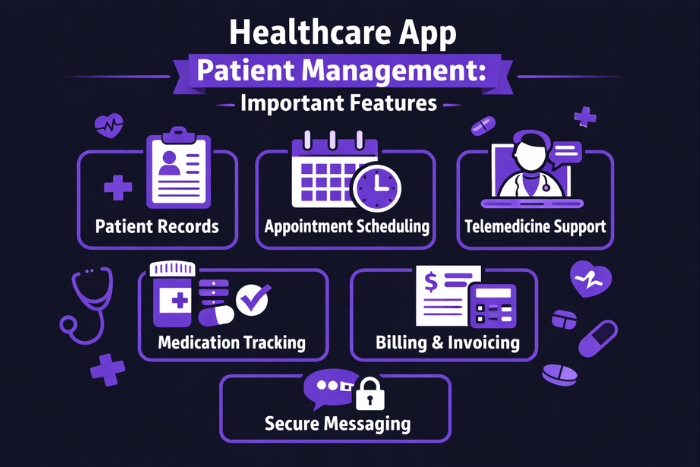
Important Features of a Healthcare App
Healthcare mobile applications are transforming the way patients and medical professionals interact, manage health records, and access medical services. With the increasing demand for digital healthcare solutions, hospitals, clinics, and healthcare startups are investing in advanced mobile applications to improve patient care and streamline medical operations. Understanding the important features of a healthcare app is essential for building a reliable and user-friendly digital healthcare platform.
Modern healthcare apps allow patients to book appointments, consult doctors through telemedicine, access electronic health records, monitor health conditions, and receive personalized medical recommendations. These apps help reduce waiting times, improve communication between patients and healthcare providers, and make healthcare services more accessible. At the same time, healthcare professionals benefit from better data management, remote patient monitoring, and improved clinical decision-making tools.
A well-designed healthcare application combines secure data management, seamless communication tools, and advanced analytics to deliver efficient healthcare services. By implementing the right features, healthcare providers can enhance patient engagement, improve treatment outcomes, and optimize healthcare delivery systems.
Why Important Features of a Healthcare App Are Important
The healthcare industry relies on technology to improve accessibility, efficiency, and patient care. The important features of a healthcare app ensure that patients receive timely medical services while healthcare providers can manage clinical data effectively.
Here’s why these features are essential:
Improved Patient Accessibility
Patients can connect with healthcare professionals from anywhere through digital platforms.Better Healthcare Management
Healthcare providers can efficiently manage appointments, patient records, and treatment plans.Enhanced Patient Engagement
Interactive features encourage patients to actively monitor their health.Remote Healthcare Services
Telemedicine and remote monitoring enable doctors to provide care without physical visits.Efficient Data Management
Electronic health records help organize patient information securely.Improved Healthcare Outcomes
Data-driven insights help medical professionals make better treatment decisions.
Implementing these features ensures that healthcare applications provide reliable and efficient medical services.
Types of Healthcare Application Solutions
Healthcare applications can serve different purposes depending on the needs of patients and medical providers.
Telemedicine Apps
Platforms that allow patients to consult doctors through video calls, chat, or voice communication.Appointment Booking Apps
Applications designed for scheduling doctor visits and managing medical appointments.Health Monitoring Apps
Apps that track patient health metrics such as heart rate, blood pressure, and activity levels.Electronic Health Record (EHR) Apps
Applications that allow healthcare providers to store and manage patient medical records.Fitness and Wellness Apps
Platforms designed to promote healthy lifestyles through exercise tracking and wellness programs.
Each solution requires specific features to meet the needs of healthcare providers and patients.
Key Features of a Healthcare App
To build a successful healthcare application, several essential features must be integrated to ensure usability, security, and efficiency.
User Registration and Profile Management
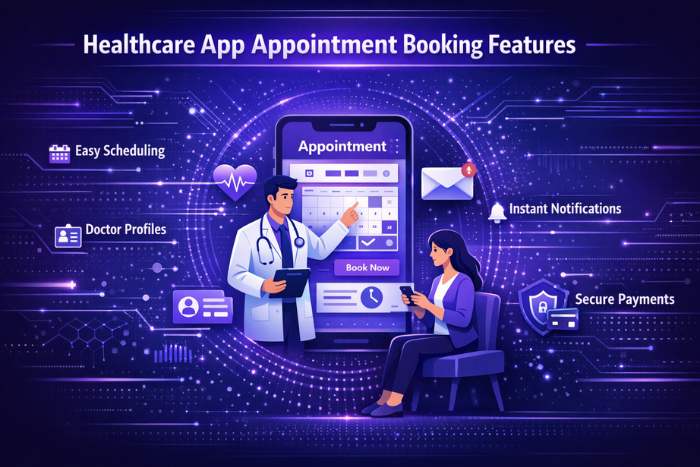
Patients and doctors can create accounts and manage personal health information.Appointment Scheduling System
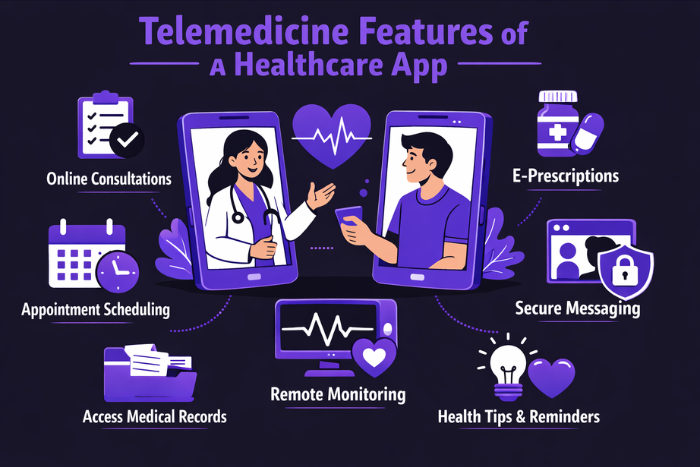
Users can book, reschedule, or cancel medical appointments easily.Telemedicine and Video Consultation
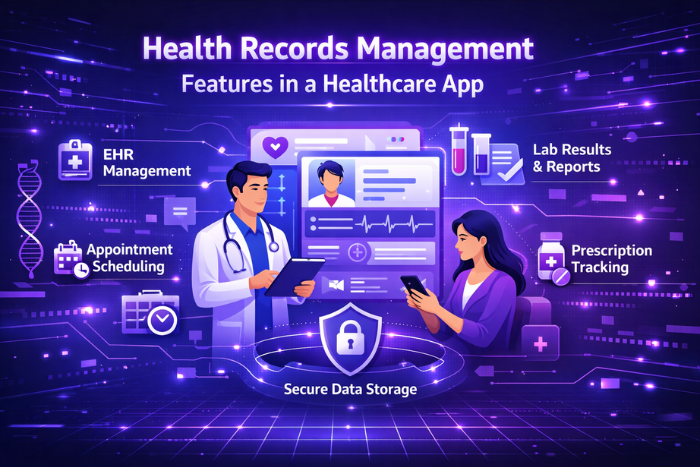
Patients can consult doctors remotely through secure video calls.Electronic Health Records Integration
Healthcare providers can access patient history and medical records digitally.Prescription Management and Refills
Doctors can send prescriptions digitally, and patients can request refills.Secure Payments and Billing
Patients can pay medical bills through integrated payment gateways.Health Tracking and Monitoring
Apps can track vital health metrics and generate reports.Push Notifications and Medication Reminders
Patients receive alerts for medication schedules and appointments.Wearable Device Integration
Apps can sync with smart devices to collect health data.Privacy and Data Security
Compliance with healthcare regulations ensures patient data protection.
These features help healthcare apps provide efficient, secure, and convenient healthcare services.
Development Process for a Healthcare Application
Building a healthcare application requires a structured development process to ensure reliability and compliance with medical standards.
Market Research and Requirement Analysis
Identify the healthcare needs, target users, and regulatory requirements.Feature Planning and System Architecture
Define essential features and design the application infrastructure.UI/UX Design and Prototyping
Create intuitive interfaces that simplify patient and doctor interactions.Frontend and Backend Development
Develop the mobile interface and backend systems for data management.API Integration and Healthcare Compliance
Integrate EHR systems, wearable devices, and ensure regulatory compliance.Testing and Quality Assurance
Conduct security testing, performance testing, and usability checks.Deployment and Launch
Release the app on mobile platforms and ensure smooth functionality.Maintenance and Continuous Updates
Improve performance and add new features based on user feedback.
This development approach ensures that healthcare applications remain secure, reliable, and scalable.
Technology Stack for Healthcare App Development
Developing a healthcare app requires advanced technologies and features to ensure secure and scalable healthcare services.
Frontend Technologies: React Native, Flutter, Swift, Kotlin
Backend Technologies: Node.js, Python, Java, PHP
Databases: MongoDB, PostgreSQL, MySQL
Cloud Platforms: AWS, Google Cloud Platform, Microsoft Azure
Healthcare APIs: HL7, FHIR, EHR integrations
DevOps Tools: Docker, Kubernetes, CI/CD pipelines
Security Technologies: SSL encryption, OAuth authentication, HIPAA compliance
These technologies enable healthcare apps to handle sensitive patient data securely and deliver real-time medical services.
Cost Factors in Healthcare App Development
The cost of developing a healthcare application depends on several technical and operational factors.
Complexity of features and functionality
Compliance with healthcare regulations
Platform choice (iOS, Android, or cross-platform)
Integration with EHR systems and wearable devices
Custom UI/UX design requirements
Third-party API integrations
Cloud hosting and database infrastructure
Ongoing maintenance and security updates
Healthcare apps with advanced telemedicine capabilities and AI-powered features require higher development investment.
Latest Trends in Healthcare App Development
Healthcare technology continues to evolve with innovative solutions improving patient care and medical efficiency.
AI-Powered Health Diagnostics
Artificial intelligence assists doctors in diagnosing diseases more accurately.Remote Patient Monitoring
IoT devices track patient health data in real time.Wearable Device Integration
Smartwatches and health trackers provide continuous health insights.Voice-Based Medical Assistants
Voice technology helps patients access healthcare information quickly.Blockchain for Medical Data Security
Blockchain technology ensures secure and transparent health data management.Predictive Analytics in Healthcare
Data analytics helps predict health risks and improve treatment outcomes.
These trends are shaping the future of digital healthcare platforms.
Why Choose Us for Healthcare App Development?
Choosing the right development partner is critical when building a healthcare application that meets industry standards and user expectations. Our team specializes in creating advanced healthcare solutions designed to improve patient care and streamline healthcare operations.
Here’s why healthcare providers trust our services:
Experienced Healthcare App Developers – Skilled in building secure medical applications.
User-Centered Design Approach – Intuitive interfaces for both patients and healthcare professionals.
Compliance with Healthcare Regulations – Implementation of HIPAA and data security standards.
Scalable Cloud Infrastructure – Apps designed to support large patient databases and medical systems.
Advanced Integration Capabilities – Seamless integration with EHR systems and wearable devices.
Real-Time Telemedicine Solutions – Secure video consultations and remote healthcare services.
Agile Development Process – Transparent workflows and continuous collaboration.
Long-Term Support and Maintenance – Regular updates and security improvements.
We help healthcare organizations build reliable digital health platforms with powerful features in a healthcare app that enhance patient care and operational efficiency.
Ready to build a secure and feature-rich healthcare application?
Let our experts develop a healthcare solution tailored to your needs.
Contact us today for a free consultation and project estimate.
Key Points :
- Healthcare apps enable patients to book doctor appointments, manage medical records, and access healthcare services from their mobile devices.
- Telemedicine features allow patients to consult doctors through video calls or chat without visiting a hospital.
- Electronic Health Record (EHR) integration helps healthcare providers securely store and access patient medical history.
- Health tracking and wearable device integration allow users to monitor vital signs such as heart rate, activity levels, and sleep patterns.
- Secure payment and billing systems allow patients to pay medical fees conveniently through digital platforms.
- Strong privacy and data security features ensure patient information is protected and compliant with healthcare regulations.
FAQ's
Key features of a healthcare app include telemedicine, appointment scheduling, electronic health record integration, prescription management, and secure payments.
Development timelines usually range from three to six months depending on features and compliance requirements.
Technologies such as React Native, Node.js, MongoDB, and cloud platforms like AWS are commonly used.
Yes. Healthcare apps must follow regulations such as HIPAA to protect patient data and privacy.
Costs depend on features, integrations, security requirements, and development complexity.
Yes. Telemedicine features allow patients to consult doctors remotely through video calls and chat.
Yes. Regular updates ensure security, compliance, and improved functionality.