Explore the important features of a job portal website including resume management, job search filters, employer dashboards, and applicant tracking tools.
Important Features of a Job Portal Website
The digital transformation of recruitment has made job portals an essential platform for connecting employers with potential candidates. Modern job seekers rely heavily on online platforms to search for employment opportunities, upload resumes, and apply for positions efficiently. At the same time, employers use these platforms to manage job listings, review applications, and streamline the hiring process. Understanding the important features of a job portal website is crucial for building a recruitment platform that delivers a seamless experience for both job seekers and employers.
A well-designed job portal website combines advanced search capabilities, resume management tools, employer dashboards, and applicant tracking systems to simplify the hiring process. These platforms also integrate communication tools, analytics dashboards, and automated candidate matching features to improve recruitment efficiency.
As the job market becomes increasingly competitive, companies must invest in feature-rich job portal solutions that provide scalability, security, and personalized experiences. By implementing the right features, businesses can create powerful recruitment platforms that attract job seekers, help employers find qualified candidates faster, and streamline the overall hiring workflow.
Why the Important Features of a Job Portal Website Are Important
The success of a job portal website depends on how effectively it connects employers with the right candidates. The right set of features improves usability, simplifies recruitment processes, and enhances overall platform efficiency.
Here’s why these features are essential:
Improved Job Search Experience
Advanced search filters help job seekers quickly find relevant opportunities.Efficient Recruitment Management
Employers can manage job postings, applications, and candidate communication in one place.Better Candidate Matching
Smart algorithms match job seekers with suitable roles based on skills and experience.Faster Hiring Process
Automated workflows help recruiters shortlist candidates quickly.Enhanced User Engagement
Personalized job alerts keep job seekers informed about new opportunities.Scalable Recruitment Platforms
Modern job portals can support thousands of users and job listings simultaneously.
These features ensure the platform remains efficient and competitive in the digital recruitment market.
Types of Job Portal Platform Solutions
Different job portal platforms serve various recruitment needs depending on the target audience and hiring processes.
General Job Portals
Platforms that list job opportunities across multiple industries and locations.Niche Job Portals
Websites focused on specific industries such as IT, healthcare, or finance.Freelance Job Platforms
Platforms designed for freelancers and contract-based professionals.Company Career Portals
Dedicated job portals created by organizations to manage internal recruitment.Recruitment Agency Platforms
Websites used by recruitment agencies to connect employers with candidates.
Each solution requires specific features tailored to different hiring requirements.
Key Features of a Job Portal Website
A successful job portal must include several essential features that support job searching, candidate management, and employer recruitment processes.
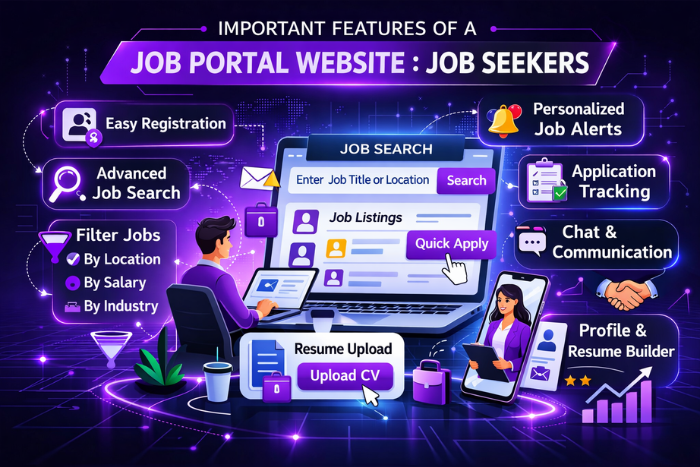
User Registration and Profile Management
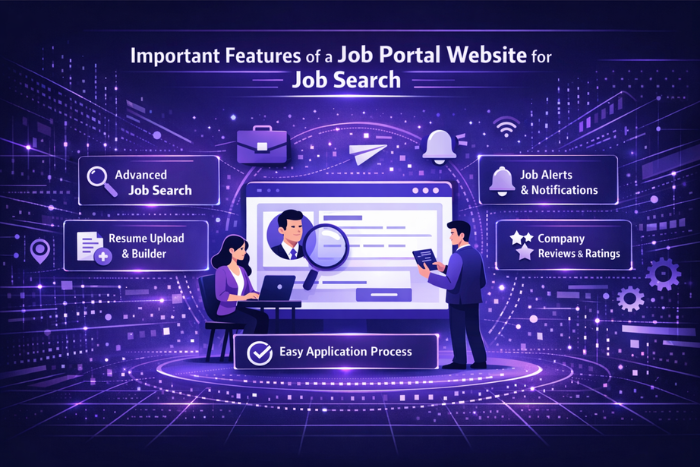
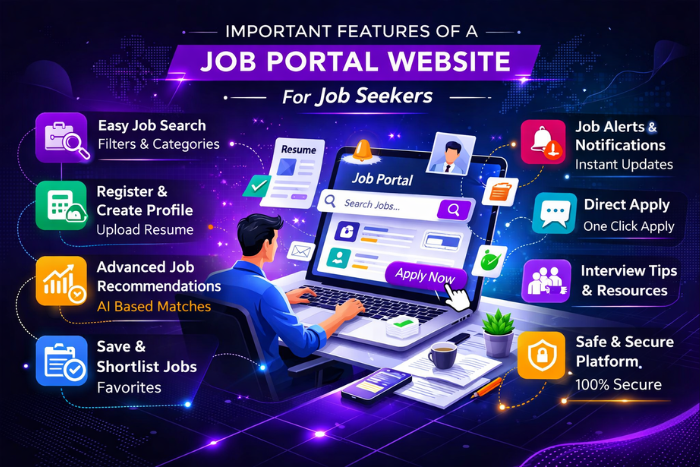
Job seekers and employers can create accounts and manage their profiles.Advanced Job Search and Filtering
Users can filter jobs based on location, industry, experience level, salary range, and job type.Resume Upload and Management
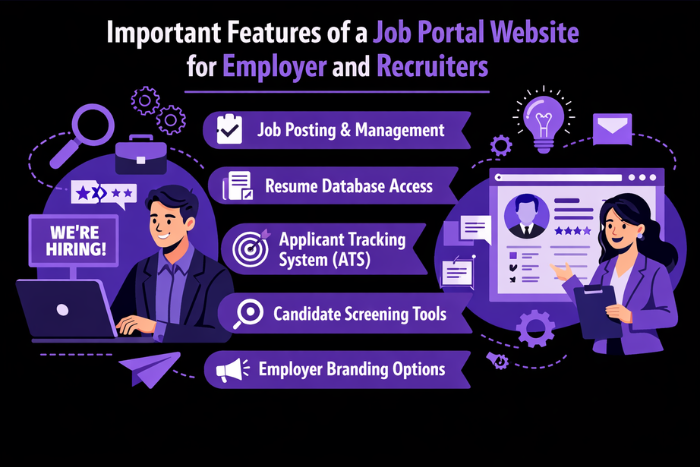
Candidates can upload resumes and update their professional profiles.Job Posting and Management Tools
Employers can post job listings and manage job applications efficiently.Application Tracking System (ATS)
Employers can track candidate applications throughout the recruitment process.AI-Based Candidate Matching
Algorithms recommend relevant job opportunities to candidates.Employer Dashboards
Recruiters can manage job postings, candidate shortlisting, and communication.In-App Messaging and Notifications
Communication tools allow employers and candidates to interact directly.Job Alerts and Email Notifications
Job seekers receive updates when new opportunities match their skills.Admin Panel and Analytics Dashboard
Administrators can manage users, listings, and platform performance.
These features help create an efficient and user-friendly recruitment ecosystem.
Development Process for a Job Portal Platform
Developing a job portal website requires a structured development strategy to ensure scalability and usability.
Market Research and Requirement Analysis
Identify target users, recruitment workflows, and core platform features.Feature Planning and System Architecture
Define system components and design the platform structure.UI/UX Design and Prototyping
Create intuitive interfaces that simplify job search and recruitment.Frontend and Backend Development
Develop user interfaces and backend systems for managing data and applications.Integration with Resume Parsing and APIs
Integrate tools that automatically extract information from resumes.Testing and Quality Assurance
Perform usability testing, performance testing, and security checks.Deployment and Platform Launch
Release the platform and ensure smooth user onboarding.Maintenance and Continuous Improvements
Update features and optimize performance based on user feedback.
This development approach ensures the job portal remains reliable and scalable.
Technology Stack for Job Portal Website Development
Modern job portal platforms rely on advanced technologies for performance and scalability.
Frontend Technologies: React.js, Angular, Vue.js
Backend Technologies: Node.js, Python, Java, PHP
Databases: MongoDB, PostgreSQL, MySQL
Cloud Platforms: AWS, Google Cloud Platform, Microsoft Azure
Search Technologies: Elasticsearch, Algolia
AI Tools: Machine learning algorithms for candidate-job matching
DevOps Tools: Docker, Kubernetes, CI/CD pipelines
Security Technologies: SSL encryption, OAuth authentication
These technologies enable secure and high-performance recruitment platforms.
Cost Factors in Job Portal Website Development
The cost of building a job portal website depends on several technical and business factors.
Platform complexity and feature set
Integration with resume parsing and applicant tracking systems
Number of user roles (job seekers, employers, administrators)
Custom UI/UX design requirements
Third-party API integrations
Hosting and cloud infrastructure
Security and compliance requirements
Ongoing maintenance and platform updates
Advanced recruitment platforms with AI-powered features typically require higher development investment.
Latest Trends in Job Portal Website Development
The recruitment technology industry continues to evolve with innovative features that improve hiring efficiency.
AI-Based Candidate Matching
Machine learning algorithms match candidates with suitable job roles.Automated Resume Screening
Resume parsing tools automatically extract and analyze candidate information.Video Interview Integration
Employers can conduct interviews directly through the platform.Mobile-First Job Portal Design
Many job seekers search for opportunities using mobile devices.Skill-Based Hiring Platforms
Companies increasingly focus on skills and competencies rather than traditional resumes.Data Analytics for Recruitment Insights
Recruiters can analyze hiring patterns and candidate engagement.
These trends are shaping the future of digital recruitment platforms.
Why Choose Us for Job Portal Website Development?
Selecting the right development partner is crucial for building a reliable and scalable job portal platform. Our team specializes in creating advanced recruitment platforms tailored to the needs of modern hiring processes.
Here’s why businesses trust our services:
Experienced Recruitment Platform Developers – Skilled in building scalable job portal systems.
User-Centered Platform Design – Intuitive interfaces for job seekers and recruiters.
Advanced Candidate Matching Systems – AI-powered job recommendation engines.
Secure Data Management – Strong security protocols to protect candidate data.
Scalable Cloud Infrastructure – Platforms designed to support large user bases.
CRM and ATS Integration – Seamless integration with recruitment tools.
Agile Development Workflow – Transparent processes and continuous collaboration.
Long-Term Support and Maintenance – Ongoing updates and performance improvements.
We help businesses build powerful recruitment platforms that connect employers with the right talent efficiently.
Ready to launch your job portal website?
Let our experts develop a feature-rich recruitment platform tailored to your business.
Contact us today for a free consultation and project estimate.
Key Points :
- A job portal website should include advanced job search and filtering options to help users quickly find relevant job opportunities.
- Resume upload and profile management features allow job seekers to create professional profiles and apply for jobs easily.
- Employer dashboards enable recruiters to post jobs, manage listings, and review candidate applications efficiently.
- Applicant Tracking Systems (ATS) help employers track and manage candidates throughout the recruitment process.
- Real-time job alerts and notifications keep job seekers updated about new job postings and application status.
- Admin dashboards and analytics tools help manage platform activity, monitor job listings, and track user engagement.
FAQ's
Important features include job search filters, resume upload systems, employer dashboards, applicant tracking systems, and communication tools.
Development timelines typically range from three to six months depending on complexity and features.
Technologies such as React.js, Node.js, MongoDB, and cloud platforms like AWS are commonly used.
Costs depend on features, integrations, design complexity, and platform scalability.
Yes. Many modern platforms integrate video interview tools for remote recruitment.
Yes. Many job seekers browse and apply for jobs using mobile devices.
Yes. Continuous updates are necessary for security, performance improvements, and new features.