


Should I go for hybrid or native app development? Compare performance, cost, scalability, and UX to choose the right approach for your app.
Should I Go for Hybrid or Native App Development?
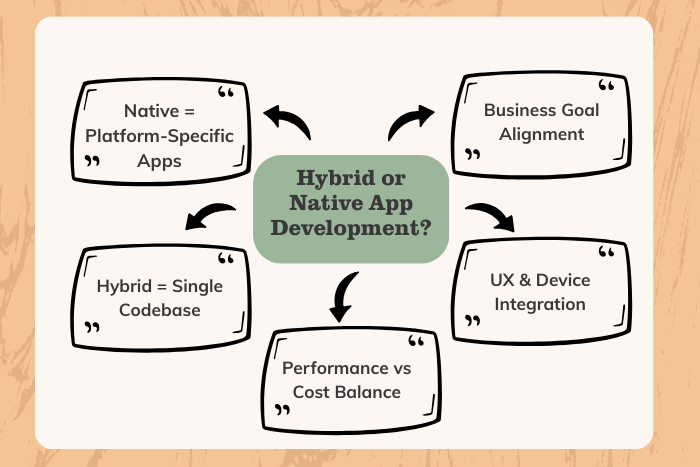
If you’re planning to build a mobile application, one of the most common and critical questions you’ll face is: should I go for hybrid or native app development? The choice between native and hybrid directly impacts your app’s performance, development cost, scalability, user experience, and long-term maintenance.
Native app development involves building applications specifically for a single platform such as iOS or Android using platform-specific languages. Hybrid app development, on the other hand, allows developers to create one codebase that works across multiple platforms.
Both approaches have advantages and trade-offs. The right decision depends on your business goals, target audience, budget, timeline, and performance expectations. Whether you’re launching a startup MVP, enterprise solution, gaming app, or eCommerce platform, understanding the difference between hybrid and native app development is essential.
In this complete guide, we break down performance comparisons, cost implications, technology stacks, scalability considerations, and real-world use cases to help you make the right choice.
Why Choosing Between Hybrid and Native App Development Is Important
The development approach you choose influences:
App speed and responsiveness
User experience and UI performance
Development cost and timeline
Long-term maintenance requirements
Scalability and future upgrades
Access to device-specific features
Security and compliance standards
Choosing the wrong approach can lead to performance bottlenecks, higher long-term costs, or limitations in feature expansion. A strategic decision ensures your app aligns with both short-term goals and long-term growth plans.
Types of App Development Solutions
When deciding whether to go hybrid or native, it’s important to understand the two primary approaches.
Native App Development
Built specifically for iOS (Swift) or Android (Kotlin)
Full access to device hardware and APIs
High performance and smooth animations
Ideal for complex, high-performance apps
Hybrid App Development
Single codebase for iOS and Android
Faster development cycle
Lower initial development cost
Suitable for startups and MVPs
Cross-Platform Framework-Based Apps
Built using Flutter or React Native
Near-native performance
Faster updates and deployment
Cost-effective scalability
Each solution serves different business objectives and technical requirements.
Key Features: Native vs Hybrid Comparison
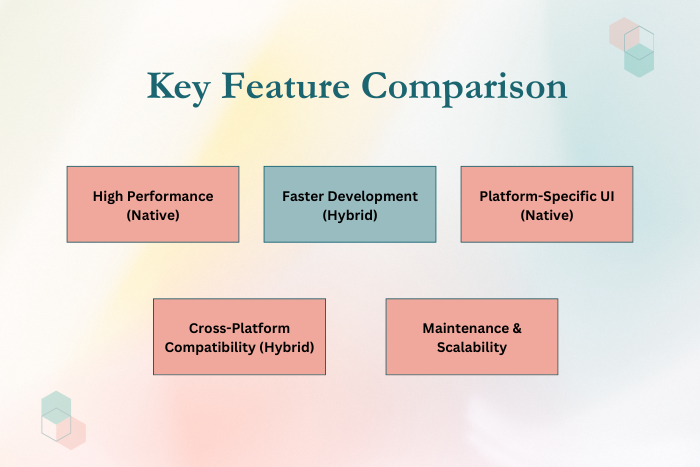
Here’s a side-by-side breakdown of key features:
- Performance:
Native apps offer superior speed and performance, while hybrid apps may have slight performance limitations for heavy graphics or complex tasks. - User Experience (UX):
Native apps provide platform-specific UI consistency. Hybrid apps offer unified design but may require additional optimization. - Development Speed:
Hybrid apps are generally faster to build due to shared codebase. - Cost Efficiency:
Hybrid development reduces initial costs. Native development may cost more but offers higher optimization. - Maintenance:
Hybrid apps simplify updates across platforms. Native apps require separate updates. - Security:
Native apps provide stronger security customization, especially for fintech or healthcare apps.
Development Process
The development lifecycle varies slightly depending on the chosen approach:
Requirement Analysis
Identify platform needs, performance expectations, and business goals.Architecture Planning
Choose between native frameworks or hybrid cross-platform tools.UI/UX Design
Native: platform-specific design guidelines.
Hybrid: unified UI adaptable across devices.Frontend & Backend Development
Native: separate codebases.
Hybrid: shared codebase with API integrations.Testing & Quality Assurance
Native: device-specific optimization testing.
Hybrid: cross-platform compatibility testing.Deployment & Maintenance
Publish to App Store and Google Play; maintain updates accordingly.
Choosing the right model at the planning stage prevents costly rework later.
Technology Stack
A modern hybrid or native development stack includes:
Native Technologies:
Swift (iOS), Kotlin (Android), Java (Android)Hybrid & Cross-Platform Frameworks:
Flutter, React Native, IonicBack-End Technologies:
Node.js, Python, Java, .NETDatabases:
MongoDB, PostgreSQL, MySQL, FirebaseCloud Services:
Amazon Web Services (AWS), Google Cloud Platform (GCP), Microsoft AzureDevOps & Deployment:
Docker, Kubernetes, CI/CD pipelinesSecurity Technologies:
OAuth 2.0, SSL/TLS encryption, Multi-Factor Authentication (MFA)
The chosen stack depends on app complexity and scalability goals.

Cost Factors
Cost is often the deciding factor in the hybrid vs native debate.
Key cost influencers include:
Number of platforms (single vs multiple)
App complexity and feature depth
UI/UX customization level
Third-party integrations
Backend infrastructure requirements
Maintenance and future scalability
Estimated comparison:
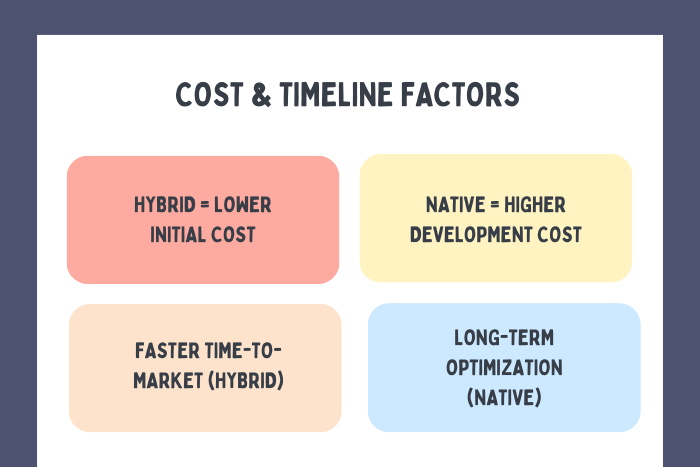
Hybrid apps: Lower upfront development cost
Native apps: Higher initial cost but optimized long-term performance
For startups, hybrid may be ideal for MVP validation. For enterprise-level apps, native may offer better long-term value.
Latest Trends in Hybrid and Native Development
Modern trends are narrowing the gap between the two approaches:
Flutter’s near-native performance
AI-powered code generation
5G optimization
Cloud-native mobile architecture
Modular app development
Progressive Web App integration
Enhanced security frameworks
Real-time data streaming
The rise of advanced cross-platform frameworks makes hybrid development more competitive than ever.
Why Choose Us for Hybrid or Native App Development?
We help you make the right decision based on business goals, budget, and scalability needs.
Strategic consultation before development
Native and cross-platform expertise
Scalable backend architecture
Agile development methodology
Transparent cost estimation
Long-term support and maintenance
We don’t push one approach, we recommend what’s best for your project.
Still unsure whether to choose hybrid or native?
Let’s analyze your project requirements together.
Contact us today for a free consultation and expert recommendation.
Key Points :
- The choice between hybrid and native app development impacts performance, cost, and scalability.
- Native apps offer superior speed, security, and platform-specific user experience.
- Hybrid apps use a single codebase, reducing development time and initial costs.
- Cross-platform frameworks like Flutter and React Native provide near-native performance.
- Hybrid development is ideal for startups and MVP launches with limited budgets.
- Native development is better suited for high-performance and enterprise-level apps.
- Maintenance is simpler in hybrid apps but more optimized in native solutions.
- The right approach depends on business goals, target audience, and long-term growth plans.
FAQ's
It depends on your budget, timeline, performance needs, and long-term scalability goals.
Hybrid development is generally more cost-effective for multi-platform apps.
Native apps provide better performance and smoother user experience.
Hybrid can work for enterprise apps, but high-performance systems may benefit from native development.
A single codebase reduces development time and maintenance effort.
Choose native if your app requires high performance, advanced graphics, or deep device integration.
Yes, modern frameworks like Flutter and React Native offer near-native performance.