




What Are the App Development Best Practices? Guide
Learn the best app development practices for building secure, scalable, and high-performance mobile and web applications.
What Are the App Development Best Practices?
Building a successful application requires more than just writing code. Developers must follow structured strategies, modern technologies, and industry standards to create applications that are reliable, scalable, and user-friendly. This is why many businesses ask: “What are the app development best practices?”
App development best practices refer to the set of guidelines and techniques that ensure applications are built efficiently, securely, and with a strong focus on user experience. These practices cover everything from project planning and architecture design to testing, deployment, and maintenance.
In today’s competitive digital environment, users expect fast, responsive, and secure applications. Poorly designed apps often suffer from performance issues, security vulnerabilities, and poor user engagement. Following proven development practices helps developers avoid these challenges and deliver high-quality applications that meet user expectations.
Best practices also help teams collaborate effectively, maintain clean code, and build applications that can evolve with new technologies. Whether you are building a startup app, enterprise platform, or mobile solution, following industry-standard development practices is essential for long-term success.
In this guide, we will explore the key app development best practices, including architecture design, development processes, technology stacks, and strategies for creating secure and scalable applications.
Why App Development Best Practices Are Important
Following established development practices ensures that applications perform reliably, remain secure, and provide excellent user experiences.
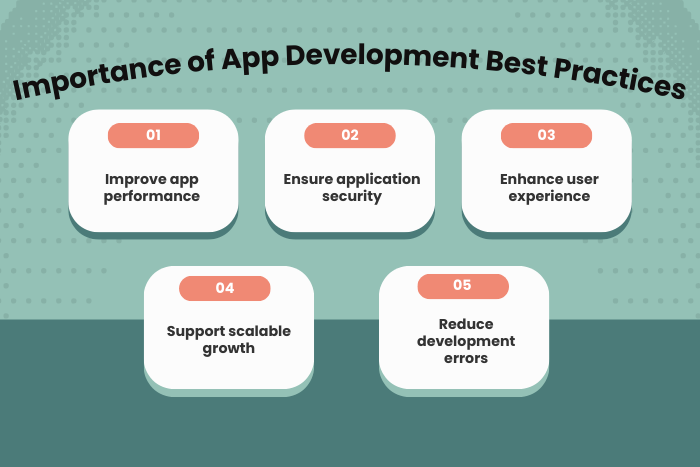
Here are several reasons why app development best practices are important:
Improved Application Performance
Best practices help developers optimize code and system architecture for faster performance.Enhanced Security
Implementing secure coding standards protects applications from vulnerabilities and cyber threats.Better User Experience
Well-designed apps provide intuitive navigation and smooth interactions.Scalability and Future Growth
Applications built with best practices can easily handle increased users and new features.Efficient Development Process
Structured development workflows improve collaboration and productivity.Reduced Maintenance Issues
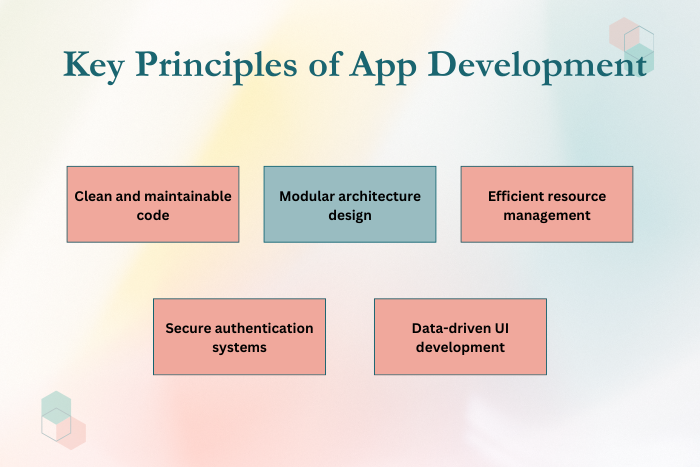
Clean and maintainable code makes it easier to update and improve applications.
By following these practices, businesses can build reliable digital products that remain competitive in the market.
Types of App Development Best Practice Solutions
Different development strategies help ensure applications are efficient and maintainable.
Architecture-Based Development
Structured application architecture helps maintain clean and scalable code.
Separation of concerns
Modular design
Layered architecture
User Experience–Focused Development
Prioritizing user experience ensures the app remains intuitive and engaging.
Simple navigation
Fast loading times
Consistent design elements
Security-First Development
Security practices protect sensitive user data and prevent vulnerabilities.
Secure authentication systems
Data encryption
Secure APIs
Performance Optimization Practices
Optimizing performance ensures the app runs smoothly even with heavy usage.
Efficient resource management
Caching mechanisms
Load balancing
Continuous Integration and Deployment
Automated development workflows ensure faster updates and reliable deployments.
Automated testing
CI/CD pipelines
Continuous monitoring
These solutions help create high-quality applications that perform well and scale efficiently.
Key Features of App Development Best Practices
Successful application development involves several essential principles and features.
Key features include:
Clean and maintainable code structure
Modular and scalable architecture design
Secure authentication and data protection
Optimized database performance
Responsive user interface and accessibility
Comprehensive testing strategies
Continuous integration and automated deployment
Monitoring and analytics for performance tracking
These features ensure that applications remain efficient, secure, and adaptable to changing requirements.
Development Process Following Best Practices
A structured development process ensures that applications are built efficiently and meet quality standards.
Project Planning and Requirement Analysis
Define project goals, user needs, and functional requirements.Architecture Design
Create scalable system architecture with clear separation of components.UI/UX Design
Develop user-friendly interfaces that enhance usability and engagement.Application Development
Implement frontend and backend functionalities using best coding practices.Testing and Quality Assurance
Perform functional, performance, and security testing.Deployment and Release
Deploy the application to production environments or app stores.Performance Monitoring
Track application performance using analytics and monitoring tools.Maintenance and Continuous Improvement
Release updates, fix bugs, and improve features based on user feedback.
Following this development workflow ensures reliable and scalable application development.
Technology Stack
Modern technologies support efficient app development and enable developers to implement best practices effectively.
Mobile Development: Flutter, React Native, Swift, Kotlin
Frontend Technologies: HTML5, CSS3, JavaScript, TypeScript
Backend Technologies: Node.js, Python, Java, .NET
Databases: PostgreSQL, MongoDB, MySQL, Firebase
Cloud Platforms: AWS, Google Cloud Platform, Microsoft Azure
DevOps Tools: Docker, Kubernetes, Jenkins, GitHub Actions
Testing Tools: Selenium, Appium, JUnit
Security Tools: OAuth authentication, SSL encryption
Using the right technology stack improves development efficiency and application reliability.


Cost Factors in Implementing Best Practices
Adopting best practices in app development may involve several cost considerations.
Important cost factors include:
Application complexity and feature requirements
Choice of development platform and technologies
Development team expertise
Security implementation and compliance requirements
Performance testing and monitoring tools
Infrastructure and hosting services
Maintenance and future updates
Although implementing best practices may require additional investment, it significantly reduces long-term technical risks.
Latest Trends in App Development Best Practices
The mobile and web development landscape continues to evolve with new technologies and methodologies.
Some emerging trends include:
AI-assisted coding and automation
Cloud-native application development
Microservices architecture adoption
Serverless computing models
Low-code and no-code development platforms
Advanced analytics for user behavior insights
Enhanced cybersecurity practices
Continuous integration and deployment pipelines
These trends are shaping the future of application development and improving development efficiency.
Why Choose Us for App Development Services?
Choosing the right development partner is critical for building applications that follow industry best practices. Our team focuses on delivering high-quality digital products using modern development methodologies.
Here’s why businesses choose our services:
Expert Development Team – Skilled developers with experience in modern frameworks and architectures.
Best Practice–Driven Development – Applications built using industry-standard coding and security guidelines.
Scalable Architecture Design – Systems designed to support long-term growth.
User-Centered Design Approach – Focus on delivering intuitive and engaging user experiences.
Comprehensive Testing and Quality Assurance – Ensuring stable and reliable applications.
Agile Development Methodology – Faster delivery with transparent collaboration.
Secure and Compliant Applications – Implementation of advanced security measures.
Long-Term Support and Maintenance – Continuous updates and improvements.
We help businesses build high-performance applications that follow proven development standards.
Looking to build a high-quality mobile or web application?
Let our experts implement the best app development practices for your project.
Contact us today for a free consultation and development plan.
Key Points :
- App development best practices help build secure, scalable, and high-performance applications.
- Proper planning and requirement analysis ensure the app meets business and user needs.
- User-focused UI/UX design enhances engagement and overall app usability.
- Regular testing and debugging ensure stable and bug-free applications.
- Security measures like encryption and secure APIs protect user data.
- Continuous integration and deployment enable faster updates and improvements.
- Performance monitoring and analytics help optimize the app after launch
FAQ's
App development best practices are guidelines and techniques that ensure applications are secure, scalable, efficient, and user-friendly.
They help improve app performance, security, maintainability, and overall user experience.
Common principles include separation of concerns, modular design, and unidirectional data flow.
Performance can be improved through caching, load balancing, efficient coding, and database optimization.
Testing helps identify bugs, security vulnerabilities, and performance issues before deployment.
Technologies such as cloud platforms, containerization tools, and CI/CD pipelines support efficient development.
Yes, our development process follows modern industry standards to deliver reliable and scalable applications.