
Explore enterprise app development costs, key factors, tech stack, hidden expenses, and budgeting strategies in this complete guide.
What Are the App Development Costs for Enterprise?
If you’re asking, “What are the app development costs for enterprise?”, you’re likely evaluating budgets for a large-scale, secure, and scalable business application. Enterprise app development is significantly different from startup or small-business applications. It involves complex workflows, advanced security requirements, system integrations, compliance standards, and long-term scalability planning.
Enterprise mobile and web applications are designed to streamline internal operations, enhance productivity, improve customer experience, and integrate seamlessly with existing business systems such as ERP, CRM, HRM, and cloud platforms. Because of this complexity, enterprise app development costs vary widely depending on features, infrastructure, technology stack, and team structure.
In this comprehensive guide, we break down enterprise app development pricing, solution types, features, development stages, technology considerations, hidden cost factors, and cost-optimization strategies — helping decision-makers plan budgets with clarity and confidence.
Why Enterprise App Development Cost Planning Is Important
Budget planning is one of the most critical aspects of enterprise software development. Underestimating costs can delay delivery, while overestimating may reduce ROI.
Understanding enterprise app development costs helps organizations:
Allocate realistic budgets
Reduce financial risks
Avoid scope creep
Plan long-term maintenance expenses
Align technology investments with business goals
Optimize development resources
Enterprise applications often require multi-department collaboration, compliance audits, cybersecurity frameworks, and scalable cloud infrastructure — all of which influence overall development cost.
Types of Solutions
Enterprise app costs depend largely on the type of solution being built:
Enterprise Mobility Apps – Internal apps for employees, managers, or field teams.
Customer-Facing Enterprise Applications – Large-scale consumer platforms with high traffic and secure transactions.
ERP & CRM Integrated Applications – Apps integrated with enterprise resource planning or customer management systems.
Supply Chain & Logistics Applications – Real-time tracking and inventory management systems.
Healthcare & FinTech Enterprise Apps – Highly regulated and compliance-heavy applications.
SaaS Enterprise Platforms – Cloud-based subscription business models.
AI & Data-Driven Enterprise Apps – Applications powered by analytics, AI, and automation.
Each category has different cost implications based on complexity, integration depth, and compliance needs.
Key Features That Impact Enterprise App Development Costs
Enterprise applications include advanced features that influence pricing:
Multi-role user authentication
Role-based access control (RBAC)
Advanced data encryption
API & third-party system integration
Real-time data synchronization
High-performance dashboards
Workflow automation
Cloud scalability
Offline data capability
Audit logs & compliance tracking
AI-powered analytics
Multi-language & global deployment
The more advanced and customized the feature set, the higher the development cost.
Enterprise App Development Process & Cost Stages
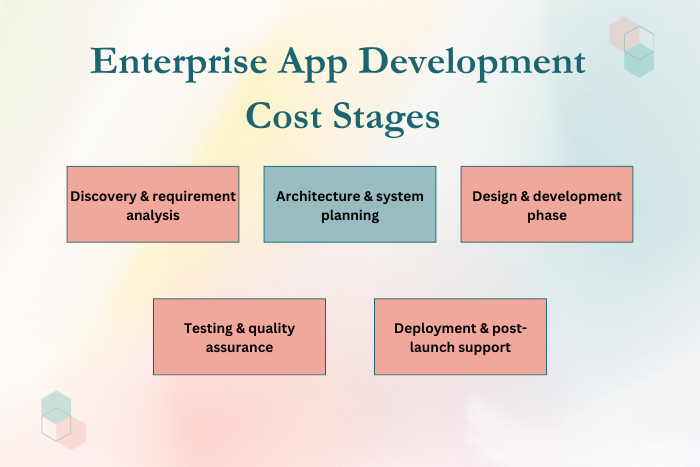
Enterprise app development costs vary across stages:
Discovery & Requirement Analysis
Business analysis, stakeholder meetings, feasibility studies.Architecture & Technical Planning
System design, scalability modeling, security planning.UI/UX Design
Enterprise-grade user interface and workflow design.Development Phase
Backend systems, APIs, mobile/web frontend development.Integration Phase
ERP, CRM, payment gateways, third-party services.Testing & Quality Assurance
Functional, security, load, and compliance testing.Deployment & Infrastructure Setup
Cloud configuration, server deployment.Post-Launch Maintenance & Scaling
Updates, performance monitoring, security patches.
Each phase contributes significantly to overall enterprise app development cost.
Technology Stack for Enterprise Application Development
The chosen technology stack directly affects development cost and scalability.
- Frontend:
React.js, Angular, Flutter, React Native - Backend:
Node.js, Java Spring Boot, .NET Core, Python - Database:
PostgreSQL, Oracle, MongoDB - Cloud Infrastructure:
AWS, Microsoft Azure, Google Cloud - DevOps & CI/CD:
Docker, Kubernetes, Jenkins - Security & Compliance:
OAuth 2.0, Multi-factor authentication, SSL/TLS encryption
Enterprise-grade technologies may require licensed software and certified professionals, increasing costs.
Key Cost Factors in Enterprise Application Development
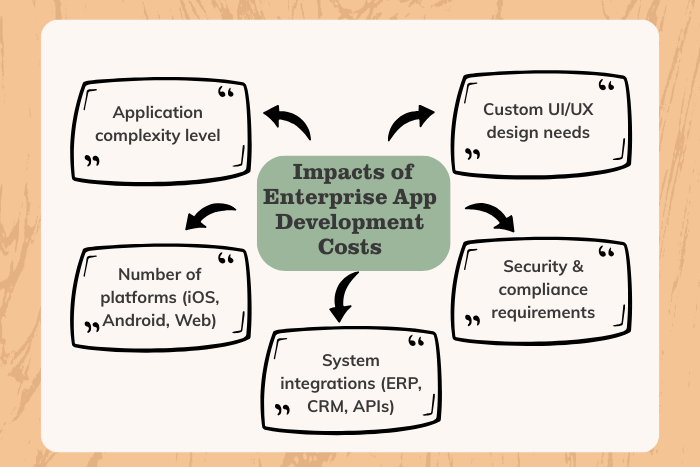
Enterprise app development cost depends on several major factors:
Application complexity
Number of supported platforms (iOS, Android, Web)
Level of system integrations
UI/UX customization
Data security & compliance requirements
AI/ML or advanced automation features
Team size and location
Project timeline
Infrastructure & cloud hosting
Ongoing maintenance
Enterprise apps typically cost more than small business apps due to advanced security, integration, and scalability requirements.
Hidden Costs in Enterprise App Development
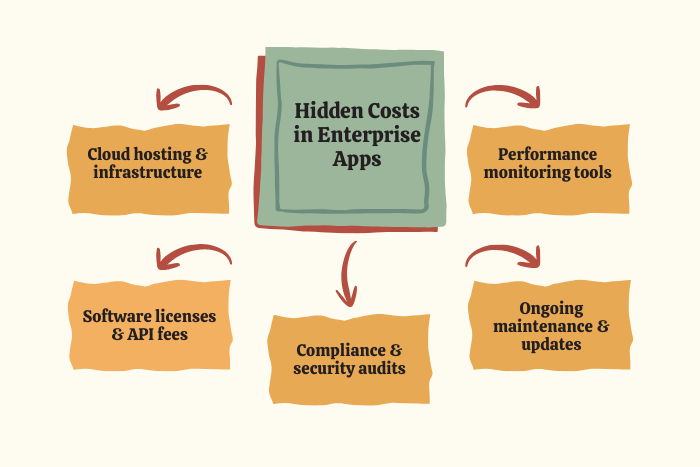
Beyond development, hidden costs may include:
Cloud hosting & server fees
Software licenses
App store fees
Compliance audits
Security testing
API subscription costs
Performance monitoring tools
Employee training
Marketing and onboarding
Planning for these hidden expenses prevents unexpected budget overruns.
Latest Trends Affecting Enterprise App Development Costs
Emerging technologies impact both cost and value:
AI & Automation Integration
Cloud-Native & Serverless Architecture
Microservices Architecture
Blockchain for Enterprise Security
DevSecOps Practices
Low-Code Enterprise Platforms
Generative AI Integration
IoT-Connected Enterprise Systems
While advanced technologies increase initial cost, they improve long-term scalability and efficiency.
Why Choose Us for Enterprise App Development?
Enterprise applications require precision, scalability, and long-term support. Our team specializes in delivering secure, high-performance enterprise solutions tailored to business objectives.
Here’s why organizations trust us:
Architecture-first enterprise planning
Compliance-ready development
Scalable cloud-native infrastructure
Transparent cost estimation process
Agile delivery methodology
Dedicated enterprise development teams
Ongoing optimization and support
We don’t just build apps — we engineer enterprise ecosystems designed for growth and efficiency.
Ready to estimate your enterprise app development cost?
Let’s build a scalable and secure enterprise solution tailored to your business.
Contact us today for a detailed cost consultation.
Key Points :
- Understand what are the app development costs for enterprise and how complexity impacts pricing.
- Explore key cost factors including integrations, security, compliance, and scalability.
- Learn how technology stack and cloud infrastructure influence enterprise app budgets.
- Identify hidden costs such as maintenance, hosting, licensing, and security audits.
- Discover how AI, automation, and microservices affect enterprise development expenses.
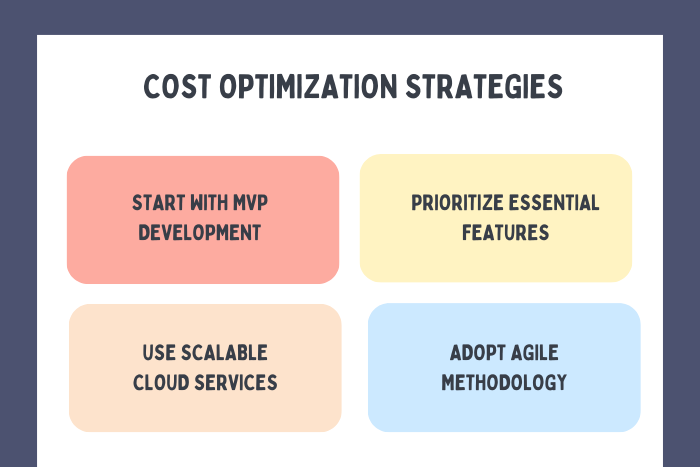
- Find cost-optimization strategies like MVP development and agile implementation.
FAQ's
Enterprise app development costs vary depending on complexity, integrations, security, and technology stack. Large-scale solutions require higher investment than basic apps.
Depending on scope, enterprise apps may take 6–12 months or longer for full-scale deployment.
Complexity, integrations, security requirements, cloud infrastructure, and development team size are major cost drivers.
Start with an MVP, use scalable cloud solutions, prioritize features, and follow agile development practices.
Yes, because they require advanced security, compliance, integrations, and scalability planning.
Maintenance typically ranges from 15–25% of the initial development cost annually.
Yes, enterprise applications often require continuous monitoring, updates, and security audits.