Discover what are the app development frameworks, types, comparisons, benefits, costs, and how to choose the right framework for your mobile app project.
What Are the App Development Frameworks?
If you’re planning to build a mobile or web application, one of the most important technical decisions you’ll face is selecting the right framework. Many businesses ask, “What are the app development frameworks, and which one should I choose for my project?”
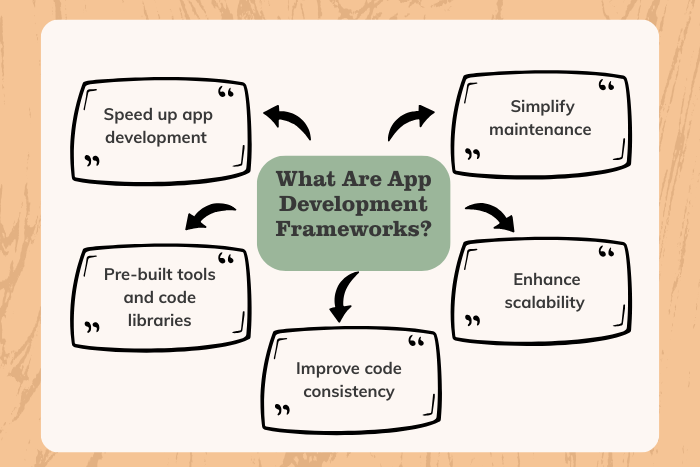
App development frameworks are structured software platforms that provide pre-written code libraries, reusable components, tools, APIs, and architectural patterns to simplify and accelerate application development. Instead of building applications from scratch, developers rely on frameworks to improve efficiency, maintain consistency, enhance security, and ensure scalability.
The choice of framework directly impacts performance, user experience, development speed, long-term maintenance costs, and scalability. Whether you are developing a startup MVP, enterprise application, fintech platform, healthcare system, SaaS solution, or eCommerce mobile app, framework selection plays a critical role in success.
Understanding what are the app development frameworks allows you to align your technical architecture with your business objectives, budget, and growth strategy.
Why Understanding App Development Frameworks Is Important
Selecting the right framework is not just a technical choice — it is a strategic business decision.
Choosing an unsuitable framework can result in:
Increased development costs
Performance bottlenecks
Security vulnerabilities
Limited scalability
Difficult maintenance and upgrades
Poor user experience
On the other hand, selecting the appropriate app development framework helps businesses:
Reduce time-to-market
Improve development productivity
Ensure smoother updates and maintenance
Enhance application performance
Scale infrastructure efficiently
Lower long-term operational expenses
Frameworks determine how easily your app can integrate APIs, manage real-time data, handle high traffic, and support future feature expansion. A well-chosen framework ensures your app remains future-ready and adaptable in a rapidly evolving digital landscape.
Types of App Development Frameworks
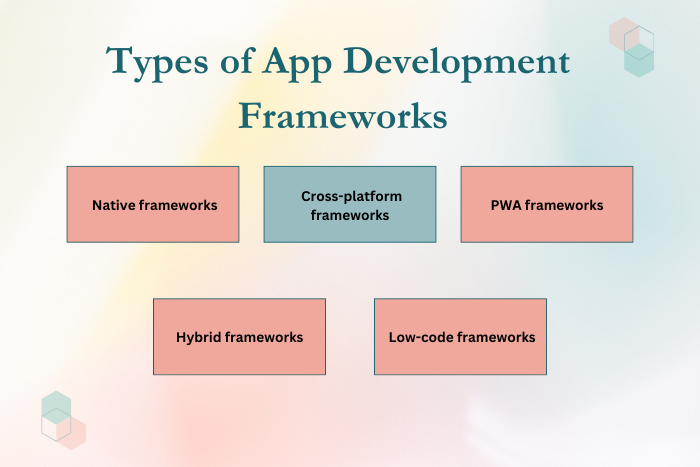
When exploring what are the app development frameworks, it is essential to understand the different categories available.
Native App Development Frameworks
Native frameworks are platform-specific. They allow developers to build applications optimized exclusively for one operating system, such as iOS or Android. Native frameworks offer superior performance, smooth animations, and deep hardware integration.Cross-Platform App Development Frameworks
Cross-platform frameworks allow developers to write a single codebase and deploy it across multiple platforms like iOS and Android. They significantly reduce development time and cost while maintaining near-native performance.Hybrid App Development Frameworks
Hybrid frameworks combine web technologies like HTML, CSS, and JavaScript with native containers. These frameworks are ideal for rapid development but may have performance limitations compared to native apps.Progressive Web App (PWA) Frameworks
PWA frameworks enable developers to build web applications that behave like mobile apps. They support offline functionality, push notifications, and home-screen installation.Low-Code / No-Code Frameworks
These frameworks provide visual development environments to accelerate app creation with minimal coding. They are suitable for prototyping and simple business applications.
Each framework category offers advantages depending on performance expectations, customization needs, and budget constraints.
Key Features of Modern App Development Frameworks
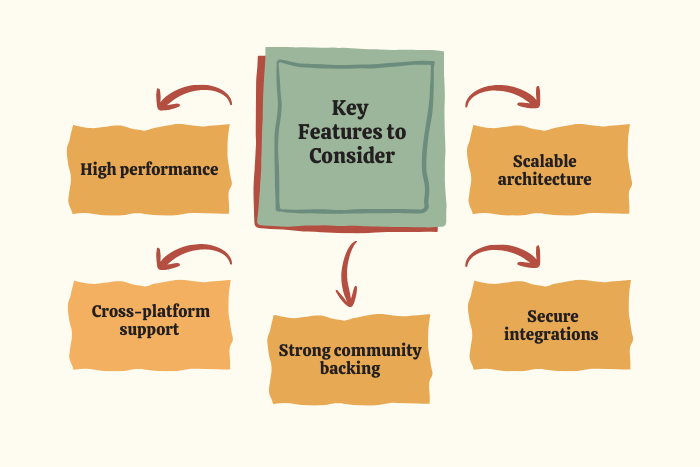
When evaluating what are the application development frameworks, look for these key features:
Reusable components and modular architecture
Cross-platform compatibility
Strong community and ecosystem support
High-performance rendering engines
Secure API integrations
Scalable architecture
Built-in testing tools
Seamless cloud integration
Modern frameworks also support AI integrations, IoT connectivity, and real-time data synchronization.
Development Process
Project Requirement Analysis
Identify target platforms, user base, performance expectations, and scalability goals.Framework Selection Strategy
Evaluate native vs cross-platform frameworks based on business objectives.Architecture Planning
Design scalable backend integration and modular app structure.UI/UX Implementation
Use framework components for responsive and interactive design.Backend & API Integration
Connect databases, cloud services, and third-party systems.Testing & Optimization
Perform functional, performance, and security testing.Deployment & Launch
Publish on app stores or web platforms.Maintenance & Updates
Regular upgrades to ensure compatibility and feature enhancement.
Technology Stack
Here are some widely used frameworks in modern mobile app development:
- Native Frameworks:
SwiftUI (iOS), Jetpack Compose (Android) - Cross-Platform Frameworks:
Flutter, React Native, .NET MAUI, Kotlin Multiplatform - Hybrid Frameworks:
Ionic, Cordova - Backend Frameworks:
Node.js, Django, Spring Boot, .NET Core - Database Solutions:
PostgreSQL, MongoDB, Firebase - Cloud Platforms:
AWS, Azure, Google Cloud
Each framework offers distinct advantages depending on project complexity and performance requirements.
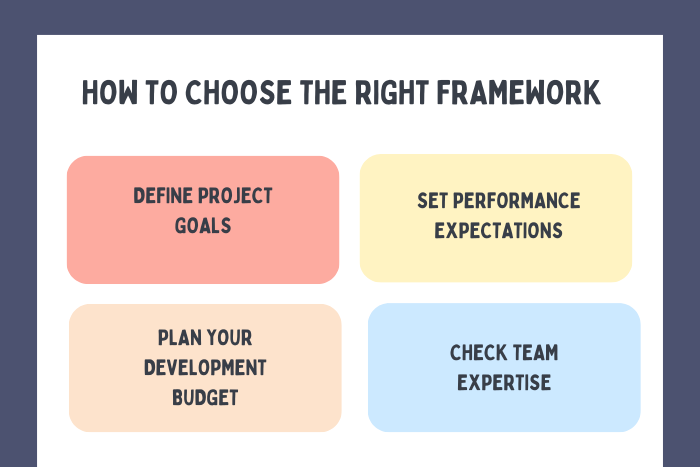
Cost Factors When Choosing App Development Frameworks
Framework selection significantly influences development and maintenance costs.
Primary cost factors include:
Platform type (native vs cross-platform)
App complexity
Performance requirements
Security standards
Integration with third-party services
Developer expertise availability
Long-term maintenance strategy
Development Budget Considerations
Native development typically costs more due to separate codebases for iOS and Android.
Cross-platform frameworks reduce development costs by sharing code.
Hybrid frameworks offer faster deployment but may require performance optimization later.
Low-code frameworks reduce initial cost but may increase customization expenses in complex apps.
A strategic framework decision balances upfront development cost with long-term scalability.
Latest Trends in App Development Frameworks (2025)
The app development landscape continues to evolve rapidly.
Emerging trends include:
AI-integrated development workflows
Unified cross-platform frameworks
Increased demand for performance optimization
Cloud-first application architecture
Growth of low-code enterprise solutions
Enhanced security frameworks
Microservices-based app architecture
Integration with wearables and IoT ecosystems
Modern frameworks now prioritize speed, developer productivity, automation, and seamless deployment pipelines.
Businesses increasingly prefer frameworks that allow rapid iteration without compromising performance.
Why Choose Us for App Development Framework Consulting
Selecting the right app development framework requires deep technical expertise and strategic planning.
We help businesses:
Analyze project requirements thoroughly
Compare framework capabilities
Optimize performance and scalability
Reduce long-term maintenance costs
Implement secure and scalable architectures
Migrate from outdated frameworks
Modernize legacy applications
Align framework strategy with business growth goals
Our team combines technical expertise with business strategy to ensure you choose the right framework for your digital product.
Ready to select the best app development framework for your project?
Contact us today for expert framework consultation and technical evaluation.
Let’s build a scalable, high-performance application that drives measurable results.
Key Points :
- App development frameworks provide reusable components, tools, and libraries to streamline mobile and web app development.
- The main types of app development frameworks include native, cross-platform, hybrid, PWA, and low-code frameworks.
- Choosing the right app development framework directly impacts performance, scalability, and long-term maintenance costs.
- Cross-platform frameworks reduce development time and cost by using a single codebase for multiple platforms.
- Cross-platform frameworks reduce development time and cost by using a single codebase for multiple platforms.
- Key features to evaluate in app development frameworks include scalability, security, community support, and cloud integration.
- Framework selection affects development budget, speed to market, and future upgrade flexibility.
FAQ's
App development frameworks are structured software platforms that provide tools, libraries, and reusable components to simplify application development.
Cross-platform frameworks are often ideal for startups due to cost efficiency and faster deployment.
Yes, framework architecture directly impacts speed, responsiveness, and scalability.
Native frameworks provide optimal performance, while cross-platform frameworks offer cost and time efficiency.
Consider target audience, scalability requirements, budget, and long-term maintenance strategy.
Yes, modern frameworks support advanced integrations including AI and IoT.
Hybrid apps run inside native containers, while PWAs run in browsers with app-like functionality.
Yes, we assist in framework upgrades, modernization, and technology migration.