

Discover what are the app development platforms available including native, cross-platform, hybrid, no-code, and cloud-based solutions.
What Are the App Development Platforms Available?
If you’re planning to build a mobile or web application, one of the first questions you’ll ask is: what are the app development platforms available? Choosing the right platform directly impacts performance, scalability, development time, cost, and long-term maintenance.
Today, businesses can choose from a wide range of app development platforms — including native platforms like Android and iOS, cross-platform frameworks such as Flutter and React Native, hybrid technologies, progressive web apps (PWAs), and even no-code or low-code builders.
Each platform comes with its own strengths, limitations, and ideal use cases. A startup validating an MVP may choose a cross-platform framework, while an enterprise building a performance-intensive application may opt for native development.
Understanding the available app development platforms helps businesses make strategic technical decisions that align with budget, timeline, and scalability goals.
This guide provides a comprehensive overview of the major app development platforms available today and how to choose the right one.
Why Choosing the Right App Development Platform Is Important
Selecting the appropriate platform ensures:
Optimal app performance
Better user experience
Faster time-to-market
Cost-efficient development
Long-term scalability
Easier maintenance and updates
Secure data handling
The wrong platform can lead to performance bottlenecks, high development costs, and limited scalability.
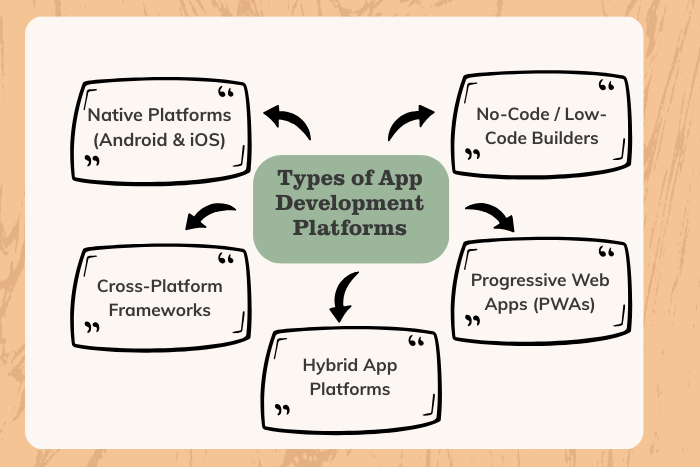
Types of App Development Platforms Available
There are several primary categories of app development platforms:
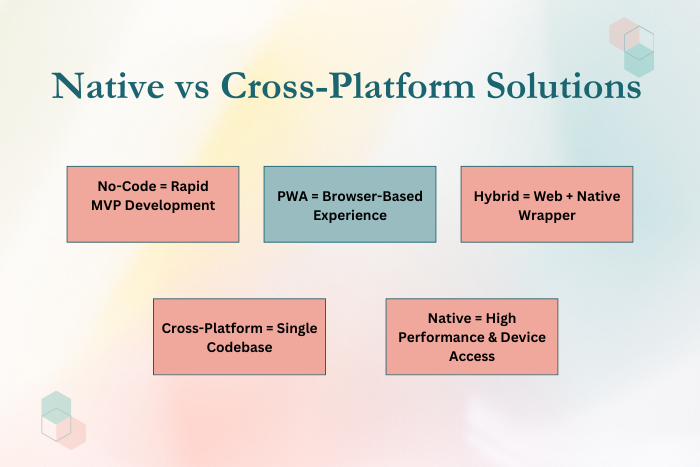
Native App Development Platforms
Android (Kotlin/Java)
iOS (Swift/Objective-C)
High performance
Direct hardware access
Cross-Platform Development Platforms
Flutter
React Native
Xamarin
Single codebase for multiple platforms
Hybrid App Development Platforms
Ionic
Cordova
Web technologies wrapped in native containers
Progressive Web App (PWA) Platforms
Web-based apps
Offline functionality
Browser-first experience
No-Code / Low-Code Platforms
Drag-and-drop builders
Rapid development
Limited customization
Each category serves different business objectives and technical requirements.
Key Features of Modern App Development Platforms
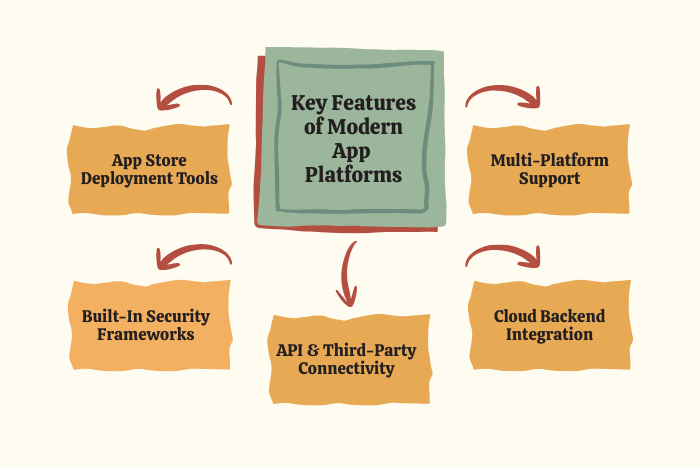
Most modern platforms offer:
Multi-platform support
API integration capabilities
Cloud backend compatibility
Built-in security frameworks
Analytics and monitoring tools
App store deployment support
Real-time database synchronization
Modular architecture
These features enable scalable and secure app development.
Development Process Using App Development Frameworks
Regardless of platform, the app development lifecycle generally includes:
Requirement Analysis & Planning
Define business goals and technical specifications.Platform Selection
Choose native, cross-platform, hybrid, or no-code approach.UI/UX Design
Create wireframes and prototypes.Frontend & Backend Development
Build user interface and server-side logic.Integration & API Setup
Connect payment systems, analytics, and third-party tools.Testing & Quality Assurance
Ensure functionality, performance, and security.Deployment & App Store Submission
Publish on Google Play and Apple App Store.Maintenance & Scaling
Monitor performance and implement updates.
Technology Stack
A modern application development tech stack across platforms includes:
Front-End Technologies:
Kotlin (Android), Swift (iOS), Flutter, React Native, JavaScript, HTML5, CSS3Hybrid Technologies:
Ionic, CordovaBack-End Technologies:
Node.js, Python (Django/Flask), Java (Spring Boot), .NETDatabases:
MongoDB, PostgreSQL, MySQL, Firebase, SQLiteCloud Platforms:
AWS, Google Cloud Platform, Microsoft AzureDevOps & CI/CD Tools:
Docker, Jenkins, GitHub ActionsSecurity Technologies:
OAuth 2.0, SSL Encryption, Role-Based Access Control
Selecting the right combination depends on your chosen platform.
Cost Factors
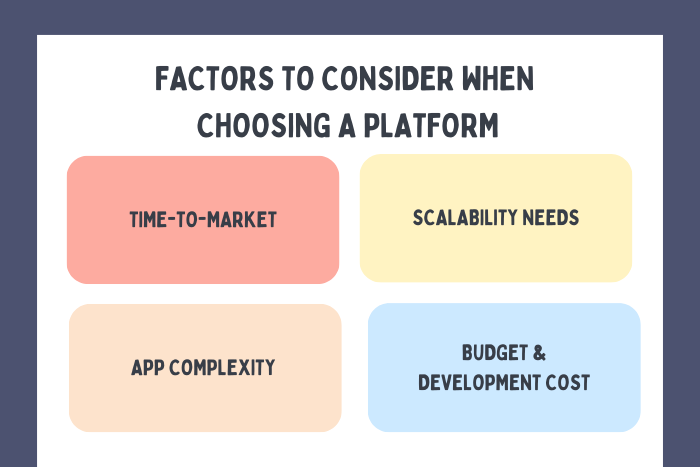
Costs vary based on:
Platform type (native vs cross-platform)
App complexity
Custom UI/UX design
Third-party integrations
Development team expertise
Ongoing maintenance
Estimated ranges:
No-code apps: $20–$200/month subscription
Cross-platform apps: $20,000–$70,000
Native apps: $30,000–$100,000+
Native development typically costs more but offers better performance.
Latest Trends in App Development
App development platforms are evolving with:
AI-powered development tools
Low-code enterprise solutions
Cloud-native architecture
Serverless backend integration
Microservices-based apps
5G-ready applications
Cross-platform performance optimization
DevSecOps integration
Businesses increasingly prefer flexible platforms that support rapid iteration and scalability.
Why Choose Us for Platform Selection & App Development?
Choosing from the available app development platforms can be complex. We help you:
Evaluate business goals and technical needs
Compare native vs cross-platform options
Select scalable and future-ready platforms
Optimize development cost
Ensure secure architecture
Deliver high-performance applications
We provide end-to-end app development solutions tailored to your platform strategy.
Not sure which app development platform is right for you?
Let’s analyze your project and choose the best technology stack.
Contact us today for a free consultation.
Key Points :
- App development platforms include native, cross-platform, hybrid, PWA, and no-code solutions.
- Native platforms like Android and iOS offer high performance and full device access.
- Cross-platform frameworks such as Flutter and React Native use a single codebase.
- Hybrid app platforms combine web technologies with native containers.
- Progressive Web Apps (PWAs) run in browsers with offline functionality.
- Platform selection impacts development cost, scalability, and time-to-market.
- Cloud integration and API support are essential features of modern app platforms.
FAQ's
Native, cross-platform, hybrid, PWA, and no-code platforms.
Native Android using Kotlin offers best performance.
Flutter and React Native are widely used.
Native offers better performance, but cross-platform reduces cost.
Consider budget, scalability, timeline, and feature requirements.
Cross-platform or no-code solutions are generally more affordable.