Explore app development services for e-learning including LMS, virtual classrooms, gamification, tech stack, costs, and trends.
What Are the App Development Services for E-Learning?
If you’re wondering, “What are the app development services for e-learning?”, you’re likely exploring how to build a scalable, interactive, and future-ready education platform. The e-learning industry has transformed how students, professionals, and organizations access knowledge. From virtual classrooms and corporate training apps to AI-powered learning platforms, digital education solutions are reshaping traditional learning models.
E-learning app development services cover the complete lifecycle of building educational mobile and web applications — from strategy and UI/UX design to LMS development, video streaming integration, gamification, analytics, and post-launch maintenance. Whether you’re a startup launching an EdTech platform, a university digitizing courses, or an enterprise implementing employee training software, professional education app development ensures secure, scalable, and engaging learning experiences.
In this guide, we’ll break down the core e-learning app development services, solution types, features, development process, technology stack, cost factors, latest trends, and how to choose the right development partner.
Why E-Learning App Development Services Are Important
The demand for digital education platforms continues to grow across schools, universities, enterprises, and online coaching businesses. Investing in professional e-learning app development services delivers measurable benefits:
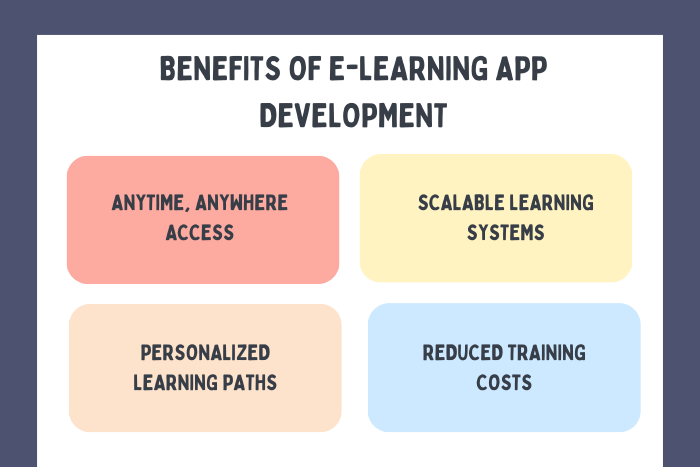
Global Accessibility – Learners can access content anytime, anywhere.
Scalable Learning Infrastructure – Cloud-based systems handle thousands of users.
Interactive Learning Experience – Video, quizzes, and gamification increase engagement.
Personalized Education Paths – AI-driven recommendations enhance outcomes.
Cost-Effective Training – Reduces infrastructure and classroom expenses.
Performance Tracking & Analytics – Monitor student progress in real time.
A robust educational app ensures improved knowledge delivery, better retention rates, and streamlined administration.
Types of E-Learning Application Development Solutions
When discussing what are the app development services for e-learning, it’s important to understand the different solution categories:
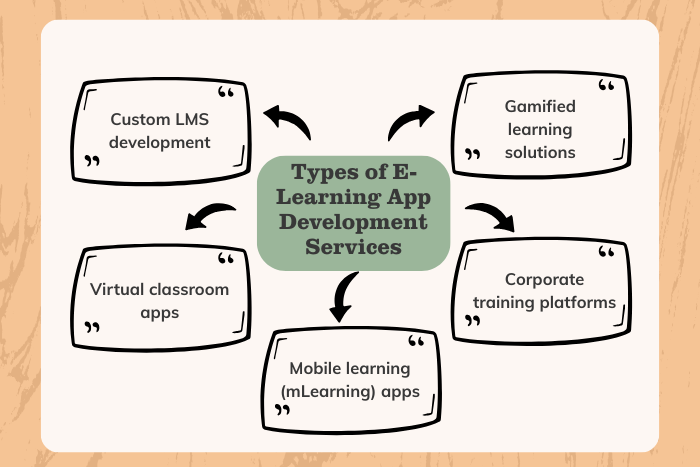
Custom LMS (Learning Management System) Development – Build centralized platforms for course creation, management, and tracking.
Virtual Classroom App Development – Live video conferencing, screen sharing, chat, and real-time interaction features.
Mobile Learning Applications (mLearning Apps) – Smartphone-optimized apps for on-the-go learning.
Corporate Training & Employee Learning Apps – Internal training, onboarding, and compliance management systems.
On-Demand Course Marketplace Platforms – Multi-instructor platforms similar to course marketplaces.
Student Information Systems (SIS) – Academic management solutions with attendance, grading, and reporting.
Gamified Learning Applications – Interactive quizzes, leaderboards, badges, and rewards.
AR/VR-Based Learning Apps – Immersive educational experiences using augmented or virtual reality.
Selecting the right e-learning solution depends on your target audience, monetization model, and scalability goals.
Key Features of E-Learning Application Development
High-performing education applications include:
User registration & profile management
Course catalog & search functionality
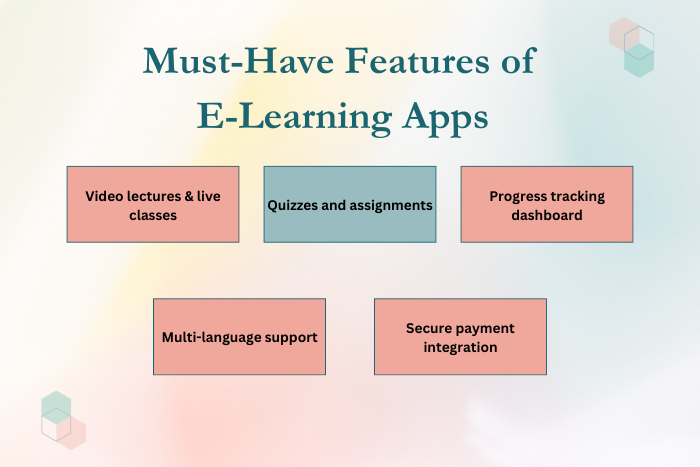
Video streaming & recorded lectures
Live classes & webinar integration
Assignments & quizzes module
Progress tracking dashboard
Push notifications & reminders
Gamification (badges, leaderboards)
Payment gateway integration
Multi-language support
Offline learning mode
Secure authentication & data protection
Analytics & reporting tools
AI-based content recommendations
These features ensure a seamless and engaging learning journey for both educators and students.
E-Learning App Development Process
Following a structured development process ensures quality and scalability:
Requirement Analysis & Consultation
Define target audience, learning goals, and monetization strategy.Platform Strategy & Feature Planning
Decide between web, mobile, or cross-platform development.UI/UX Design & Prototyping
Create intuitive learning dashboards and interactive user flows.Architecture & Backend Development
Build scalable cloud infrastructure and content management systems.Frontend & Mobile App Development
Develop responsive interfaces optimized for performance.Video & API Integration
Integrate streaming services, payment gateways, and analytics tools.Testing & Quality Assurance
Conduct performance, security, and usability testing.Deployment & Launch
Publish apps and configure cloud hosting environments.Maintenance & Continuous Improvement
Provide updates, security patches, and performance optimization.
An agile development approach ensures flexibility and faster time-to-market.
Technology Stack
Choosing the right technology stack is crucial for scalability and performance.
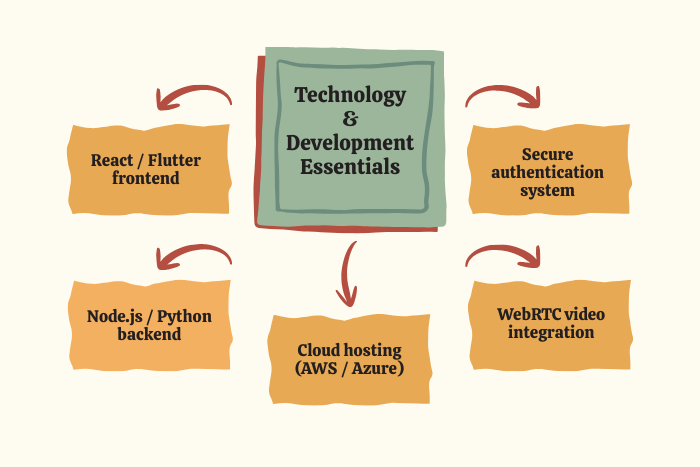
- Frontend:
React.js, Angular, Flutter, React Native - Backend:
Node.js, Python (Django/FastAPI), .NET Core - Database:
PostgreSQL, MySQL, MongoDB - Cloud & Hosting:
AWS, Microsoft Azure, Google Cloud - Video Streaming:
WebRTC, Vimeo API, AWS Media Services - DevOps & CI/CD:
Docker, Kubernetes, Jenkins - Security:
OAuth 2.0, SSL encryption, GDPR compliance
Modern cloud-native architecture ensures high availability and seamless user experience.
Cost Factors in E-Learning App Development
The cost of e-learning app development services varies based on:
App complexity and feature set
Number of user roles (students, instructors, admin)
Video streaming and cloud storage requirements
AI personalization capabilities
AR/VR integration
Payment gateway integration
Cross-platform compatibility
Ongoing maintenance and scaling
A basic MVP educational app may require a moderate investment, while enterprise-level LMS platforms with advanced analytics and AI features require a larger budget.
Latest Trends
The EdTech sector continues evolving with innovative technologies:
AI-Powered Adaptive Learning
Gamification & Microlearning Modules
AR/VR-Based Immersive Education
Blockchain for Digital Certifications
Voice-Enabled Learning Assistants
Learning Analytics & Predictive Insights
Offline-First Learning Applications
Hybrid Classroom Models
Incorporating emerging technologies enhances engagement and competitive advantage.
Why Choose Us for E-Learning App Development Services?
Developing a scalable and interactive education app requires deep technical expertise and industry understanding. We deliver end-to-end e-learning app development services tailored to startups, institutions, and enterprises.
Here’s why clients trust us:
Custom LMS & EdTech Expertise
Scalable Cloud Architecture
AI & Gamification Integration
Secure & Compliance-Ready Development
User-Centric UI/UX Design
Agile & Transparent Development Process
Post-Launch Support & Optimization
We don’t just build educational apps, we create powerful digital learning ecosystems designed for growth and engagement.
Ready to launch your custom e-learning platform?
Let’s transform your education idea into a scalable digital solution.
Contact us today for a free consultation and project estimate.
Key Points :
- Understand what are the app development services for e-learning, including LMS, virtual classrooms, and mLearning apps.
- Explore key features like video streaming, gamification, progress tracking, and AI-powered personalization.
- Learn the complete e-learning app development process from planning to deployment.
- Discover the best technology stack for scalable and secure EdTech platforms.
- Identify cost factors that impact custom education app development.
- Stay updated with latest e-learning trends such as AR/VR learning, blockchain certification, and adaptive AI learning.
FAQ's
The app development services for e-learning are include LMS development, virtual classroom apps, Learning apps, corporate training platforms, gamified learning apps, and educational management systems.
A basic MVP may take 3–4 months, while a fully featured LMS platform can take 6–9 months depending on complexity.
Popular technologies include React, Flutter, Node.js, Python, AWS, and WebRTC for video streaming.
Costs vary depending on features, integrations, scalability requirements, and platform selection.
Yes, we develop multilingual educational apps to support global audiences.
Yes, we offer ongoing support, updates, performance monitoring, and security enhancements.
Absolutely. AI can power personalized learning paths, chatbots, and predictive analytics.
Yes, we integrate secure video streaming and virtual classroom functionalities for real-time and on-demand learning.