


Discover app development services for the healthcare industry including telemedicine, EHR, HIPAA-compliant apps, costs, features, and trends.
What Are the App Development Services for Healthcare Industry?
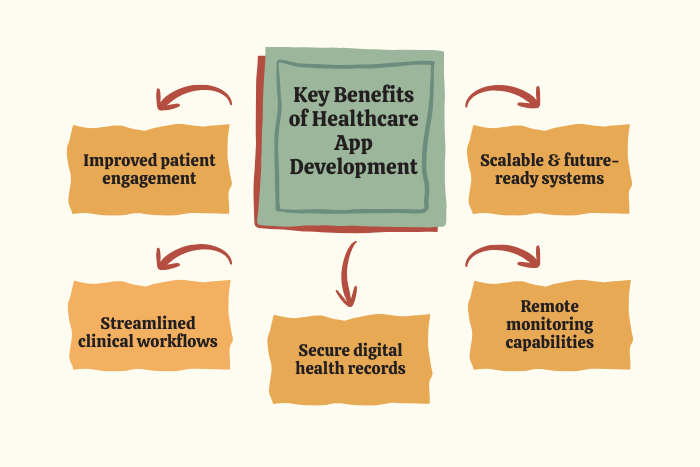
If you’re wondering, “What are the app development services for healthcare industry?”, you’re exploring one of the fastest-growing segments in digital transformation. The healthcare sector is rapidly adopting mobile and web-based applications to improve patient engagement, streamline clinical workflows, ensure regulatory compliance, and enable remote care delivery.
Healthcare app development services cover a broad spectrum — from telemedicine platforms and EHR/EMR systems to patient portals, wearable integrations, and AI-powered diagnostic tools. These applications must not only deliver seamless user experiences but also meet strict compliance standards such as HIPAA, HL7, and GDPR while maintaining high levels of security and data privacy.
Whether you are a hospital, clinic, health-tech startup, pharmaceutical company, or insurance provider, investing in custom healthcare application development can significantly improve operational efficiency and patient outcomes. In this comprehensive guide, we break down healthcare app development services, features, technologies, costs, and emerging trends to help you make informed decisions.
Why Healthcare App Development Services Are Important
Digital health solutions are no longer optional — they are essential. Healthcare providers must deliver faster, safer, and more accessible services in an increasingly connected world.
Here’s why healthcare app development services are critical:
Improve patient engagement through digital portals and mobile apps
Enable telemedicine and remote patient monitoring
Streamline clinical workflows and reduce administrative errors
Enhance interoperability between medical systems
Ensure compliance with healthcare regulations
Provide real-time data access for better decision-making
Mobile healthcare applications bridge the gap between patients and providers, enabling efficient communication, accurate record-keeping, and better treatment outcomes.
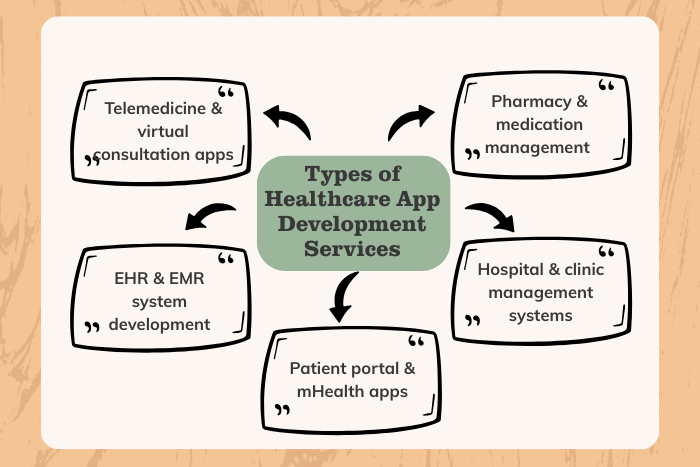
Types of Healthcare App Development Solutions
Healthcare application development services cover a wide range of solutions tailored to different stakeholders in the medical ecosystem.
Telemedicine & Telehealth App Development
Virtual consultation platforms with video calls, appointment scheduling, and e-prescriptions.EHR & EMR System Development
Digital health record systems for secure storage and retrieval of patient data.Patient Portal & mHealth Apps
Apps that allow patients to book appointments, access reports, track medications, and communicate with doctors.Remote Patient Monitoring (RPM) Apps
Applications integrated with wearable devices for tracking vitals and chronic conditions.Clinic & Hospital Management Systems
Administrative platforms for scheduling, billing, inventory management, and workflow automation.Pharmacy & Medication Management Apps
Online prescription management, reminders, and pharmacy ordering solutions.Healthcare AI & Chatbot Solutions
AI-powered triage systems, symptom checkers, and automated support assistants.
Each type of healthcare application requires custom workflows, secure architecture, and compliance-driven development practices.
Key Features of Healthcare Applications
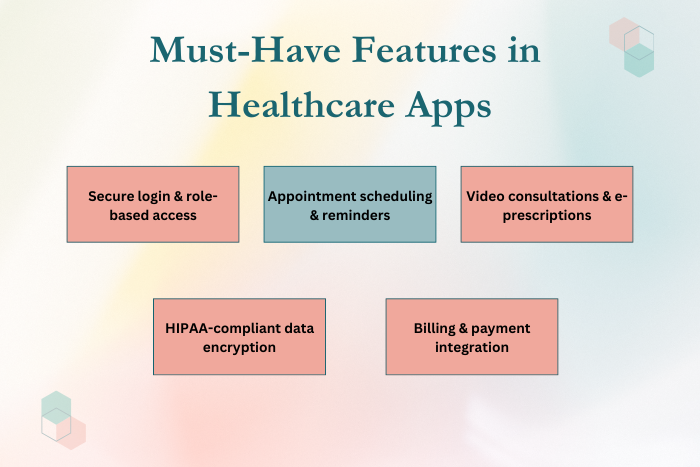
Healthcare apps must prioritize usability, security, and regulatory compliance. Core features typically include:
Secure user authentication and role-based access
HIPAA-compliant data storage and encryption
Appointment scheduling and calendar integration
Video conferencing for telehealth consultations
Electronic prescriptions and digital signatures
Real-time notifications and reminders
Payment gateway integration for billing
Integration with laboratory systems and insurance providers
Multi-language and accessibility support
Security and data privacy are fundamental components of any medical app development project.
Healthcare App Development Process
A structured development process ensures compliance, security, and high performance.
Requirement Analysis & Compliance Planning
Identify stakeholders, define features, and determine regulatory requirements.UI/UX Design for Healthcare Users
Create intuitive interfaces for patients, doctors, and administrators.Architecture & Database Design
Design secure, scalable systems capable of handling sensitive medical data.Frontend & Backend Development
Build mobile apps and backend APIs with compliance-ready coding standards.Integration with Healthcare Systems
Connect with EHR systems, HL7 standards, wearable devices, and insurance APIs.Testing & Quality Assurance
Conduct functional, usability, performance, and security testing.Deployment & Cloud Configuration
Launch on secure cloud environments with encrypted infrastructure.Maintenance & Continuous Updates
Ensure regulatory updates, performance optimization, and feature enhancements.
Technology Stack for Healthcare App Development
Choosing the right technology stack is critical for performance and compliance.
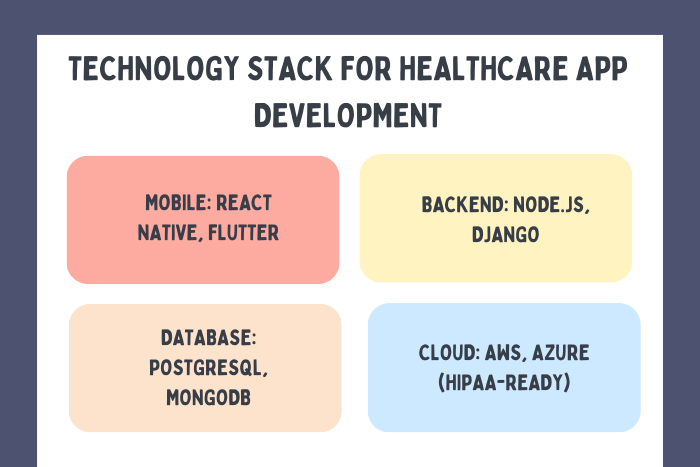
Mobile Development: React Native, Flutter, Swift, Kotlin
Backend Development: Node.js, Django, .NET Core
Database: PostgreSQL, MongoDB, MySQL
Cloud Infrastructure: AWS, Microsoft Azure, Google Cloud (HIPAA-ready environments)
Interoperability Standards: HL7, FHIR APIs
Security Protocols: OAuth 2.0, JWT, SSL encryption, multi-factor authentication
DevOps & Deployment: Docker, Kubernetes, CI/CD pipelines
Healthcare systems require scalable and secure architecture capable of handling large volumes of sensitive patient data.
Cost Factors in Healthcare Application Development
The cost of healthcare app development depends on multiple factors:
App complexity and number of modules
Compliance requirements (HIPAA, GDPR, HL7)
Integration with third-party systems
Custom UI/UX design requirements
AI or wearable device integration
Platform choice (iOS, Android, Web)
Cloud hosting and infrastructure setup
Maintenance and long-term support
A basic telemedicine MVP may require moderate investment, while a full-scale hospital management platform with interoperability integrations can require significantly higher budgets.
Latest Trends in Healthcare App Development
Healthcare technology continues evolving rapidly. Key trends include:
AI-powered diagnostics and predictive analytics
Remote patient monitoring using IoT devices
Blockchain for secure medical record management
Voice-enabled healthcare assistants
AR/VR for medical training and remote surgeries
Cloud-based interoperability solutions
Personalized medicine using data analytics
Wearable health integration for real-time tracking
Healthcare organizations adopting these innovations gain competitive advantages while improving patient outcomes.
Why Choose Us for Healthcare App Development Services?
Developing healthcare applications requires deep technical expertise, strict compliance understanding, and domain knowledge.
Here’s why healthcare providers partner with us:
Compliance-Focused Development – HIPAA, GDPR, and healthcare data standards integration.
Scalable & Secure Architecture – Designed for high performance and encrypted data protection.
Custom Healthcare Solutions – Tailored apps for hospitals, clinics, startups, and enterprises.
AI & Advanced Technology Integration – Smart healthcare solutions with automation and analytics.
Transparent Agile Process – Milestone-based delivery with full visibility.
End-to-End Support – From idea validation to long-term maintenance.
We build secure, scalable, and patient-centric healthcare applications that drive digital transformation.
Ready to modernize your healthcare services?
Let’s build a secure and compliant healthcare app tailored to your needs.
Contact us today for a free consultation and project estimate.
Key Points :
- Healthcare app development services include telemedicine, EHR/EMR systems, patient portals, and hospital management solutions.
- Custom healthcare apps improve patient engagement, operational efficiency, and remote care delivery.
- HIPAA-compliant architecture and secure data encryption are critical for medical applications.
- Core features include appointment scheduling, video consultations, e-prescriptions, and secure payments.
- Technology stack includes Node.js, React Native, Flutter, AWS, and FHIR APIs.
- Development involves compliance planning, UI/UX design, system integration, testing, and cloud deployment.
- Cost depends on app complexity, regulatory requirements, integrations, and platform choice.
FAQ's
Healthcare app development services include telemedicine apps, EHR/EMR systems, patient portals, hospital management systems, pharmacy apps, and AI-based healthcare solutions.
A simple healthcare MVP may take 3–5 months, while enterprise-grade systems can require 6–12 months depending on complexity.
Yes, healthcare apps handling patient data must comply with HIPAA (in the US) and other relevant regulations.
Costs vary based on features, integrations, compliance requirements, and platform selection.
Technologies include React Native, Flutter, Node.js, Django, AWS, HL7, and FHIR APIs.
Yes, modern healthcare apps can integrate with wearable devices for remote patient monitoring and real-time data tracking.
Yes, we offer ongoing maintenance, security updates, compliance upgrades, and performance optimization.
Absolutely. AI can support diagnostics, predictive analytics, chatbots, and workflow automation in healthcare applications.