



Discover app security best practices including encryption, secure APIs, authentication, and DevSecOps to protect your mobile and web applications.
What Are the App Security Best Practices?
If you’re asking, “What are the app security best practices?”, you’re prioritizing one of the most critical aspects of modern software development. With cyber threats increasing every year, applications are prime targets for data breaches, malware injection, API exploitation, and credential theft. A single vulnerability can compromise user data, damage brand reputation, and lead to costly legal consequences.
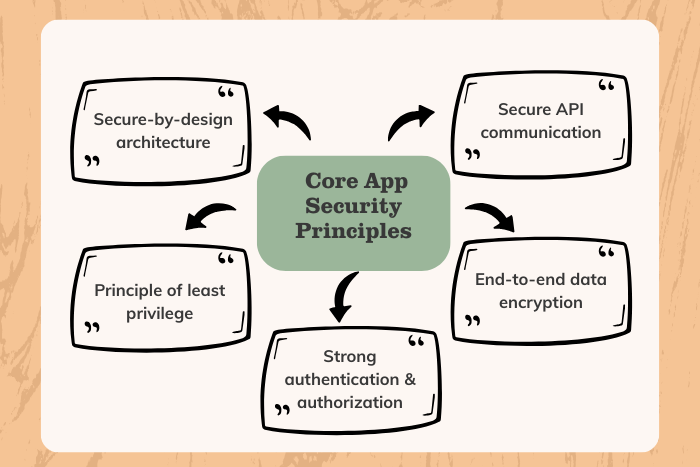
App security best practices involve protecting data at every stage — from development and deployment to post-launch monitoring. Whether you’re building a mobile app, SaaS platform, enterprise system, or on-demand marketplace, implementing strong security controls ensures confidentiality, integrity, and availability of data.
Modern application security requires secure coding, encrypted communication, strong authentication, safe data storage, continuous testing, and proactive threat monitoring. This guide explains the most important app security best practices and how to implement them effectively to safeguard your application against evolving cyber threats.
Why App Security Best Practices Are Important
Application security is no longer optional — it’s a business necessity.
Here’s why strong app security matters:
Protects sensitive user data and credentials
Prevents financial losses due to cyberattacks
Builds customer trust and brand credibility
Ensures compliance with data protection regulations
Reduces risk of downtime and service disruption
Safeguards intellectual property and APIs
Prevents reputational damage from breaches
Security breaches can cost millions in recovery and fines. Implementing best practices from the start significantly reduces long-term risks.
Types of Application Security Solutions
Different security strategies protect applications at various levels.
Secure Software Development Lifecycle (SSDLC)
Integrating security at every development stage.Mobile App Security Solutions
Platform-specific protections for iOS and Android apps.Web Application Security
Protecting backend systems, APIs, and browser interactions.Cloud Application Security
Securing infrastructure, storage, and data in cloud environments.API Security Solutions
Safeguarding endpoints against unauthorized access and abuse.DevSecOps Integration
Continuous security monitoring within CI/CD pipelines.
Selecting the right approach depends on app architecture, industry, and compliance requirements.
Key Features of App Security Best Practices
A secure application should include:
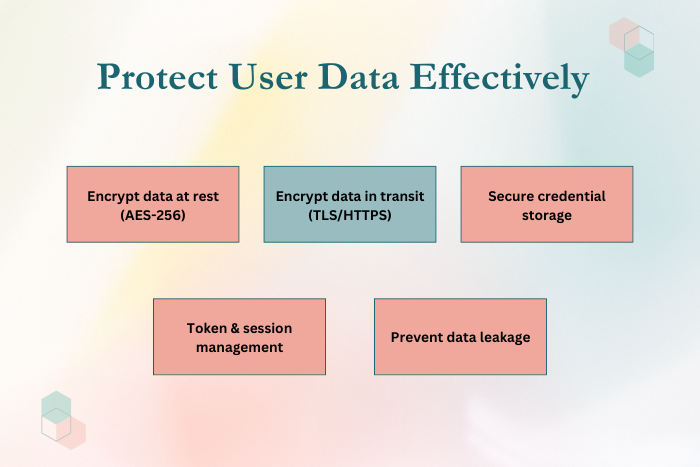
End-to-end encryption (TLS/HTTPS)
Secure authentication (OAuth, MFA, biometric login)
Strong authorization controls (RBAC)
Secure API endpoints
Data encryption at rest and in transit
Secure session management
Input validation and output sanitization
Regular security patch updates
Dependency vulnerability scanning
Secure storage mechanisms
Logging and monitoring systems
These features form the foundation of modern application security.
Development Process
Threat Modeling & Risk Assessment
Identify potential vulnerabilities and attack vectors early in development.Secure Architecture Design
Design application structure with encryption, authentication, and least-privilege access.Secure Coding Practices
Implement input validation, output encoding, and avoid hardcoded credentials.Dependency & Supply Chain Review
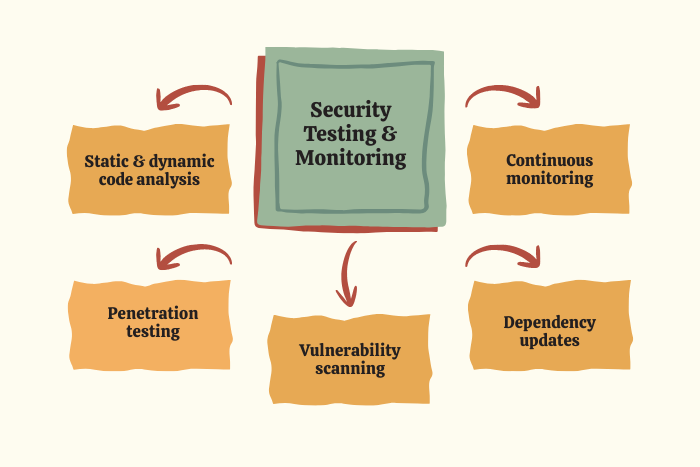
Audit third-party libraries and update outdated dependencies.Static & Dynamic Security Testing
Perform code analysis and penetration testing to identify vulnerabilities.API & Network Security Validation
Ensure secure protocols (HTTPS, TLS) and certificate pinning.Pre-Launch Security Audit
Conduct comprehensive vulnerability assessments before deployment.Continuous Monitoring & Updates
Implement post-deployment logging, monitoring, and patch management.
Security must be integrated throughout the development lifecycle, not added as an afterthought, ensuring that App Security Best Practices are consistently applied from planning and design to deployment and ongoing maintenance.
Technology Stack for App Security
Modern security tools strengthen application protection.
Encryption Standards: AES-256, RSA, TLS 1.3
Authentication Protocols: OAuth 2.0, JWT, Multi-Factor Authentication
API Security Tools: API gateways, rate limiting, token validation
Security Testing Tools: OWASP ZAP, Burp Suite, SonarQube
Mobile Security Tools: ProGuard, App Shielding Solutions
Cloud Security Tools: AWS Shield, Azure Security Center
Monitoring Tools: Splunk, Datadog, New Relic
CI/CD Security Integration: DevSecOps pipelines
Using a secure and updated technology stack significantly reduces vulnerabilities.
Cost Factors in Implementing App Security
App security investment depends on:
App complexity and architecture
Industry compliance requirements (GDPR, HIPAA, PCI-DSS)
Security testing depth
Encryption implementation
API and infrastructure protection
DevSecOps integration
Ongoing monitoring and patch management
Security typically accounts for 10–20% of development cost but prevents far greater financial losses.
Latest Trends in Application Security
Security evolves with emerging threats. Key trends include:
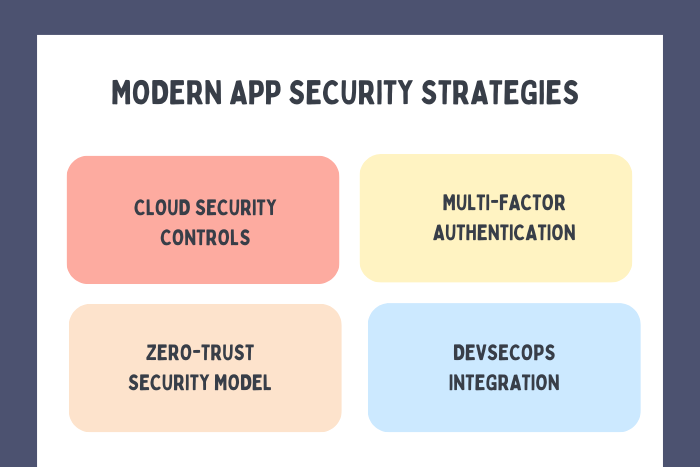
Zero-trust security models
AI-driven threat detection
Biometric authentication
Behavioral analytics monitoring
Runtime application self-protection (RASP)
Cloud-native security frameworks
Blockchain-based security solutions
Automated vulnerability scanning in CI/CD
Adopting advanced security practices future-proofs your application by aligning with App Security Best Practices, reducing evolving cyber risks, and ensuring long-term data protection and compliance.
Why Choose Us for Application Security Implementation?
Protecting your app requires expertise, proactive monitoring, and a security-first mindset.
Here’s why businesses trust us:
Security-by-Design Approach – Integrated protection from day one.
Comprehensive Risk Assessment – Identify vulnerabilities before attackers do.
Advanced Encryption & Authentication – Enterprise-grade protection.
DevSecOps Integration – Continuous security within development pipelines.
Regulatory Compliance Support – Meet industry standards confidently.
Ongoing Monitoring & Incident Response – Proactive defense strategies.
We don’t just build applications — we build secure digital ecosystems.
Ready to secure your app against modern threats?
Let’s implement industry-leading app security best practices today.
Contact us for a comprehensive security consultation.
Key Points :
- Comprehensive guide covering essential app security best practices for mobile and web applications.
- Explains secure coding, encryption standards, authentication, and API protection strategies.
- Highlights the importance of secure software development lifecycle (SSDLC) and DevSecOps integration.
- Covers data protection methods including encryption at rest and in transit.
- Details security testing approaches such as penetration testing and vulnerability scanning.
- Addresses compliance requirements like GDPR, HIPAA, and PCI-DSS.
- Discusses modern security trends including zero-trust architecture and AI-driven threat detection.
- Conversion-focused content encouraging businesses to implement proactive application security solutions.
FAQ's
Encryption, secure authentication, API protection, secure coding, and regular vulnerability testing.
Use encrypted communication, secure storage, certificate pinning, and regular updates.
APIs expose backend functionality. Without protection, they become entry points for attackers.
Security testing should be continuous, especially before each major release.
DevSecOps integrates security practices into the development and deployment pipeline.
Costs vary but typically represent 10–20% of overall development investment.
Yes. We offer continuous monitoring, patch management, and incident response services.