



Explore education app development services including eLearning apps, LMS, features, costs, tech stack, and trends. Build scalable EdTech solutions.
What Are the Education App Development Services?
If you’re asking, “What are the education app development services?”, you are exploring one of the fastest-growing sectors in digital transformation. The education industry has rapidly evolved with the rise of eLearning platforms, mobile learning apps, virtual classrooms, and AI-powered tutoring systems. Educational institutions, corporate training providers, EdTech startups, and enterprises now rely on scalable and interactive digital solutions to deliver effective learning experiences.
Education app development services include designing, developing, and maintaining mobile and web-based applications tailored to academic institutions, training organizations, and online learning businesses. These services focus on user-friendly design, secure data handling, performance optimization, content management, and integration with learning management systems (LMS).
From K-12 learning apps to corporate training platforms and language learning solutions, professional education app development helps organizations increase engagement, improve learning outcomes, and expand their digital reach. This guide explains the types of services, features, development process, technology stack, costs, and trends shaping modern EdTech solutions.
Why Education App Development Services Are Important
The digital learning market is expanding rapidly due to remote learning adoption, personalized education needs, and mobile-first learners. Education app development services play a vital role in modernizing learning experiences.
Here’s why these services matter:
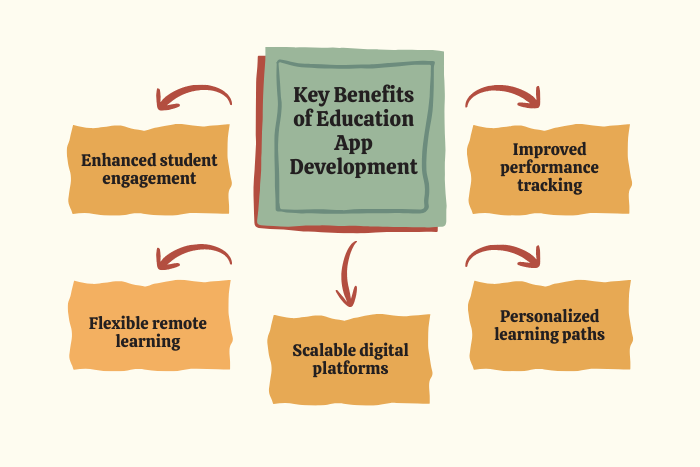
Enable remote and hybrid learning environments
Increase student engagement through interactive content
Provide personalized learning paths using analytics
Simplify administration and attendance management
Support scalability for growing institutions
Improve accessibility and flexible learning options
Custom educational apps help institutions automate operations while delivering engaging and measurable learning experiences.
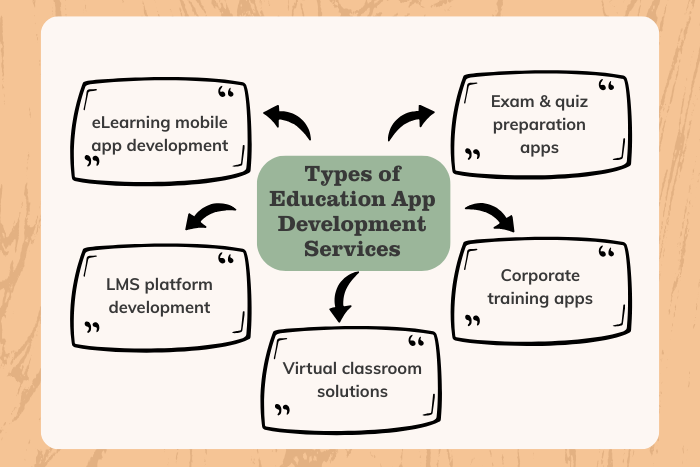
Types of Education App Development Solutions
Education app development services cover various learning models and use cases.
eLearning App Development
Interactive mobile learning apps for schools, colleges, and online courses.Learning Management System (LMS) Development
Platforms to manage courses, content, student progress, and assessments.Virtual Classroom & Video Conferencing Apps
Real-time online teaching platforms with recording and chat features.Language Learning App Development
Apps with quizzes, audio lessons, speech recognition, and gamification.Corporate Training App Development
Employee onboarding, compliance training, and skill development apps.Exam Preparation & Quiz Apps
Practice tests, mock exams, performance analytics, and leaderboards.Kids Learning & Gamified Education Apps
Interactive games designed to improve cognitive skills and engagement.
Each solution is customized to meet specific learning objectives and audience needs.
Key Features of Education Applications
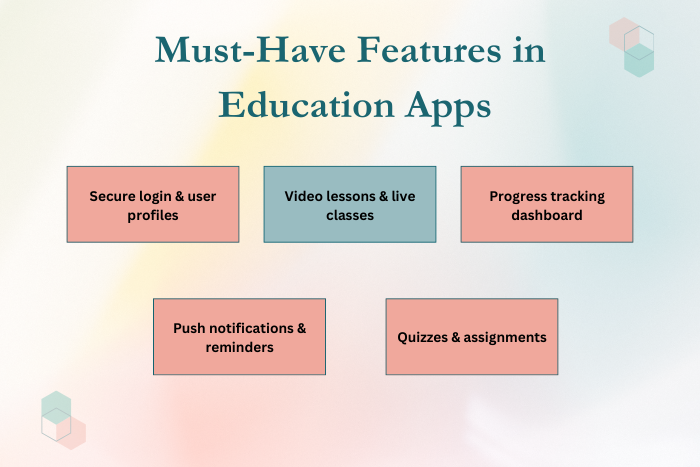
A successful education app combines usability, engagement, and scalability. Core features typically include:
Secure sign-up and user profile management
Course catalog and content management
Video lessons and live sessions
Quiz modules and assignments
Progress tracking dashboard
Push notifications and reminders
Payment gateway integration
Gamification elements (badges, leaderboards)
Offline learning mode
Multi-language support
Advanced features may include AI-based personalization, AR/VR learning modules, and speech recognition tools.
Education App Development Process
A structured and agile development approach ensures quality and scalability.
Requirement Analysis & Planning
Define target audience, business goals, content structure, and monetization strategy.UI/UX Design
Create intuitive, engaging, and accessible interfaces for students and educators.Architecture & Backend Development
Build scalable backend systems and secure databases.Mobile & Web App Development
Develop cross-platform or native applications for Android, iOS, and web.Integration & Testing
Integrate LMS, payment gateways, and analytics tools, followed by rigorous testing.Deployment & Launch
Publish the app on app stores and configure cloud hosting.Maintenance & Updates
Provide continuous improvements, bug fixes, and performance enhancements.
This process ensures your education app remains reliable and competitive.
Technology Stack for Education App Development
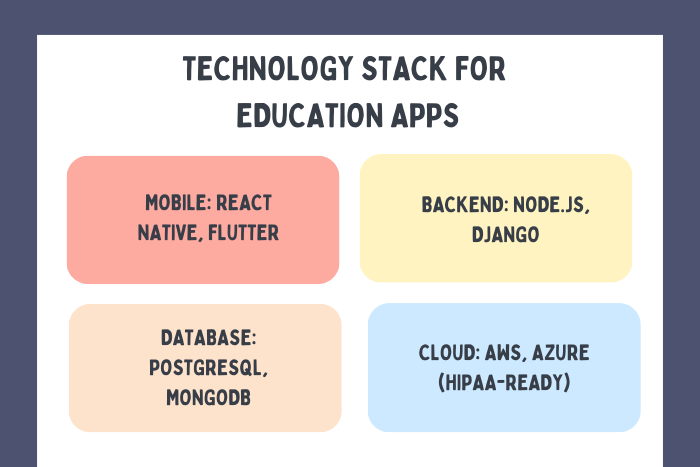
Selecting the right technology stack ensures scalability and long-term performance.
Mobile Development: React Native, Flutter, Swift, Kotlin
Backend Development: Node.js, Django, .NET Core
Database: PostgreSQL, MongoDB, MySQL
Cloud Platforms: AWS, Microsoft Azure, Google Cloud
Video & Streaming: WebRTC, Zoom SDK
DevOps: Docker, Kubernetes, CI/CD pipelines
Security: OAuth 2.0, SSL encryption, role-based access control
A robust tech stack supports high user traffic, secure content delivery, and smooth video streaming.
Cost Factors in Education Application Development
The cost of developing an educational app depends on several factors:
App complexity and feature set
Platform selection (iOS, Android, Web)
Live streaming and video integration
UI/UX design customization
Third-party integrations
AI or AR/VR feature inclusion
Content management system requirements
Ongoing maintenance and updates
A simple MVP education app may require moderate investment, while a full-featured LMS with AI capabilities demands a larger budget.
Latest Trends in Education App Development
The EdTech industry is evolving with innovative technologies. Emerging trends include:
AI-driven personalized learning
AR/VR immersive learning experiences
Gamification and microlearning
Blockchain-based certification
Adaptive learning algorithms
Voice-enabled tutoring assistants
Data analytics for performance insights
Hybrid learning ecosystems
Institutions that adopt these trends gain competitive advantages and improve learning outcomes.
Why Choose Us for Education App Development Services?
Building a high-performing education app requires technical expertise and domain knowledge.
Here’s why clients choose us:
Custom EdTech Solutions – Tailored apps aligned with your academic or business goals.
Scalable Architecture – Designed for high user engagement and future growth.
Interactive & Engaging Design – User-focused UI/UX for students and instructors.
Secure Development Standards – Data protection and encrypted communication.
Agile Development Process – Transparent milestones and faster delivery.
End-to-End Support – From idea validation to post-launch optimization.
We help educational institutions and EdTech startups transform ideas into scalable digital learning platforms.
Ready to build your education app?
Let’s create an engaging and scalable eLearning solution.
Contact us today for a free consultation and project estimate.
Key Points :
- Education app development services include eLearning apps, LMS platforms, virtual classrooms, and training solutions.
- Custom EdTech apps improve student engagement, accessibility, and personalized learning experiences.
- Core features include video lessons, quizzes, progress tracking, push notifications, and payment integration.
- Development involves requirement analysis, UI/UX design, backend architecture, testing, and deployment.
- Popular tech stack includes Node.js, React Native, Flutter, and cloud platforms like AWS.
- Costs depend on app complexity, platform choice, live streaming features, and third-party integrations.
- Ongoing maintenance and scalability planning are essential for long-term EdTech success.
FAQ's
Education app development services include eLearning apps, LMS platforms, virtual classrooms, language learning apps, and corporate training solutions.
An MVP may take 3–4 months, while a fully featured LMS or EdTech platform may require 6–9 months.
Costs vary depending on features, integrations, platform choice, and scalability requirements.
Technologies include React Native, Flutter, Node.js, AWS, WebRTC, and secure cloud infrastructure.
Yes, AI can enable personalized learning, smart recommendations, and automated assessments.
Yes, many apps include offline mode for accessing downloaded content without internet connectivity.
Common models include subscriptions, freemium plans, course purchases, and advertisements.
Yes, we offer maintenance, updates, performance optimization, and feature enhancements.