

Discover the cost of food delivery app development, key features, tech stack, and pricing factors. Get a detailed breakdown and estimate.
What Is the Cost of Food Delivery App Development?
If you’re asking, “What is the cost of food delivery app development?”, you’re likely planning to enter the booming on-demand food delivery market. With customers expecting seamless ordering, real-time tracking, and fast doorstep delivery, food delivery apps have become essential for restaurants, cloud kitchens, and startups.
The cost of developing a food delivery app depends on multiple factors such as business model, features, platform selection, backend complexity, third-party integrations, and ongoing maintenance. Whether you aim to build a marketplace like Uber Eats, a single-restaurant ordering app, or a hyperlocal delivery solution, understanding the pricing structure helps you plan effectively.
In this guide, we break down food delivery app development costs, key features, technology stack, development process, and the latest trends. This will help you estimate your investment and choose the right development approach for long-term scalability and profitability.
Why Food Delivery App Development Is Important
The food delivery industry continues to grow rapidly due to digital adoption and changing consumer habits.
Here’s why investing in food delivery app development matters:
Expands customer reach beyond physical locations
Increases order volume and revenue potential
Reduces dependency on third-party platforms
Enhances customer loyalty through personalized offers
Automates order and delivery management
Provides valuable data analytics for business growth
A custom food delivery app enables restaurants and startups to build a strong digital presence while improving operational efficiency.
Types of Food Delivery App Solutions
The cost varies depending on the type of food delivery model you choose.
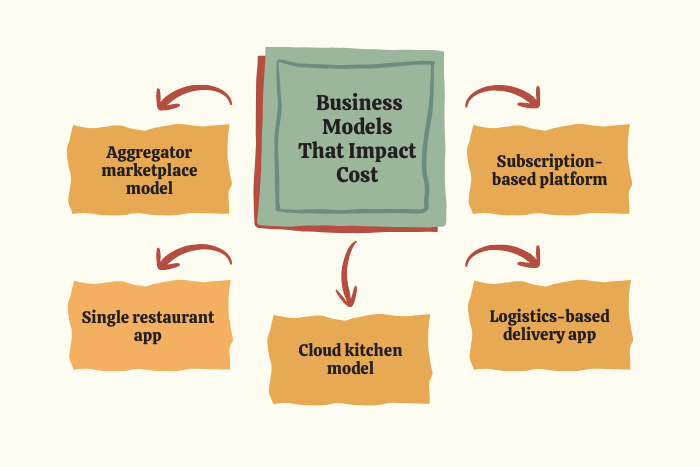
Aggregator Model
Multi-restaurant marketplace connecting customers, restaurants, and delivery partners.Restaurant-Owned App
Single-brand app for direct online ordering and delivery.Cloud Kitchen App
Delivery-only kitchen platform without physical dining.Logistics-Based Delivery App
Focuses on delivery services for multiple food vendors.Subscription-Based Model
Membership-based ordering with exclusive benefits.
Each model impacts development complexity and cost structure.
Key Features of a Food Delivery Application
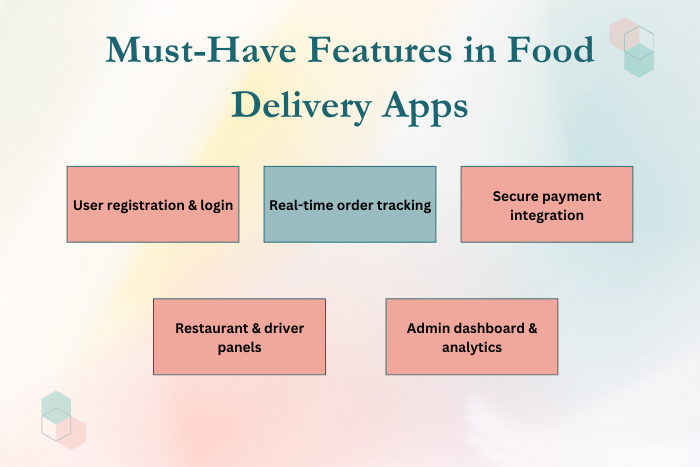
A robust food delivery app includes multiple panels: customer, restaurant, delivery partner, and admin.
Customer App Features
User registration and profile management
Restaurant browsing and menu search
Cart and order customization
Real-time GPS tracking
Secure in-app payments
Ratings and reviews
Push notifications and offers
Restaurant Panel Features
Menu management
Order acceptance/rejection
Inventory tracking
Earnings dashboard
Delivery Partner Panel
Order notifications
Route optimization
Earnings and incentive tracking
Admin Panel
User and vendor management
Commission setup
Analytics dashboard
Promotion management
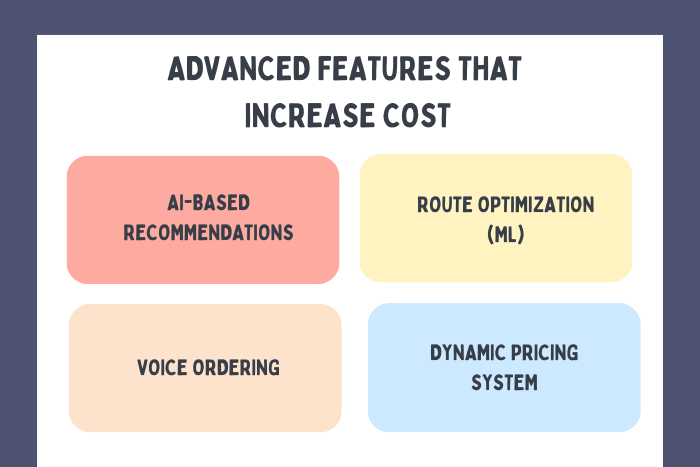
Advanced features like AI-based recommendations and dynamic pricing increase development costs.
Food Delivery App Development Process
A structured development process ensures cost optimization and scalability.
Business Model Finalization
Define revenue streams and operational workflow.Requirement Analysis & MVP Planning
Identify essential features for launch.UI/UX Design
Create intuitive and mobile-friendly interfaces.Backend & API Development
Build scalable infrastructure with third-party integrations.App Development (iOS & Android)
Develop cross-platform or native apps.Testing & QA
Conduct security, performance, and usability testing.Deployment & Launch
Publish apps and configure cloud hosting.Post-Launch Maintenance
Continuous updates and performance optimization.
Technology Stack for Food Delivery App Development
Choosing the right tech stack directly impacts performance and cost.
Mobile Development: React Native, Flutter, Swift, Kotlin
Backend Development: Node.js, Django, .NET Core
Database: PostgreSQL, MongoDB
Cloud Hosting: AWS, Microsoft Azure, Google Cloud
APIs & Integrations: Stripe, PayPal, Google Maps API
DevOps: Docker, Kubernetes, CI/CD
Scalable cloud architecture ensures your app handles high traffic during peak hours.
Cost Factors in Food Delivery Application Development
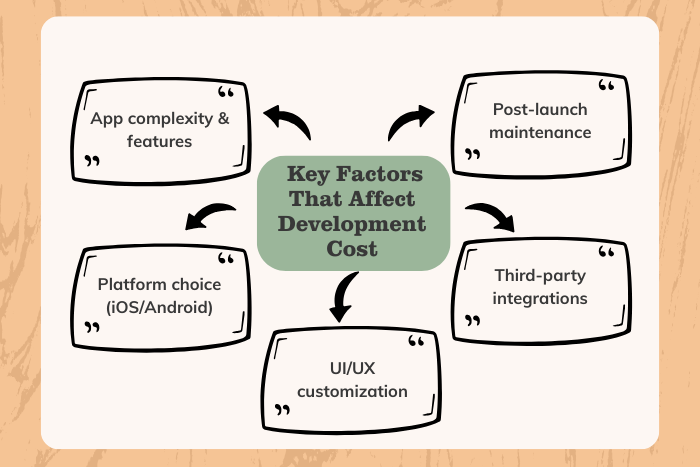
The cost of food delivery app development typically depends on the following:
App Complexity & Features – Basic vs advanced AI-driven features
Platform Selection – iOS, Android, or both
UI/UX Customization – Unique design elements increase costs
Third-Party Integrations – Payment gateways, maps, chat systems
Backend Infrastructure – Scalable microservices architecture
Security Measures – Data encryption and compliance
Development Team Location – Regional pricing differences
Post-Launch Maintenance – Updates and feature enhancements
Estimated Cost Range
Basic MVP App: Moderate investment
Mid-Level App with Multiple Panels: Higher investment
Enterprise-Grade Marketplace: Premium investment
Exact pricing depends on project scope and customization level.
Latest Trends
The future of food delivery apps is driven by innovation:
AI-powered personalized recommendations
Machine learning for route optimization
Voice-based food ordering
Chatbots for instant support
Drone and autonomous delivery
Sustainable delivery practices
Multi-language and multi-currency support
In-app gamification for retention
Incorporating advanced features increases initial cost but enhances long-term ROI.
Why Choose Us for Food Delivery App Development?
Understanding the cost of food delivery app development is only the first step — execution matters more.
Here’s why businesses partner with us:
Transparent Pricing Models – Clear cost breakdown and no hidden fees.
Scalable Architecture – Designed to grow with your business.
Custom UI/UX Design – High-conversion user interfaces.
Secure & Compliant Development – Advanced security implementation.
Agile Development Process – Faster time to market.
Long-Term Support – Continuous maintenance and feature upgrades.
We build scalable, secure, and revenue-driven food delivery platforms tailored to your business goals.
Ready to estimate your food delivery app cost?
Let’s build a profitable on-demand food delivery solution.
Contact us today for a detailed cost breakdown and consultation.
Key Points :
- Food delivery app development cost depends on app complexity, features, and business model.
- Common models include aggregator, restaurant-owned, cloud kitchen, and subscription-based apps.
- Core features like real-time tracking, secure payments, and multi-panel dashboards impact pricing.
- Platform choice (iOS, Android, or both) significantly affects development cost.
- Technology stack includes Node.js, React Native, Flutter, and cloud hosting platforms.
- Third-party integrations such as payment gateways and GPS APIs increase overall investment.
- Ongoing maintenance, updates, and scalability planning are essential cost considerations.
FAQ's
The cost of food delivery app depends on features, platform choice, integrations, and app complexity. Basic apps cost less than enterprise marketplaces.
An MVP may take 3–4 months, while a fully featured platform can take 6–9 months.
Advanced features, AI integration, custom design, and third-party APIs significantly impact pricing.
Yes, launching with a Minimum Viable Product helps validate your idea and control costs.
Popular technologies include React Native, Flutter, and Node.js with cloud hosting.
Revenue models include commission per order, delivery fees, surge pricing, subscriptions, and in-app advertising.
Yes, maintenance covers updates, server hosting, security patches, and performance optimization.
Yes, we offer long-term support, scaling strategies, and continuous improvements.