

Discover what is the timeline and milestones for app development, including stages, cost factors, and strategies to deliver your app on time.
What Is the Timeline and Milestones for App Development?
If you’re planning to build a mobile or web application, one of the first questions you’ll ask is: what is the timeline and milestones for app development? Understanding the realistic timeframe and key delivery checkpoints is essential for budgeting, planning, and successful product launch.
App development is not a one-step process. It follows a structured lifecycle that includes discovery, planning, design, development, testing, deployment, and post-launch optimization. Each stage has specific milestones that ensure progress remains measurable and aligned with business objectives. The timeline can vary significantly depending on app complexity, feature depth, integrations, compliance requirements, and team expertise.
Whether you’re building a startup MVP, an enterprise-grade application, or a cross-platform product, having a clear development roadmap reduces delays, controls costs, and improves stakeholder confidence. In this guide, we break down realistic app development timelines, milestone checkpoints, influencing factors, and strategies to deliver your application efficiently without compromising quality.
Why Understanding the App Development Timeline Is Important
Defining a clear timeline and milestone structure is critical for both technical and business success.
Here’s why:
Enables accurate project planning and budgeting
Reduces risk of scope creep and delays
Improves stakeholder transparency and reporting
Aligns development with marketing and launch strategies
Ensures quality assurance at each stage
Helps manage resources efficiently
Without milestone-based planning, projects often face extended deadlines, cost overruns, and misaligned expectations. A structured timeline allows teams to track progress in measurable phases and deliver predictable outcomes.
Types of App Development Timeline Solutions
Different projects require different timeline strategies depending on scope, complexity, and urgency.
MVP-Focused Timeline
2–4 weeks discovery phase
2–3 months development
Rapid testing and launch
Ideal for startups validating product-market fit
Standard Business App Timeline
1 month planning and design
3–5 months development
1 month testing and optimization
Suitable for mid-scale applications
Enterprise App Timeline
4–8 weeks discovery and architecture planning
6–9 months development
Advanced QA, compliance checks, integrations
Designed for large-scale, secure systems
Cross-Platform Accelerated Timeline
Shared codebase reduces build time
20–30% faster than separate native builds
Cost-effective and efficient deployment
Agile Sprint-Based Timeline
2-week sprint cycles
Continuous milestone delivery
Frequent stakeholder feedback
Each approach is structured around defined milestones to ensure transparency and controlled progress.
Key Features of a Structured App Development Timeline
A professional app development timeline includes:
Clearly defined project phases
Documented deliverables for each milestone
Sprint-based progress tracking
Risk assessment checkpoints
QA validation cycles
Deployment readiness evaluation
Post-launch stabilization period
These features help ensure your application moves from concept to launch smoothly and efficiently.
Development Process and Timeline Breakdown
Below is a realistic stage-by-stage breakdown of the timeline and milestones for app development typically look like:
Discovery & Requirement Analysis (2–4 Weeks)
Business analysis, user research, competitor evaluation, technical feasibility study, and finalization of product scope.Planning & Roadmap Creation (1–2 Weeks)
Feature prioritization, sprint planning, timeline modeling, and resource allocation.UI/UX Design Phase (3–6 Weeks)
Wireframes, user flows, high-fidelity designs, and interactive prototypes approved by stakeholders.Architecture & Backend Setup (3–5 Weeks)
Database design, API planning, server configuration, cloud setup, and security architecture implementation.Frontend & Backend Development (3–6 Months)
Core feature development, integrations, iterative sprint releases, and ongoing internal testing.Quality Assurance & Testing (4–8 Weeks)
Functional testing, performance testing, regression testing, device compatibility checks, and security audits.Deployment & App Store Submission (2–3 Weeks)
Compliance validation, publishing to App Store/Google Play, and launch readiness activities.Post-Launch Monitoring & Stabilization (Ongoing)
Bug fixes, performance monitoring, user analytics, and continuous feature improvements.
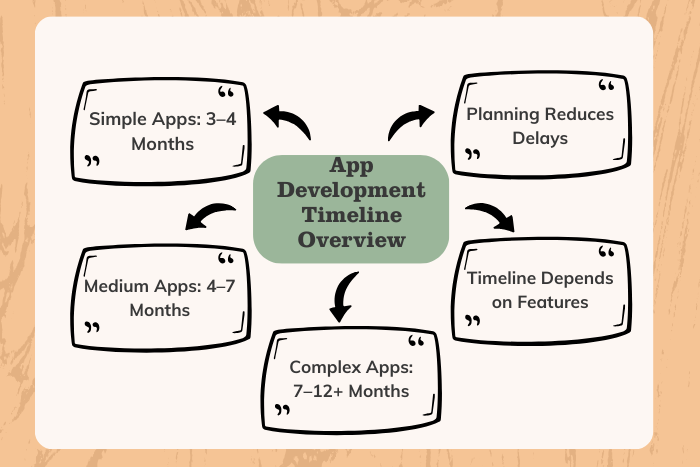
Overall development timelines typically range from:
Simple apps: 3–4 months
Medium complexity apps: 4–7 months
Complex enterprise apps: 7–12+ months
Technology Stack and Its Impact on Timeline
Technology choices directly affect app development speed and milestone scheduling.
Front-End Technologies:
Swift, Kotlin, Flutter, React Native
Back-End Technologies:
Node.js, Python, Java, .NET
Databases:
PostgreSQL, MongoDB, MySQL, Firebase
Cloud Infrastructure:
AWS, Google Cloud, Microsoft Azure
DevOps & Automation:
Docker, Kubernetes, CI/CD pipelines
Security Frameworks:
OAuth 2.0, SSL encryption, compliance protocols
Using modern frameworks, pre-built components, and automation tools can significantly reduce development time without compromising quality.
Cost Factors Related to Timeline
Time and budget are directly connected in app development. A longer timeline often means higher investment.
Major cost-driving factors include:
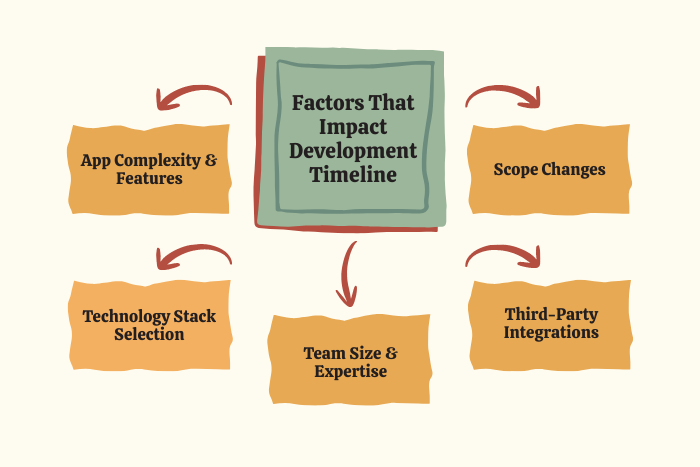
App complexity and feature depth
Custom UI/UX requirements
Third-party API integrations
Regulatory compliance (healthcare, fintech, etc.)
Platform selection (iOS, Android, web)
Team size and expertise level
Changes in scope during development
Accelerating timelines may increase short-term costs due to larger teams, while optimized planning can reduce overall burn rate.
Latest Trends Influencing App Development Timelines
Modern technologies are helping businesses reduce delivery time:
Agile and Scrum methodologies
Low-code and no-code accelerators
Cross-platform frameworks
AI-assisted coding tools
Cloud-native architecture
Automated testing and DevOps pipelines
Modular microservices architecture
Adopting these innovations ensures faster releases and continuous improvement cycles.
Why Choose Us for App Development Timeline Planning?
We specialize in delivering predictable timelines with milestone-driven execution.
Detailed discovery and accurate time estimation
Transparent sprint-based reporting
Dedicated project managers
Agile methodology with continuous feedback
Risk mitigation and change management
Scalable team allocation based on urgency
Our structured development roadmap ensures your app is delivered on time, within budget, and aligned with your business goals.
Need a clear timeline for your app idea?
Let’s map out your development milestones today.
Contact us for a free consultation and customized project timeline.
Key Points :
- App development timelines typically range from 3 to 12+ months depending on complexity and features.
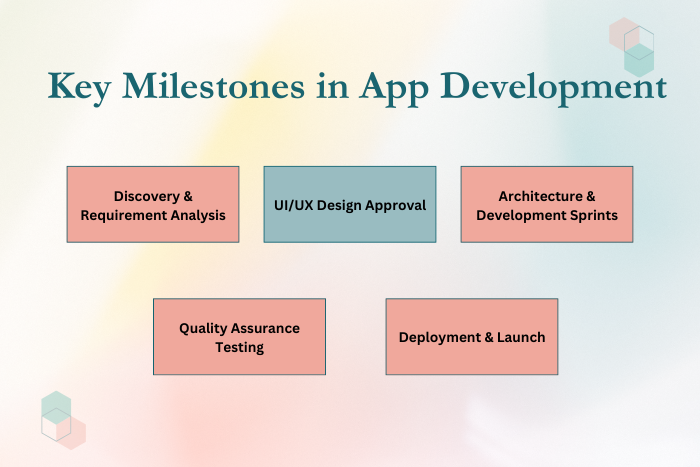
- Key milestones include discovery, design approval, development sprints, testing, deployment, and post-launch stabilization.
- A structured timeline improves budgeting accuracy and reduces project delays.
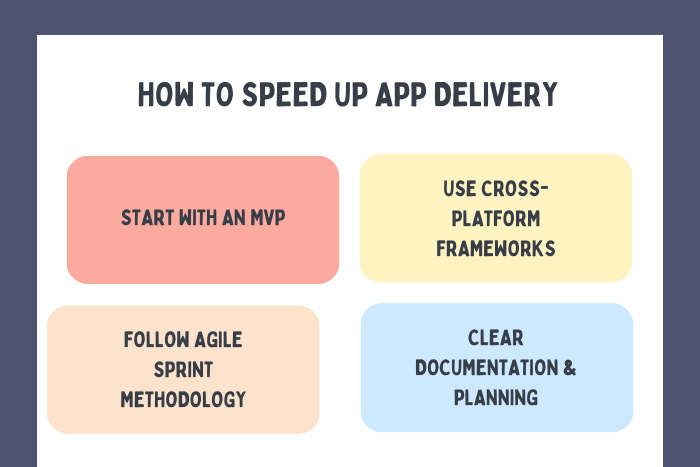
- MVP-based development can significantly shorten time-to-market.
- Agile sprint planning ensures continuous milestone delivery and stakeholder transparency.
- Technology stack and integrations directly impact development speed.
- Scope changes and compliance requirements are major factors affecting timelines.
- Clear roadmap planning ensures on-time delivery without compromising quality.
FAQ's
Most apps take between 3 to 9 months depending on complexity and features.
Major milestones include discovery, design approval, architecture setup, development sprints, QA testing, and launch.
Yes, simple MVP applications can be built within 3–4 months.
Scope changes, unclear requirements, third-party approval delays, and integration issues.
Yes, it typically reduces development time by 20–30% compared to separate native builds.
Agile sprints deliver incremental milestones every 2 weeks, improving flexibility and progress tracking.
More features, integrations, and security requirements increase development duration.