




Explore the services offered for real estate app development, including property listing apps, CRM solutions, key features, technology stack, development costs, and latest industry trends.
What Services Are Offered for Real Estate App Development?
If you’re asking, “What services are offered for real estate app development?”, you’re likely planning to build a digital solution for property buyers, sellers, agents, or real estate enterprises. The real estate industry has undergone massive digital transformation, with mobile apps becoming essential tools for property searches, virtual tours, lead management, and seamless transactions.
Real estate app development services cover everything from custom mobile app design and backend development to CRM integration, property listing management, payment gateways, and AI-driven property recommendations. Whether you’re a real estate startup, brokerage firm, aggregator platform, or property management company, investing in a scalable and feature-rich mobile application helps streamline operations and enhance customer engagement.
In this complete guide, we outline the services offered for real estate app development, including solution types, must-have features, development process, technology stack, cost factors, and the latest industry trends — helping you make informed decisions for your digital real estate platform.
Why Real Estate App Development Services Are Important
The modern property market is highly competitive and customer-driven. Buyers and renters expect real-time listings, advanced filters, interactive maps, and instant communication — all accessible via mobile devices.
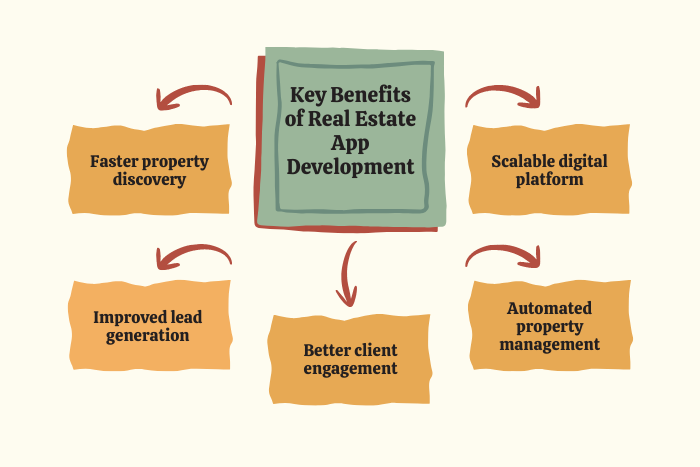
Here’s why real estate app development services are essential:
Simplify property search with smart filters and map integration
Improve lead generation and client engagement
Offer virtual tours and 3D property visualization
Enable seamless communication between buyers and agents
Automate document management and transactions
Increase operational efficiency with CRM integration
A well-designed real estate app enhances transparency, speeds up decision-making, and drives higher conversion rates.
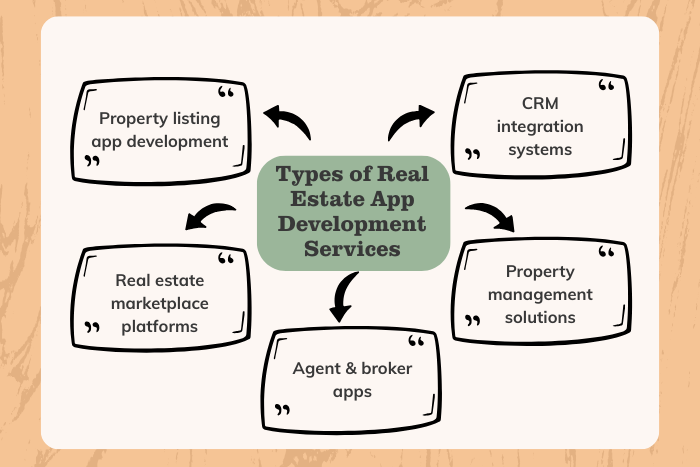
Types of Real Estate App Development Solutions
Real estate app development services include various solution types tailored to different stakeholders.
Property Listing Apps
Apps for browsing, filtering, and comparing properties for sale or rent.Real Estate Marketplace Apps
Aggregator platforms connecting buyers, sellers, and agents.Agent & Broker Apps
Tools for lead management, property tracking, and communication.Property Management Apps
Solutions for landlords and property managers to handle tenants, rent collection, and maintenance.Real Estate Investment Apps
Platforms for property valuation, ROI calculation, and portfolio tracking.CRM Integration Solutions
Custom CRM modules integrated into real estate applications.Virtual Tour & AR-Based Apps
Apps featuring immersive 3D property walkthroughs.
Each solution is customized based on your business model and user requirements.
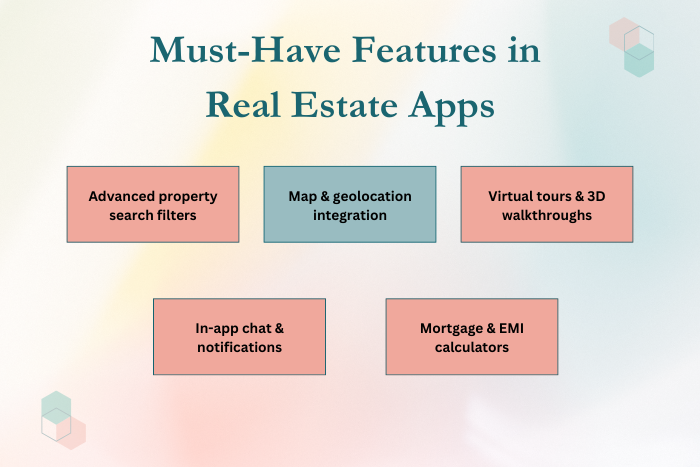
Key Features of Real Estate Applications
A successful real estate app must offer intuitive navigation and powerful functionality.
User Features
Secure sign-up and profile management
Advanced search filters (location, price, property type)
Map integration with geolocation
Property comparison tool
Favorites and saved listings
Virtual tours and high-resolution images
In-app chat or messaging
Mortgage and EMI calculators
Push notifications
Agent Features
Lead management dashboard
Listing creation and editing
Performance analytics
Appointment scheduling
Admin Features
User and property management
Analytics and reporting
Commission tracking
Content moderation
Advanced AI-based recommendations and chatbots can further enhance user engagement.
Real Estate App Development Process
A structured development process ensures scalability and reliability.
Requirement Analysis & Market Research
Identify target audience and define core functionalities.UI/UX Design & Wireframing
Create visually appealing and user-friendly interfaces.Backend Architecture Development
Build secure and scalable systems for listing and data management.Mobile & Web App Development
Develop cross-platform or native applications.API & Third-Party Integration
Integrate payment gateways, map services, and CRM tools.Testing & Quality Assurance
Perform security, usability, and performance testing.Deployment & Launch
Publish on app stores and configure cloud hosting.Maintenance & Support
Continuous updates, optimization, and feature upgrades.
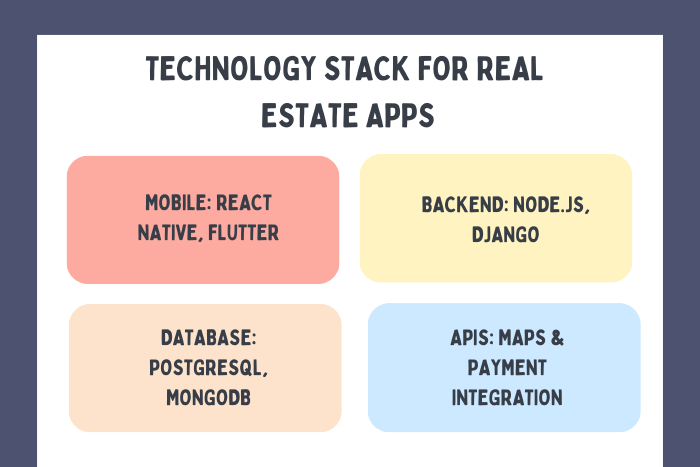
Technology Stack for Real Estate App Development
Selecting the right technology stack is crucial for performance and scalability.
Mobile Development: React Native, Flutter, Swift, Kotlin
Backend Development: Node.js, Django, .NET Core
Database: PostgreSQL, MongoDB
Cloud Infrastructure: AWS, Microsoft Azure, Google Cloud
Maps & Location Services: Google Maps API
Security: SSL encryption, OAuth 2.0, multi-factor authentication
DevOps: Docker, Kubernetes, CI/CD pipelines
This tech stack ensures smooth performance even with large property databases.
Cost Factors in Real Estate Application Development
The cost of real estate app development depends on multiple variables:
App complexity and number of features
Platform selection (iOS, Android, Web)
UI/UX customization level
Third-party integrations
Backend infrastructure scalability
Security implementation
Development team location
Post-launch maintenance
Basic property listing apps require moderate investment, while enterprise-level real estate marketplaces with AI and AR features require higher budgets.
Latest Trends in Real Estate App Development
The real estate sector continues evolving with new technologies.
AI-driven property recommendations
Augmented Reality (AR) virtual tours
Blockchain for secure transactions
Big data analytics for pricing insights
Chatbots for automated client support
IoT integration for smart homes
Digital document verification
Voice-based property search
Integrating innovative features improves user experience and market competitiveness.
Why Choose Us for Real Estate App Development Services?
Building a high-performing real estate app requires domain expertise and scalable architecture.
Here’s why clients trust us:
Custom Real Estate Solutions tailored to your business model.
Scalable & Secure Infrastructure built for high traffic.
Advanced Technology Integration including AI and AR.
User-Centric UI/UX Design for better engagement.
Transparent Agile Development Process for faster delivery.
Long-Term Maintenance & Support for continuous growth.
We help real estate businesses transform property transactions into seamless digital experiences.
Ready to build your real estate app?
Let’s create a scalable property platform that drives leads and conversions.
Contact us today for a free consultation and project estimate.
Key Points :
- Real estate app development services include property listing apps, marketplace platforms, and CRM-integrated solutions.
- Solutions are tailored for buyers, sellers, agents, brokers, and property management companies.
- Core features include advanced search filters, map integration, virtual tours, and in-app messaging.
- Development covers UI/UX design, backend architecture, API integrations, and cloud deployment.
- Technology stack includes Node.js, React Native, Flutter, and secure cloud platforms.
- Cost depends on app complexity, platform choice, integrations, and scalability requirements.
- Post-launch maintenance and performance optimization ensure long-term growth and user retention.
FAQ's
Real estate app development services include property listing apps, marketplace platforms, CRM integration, virtual tours, and property management solutions.
Costs depend on app complexity, integrations, features, and platform choice.
An MVP may take 3–4 months, while a full-featured platform can take 6–9 months.
Search filters, map integration, property comparison, virtual tours, and messaging are essential features.
Yes, AI enables smart property recommendations and chatbots.
Yes, cloud hosting ensures scalability and secure data storage.
Yes, we offer continuous updates, optimization, and feature enhancements.
Revenue models include listing fees, subscription plans, commissions, and advertisements.