



What is the app development process flowchart? Learn each stage from ideation to launch with a structured flow for scalable app success.
What Is the App Development Process Flowchart?
If you’re asking what is the app development process flowchart, you’re looking for a clear, structured visualization of how a mobile application moves from idea to launch — and beyond. A development process flowchart outlines every stage of app creation, decision points, feedback loops, and quality checkpoints in a logical sequence.
Rather than treating app development as a linear activity, a flowchart organizes tasks into structured phases such as ideation, planning, design, development, testing, deployment, and maintenance. It helps stakeholders understand responsibilities, timelines, dependencies, and risk areas before development even begins.
For startups, enterprises, and product teams, a well-defined app development flowchart reduces confusion, improves collaboration, and prevents costly mistakes. It ensures transparency across design, development, QA, and deployment teams.
In this guide, we explain the complete mobile app development process flowchart, its stages, benefits, cost impact, and how to implement it for scalable digital success.
Why The App Development Process Is Important
Understanding what is the app development process flowchart is essential because:
It provides clarity and structure
Reduces project risks and scope creep
Aligns business and technical teams
Improves timeline estimation accuracy
Enhances communication across stakeholders
Identifies bottlenecks early
Without a defined process flow, app projects often suffer from miscommunication, budget overruns, missed deadlines, and unstable product releases.
A process flowchart acts as a blueprint — ensuring that every development phase is logically connected and strategically planned.
Types of Solutions
When implementing an application development process flowchart, businesses can adopt different structured models:
Waterfall Flowchart Model
Linear stage-by-stage progression with minimal iteration.Agile Development Flowchart
Iterative sprints with feedback loops and continuous improvements.MVP-Centric Flowchart
Focuses first on Minimum Viable Product before scaling features.DevOps Integrated Flowchart
Combines development and operations for faster deployment cycles.Enterprise Workflow Flowchart
Multi-team collaboration with compliance and security checkpoints.
Choosing the right process structure depends on project size, budget, and scalability goals.
Key Features of an App Development Process Flowchart
If you’re evaluating what is the application development process flowchart, these are its core components:
Clear Stage Definition
Each phase (ideation, design, development, testing, launch) is mapped sequentially.Decision Nodes
Approval checkpoints and quality validation steps.Feedback Loops
Iteration paths for design or development improvements.Role Assignment Clarity
Defines responsibilities across product managers, designers, developers, and QA teams.Milestone Markers
Clear deliverables at each stage.Risk Identification Points
Early detection of potential bottlenecks.Post-Launch Integration
Continuous updates and monitoring integrated into the flow.
Development Process: Complete Flowchart Stages
A typical mobile app development process flowchart includes:
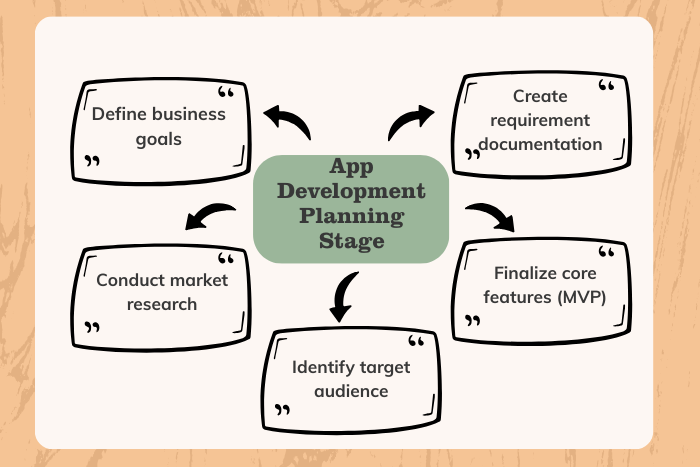
1. Ideation & Market Research
Define business objectives
Identify target audience
Conduct competitor analysis
Validate product-market fit
2. Requirement Planning
Define core features
Create technical documentation
Decide on platforms (iOS, Android, or cross-platform)
Estimate timeline and budget
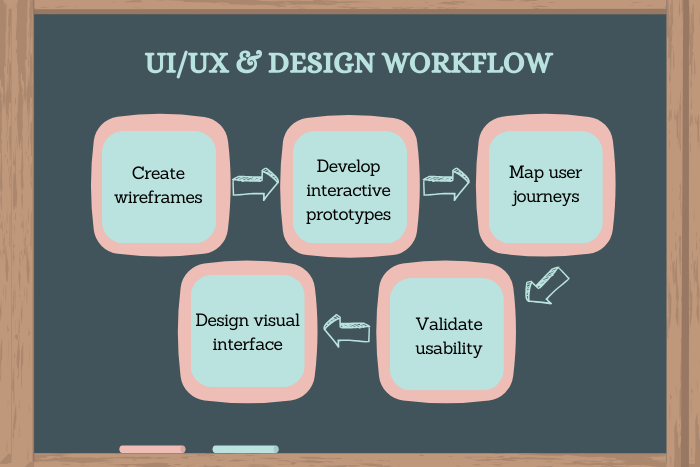
3. UI/UX Design
Wireframing
Prototyping
User journey mapping
Visual design creation
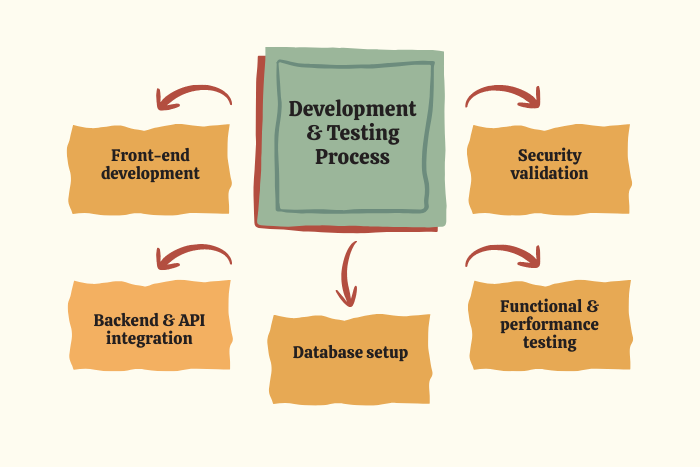
4. App Development
Front-end development
Backend architecture
API integrations
Database setup
5. Testing & Quality Assurance
Functional testing
Performance testing
Security testing
User acceptance testing
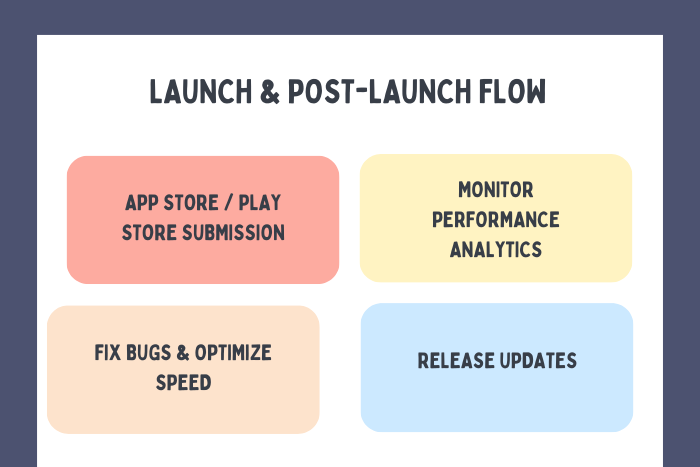
6. Deployment & Launch
App Store and Play Store submission
Server deployment
Final release approval
7. Post-Launch Support
Bug fixes
Performance monitoring
Feature updates
Scalability improvements
This structured workflow ensures predictable and efficient project execution.
Technology Stack
The flowchart integrates technical layers across development:
Front-End Development:
Swift, Kotlin, Flutter, React Native
Back-End Development:
Node.js, Django, Laravel, Spring Boot
Databases:
PostgreSQL, MongoDB, Firebase
Cloud Infrastructure:
AWS, Microsoft Azure, Google Cloud
DevOps & CI/CD:
Docker, Kubernetes, GitHub Actions
Monitoring & Analytics:
Firebase Analytics, App performance tools
Selecting the right stack ensures scalability and smoother workflow integration.
Cost Factors in the App Development Process Flowchart
An organized development process flowchart directly influences cost management. Key pricing factors include:
App complexity
Feature set and integrations
Design customization
Platform selection
Development methodology
Testing requirements
Maintenance plans
A structured flowchart reduces unexpected expenses by identifying risks early and aligning milestones with budget phases.
Latest Trends in App Development Workflow (2026)
Modern development process flowcharts now integrate:
AI-driven testing automation
Low-code rapid prototyping
DevSecOps integration
Cloud-native architecture
Microservices backend systems
Continuous deployment pipelines
Cross-platform dominance
Data-driven product iterations
Companies leveraging these innovations accelerate development and improve scalability.
Why Choose Us for the App Development Process Flowchart
If you’re searching for clarity on what is the app development process flowchart, we offer structured, transparent, and scalable development strategies.
Here’s how we help:
Custom development workflow mapping
Agile sprint-based execution
Clear milestone tracking
Risk assessment integration
Cost-optimized planning
Scalable architecture design
Dedicated project management
We transform complex development cycles into structured, predictable workflows that ensure faster time-to-market and long-term success.
Ready to build your app with a clear development roadmap?
Let’s design your custom app development process flowchart today.
Contact us for a strategic consultation.
Key Points :
- An app development process flowchart visually maps every stage from idea to launch.
- It includes phases like ideation, planning, design, development, testing, and deployment.
- Decision points and feedback loops ensure quality control and iteration.
- It improves team coordination and stakeholder transparency.
- Structured workflows reduce risks, delays, and budget overruns.
- Agile and MVP-based flowcharts are widely used in modern development.
- Post-launch maintenance and updates are part of the complete flow.
FAQ's
It’s a structured diagram outlining every stage of app creation from ideation to maintenance.
It improves clarity, reduces risk, and ensures better team coordination.
Agile is generally more flexible and adaptive for modern mobile applications.
An MVP may take 2–4 months; full-scale apps can take 6–9 months or more.
Yes, maintenance and updates are integral stages in a complete workflow.
Absolutely. It prevents budget overruns and ensures faster validation.
It identifies bottlenecks early and prevents scope creep or rework.