
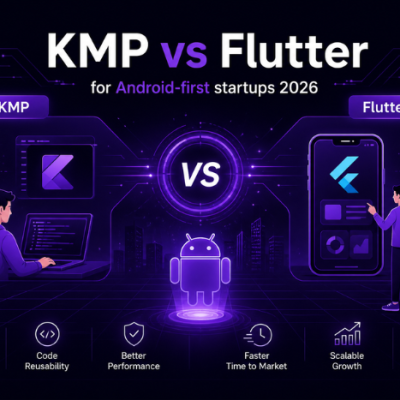
Compare KMP vs Flutter for Android-first startups 2026 to choose the best framework for performance, scalability, and growth.
Introduction
Choosing the right development framework is one of the most critical decisions for Android-first startups in 2026. With increasing demand for faster development, cross-platform scalability, and high-performance applications, startups are often deciding between Kotlin Multiplatform (KMP) and Flutter. Both technologies offer powerful capabilities, but they differ significantly in architecture, performance, flexibility, and long-term scalability.
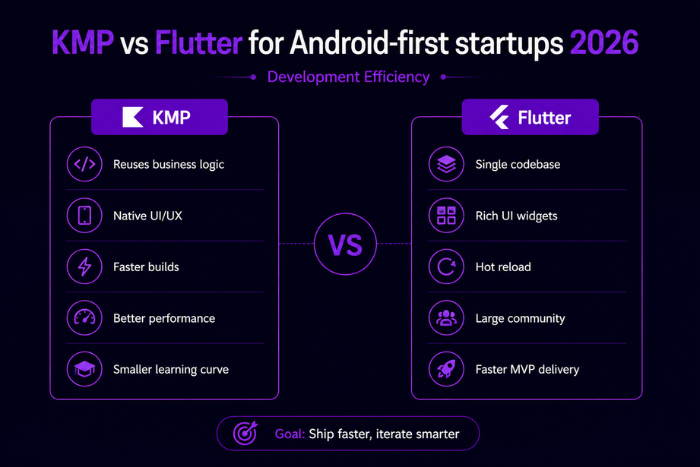
Understanding KMP vs Flutter for Android-first startups 2026 is essential for building efficient, future-ready mobile applications. While Flutter provides a unified UI toolkit for building cross-platform apps quickly, Kotlin Multiplatform focuses on sharing business logic while maintaining native UI experiences. This distinction plays a crucial role in how startups approach product development, user experience, and technical scalability.
For startups prioritizing Android-first strategies, the choice becomes even more important. Factors like time-to-market, developer expertise, performance requirements, and long-term maintenance all influence the decision. This guide helps startups evaluate both technologies and choose the best approach to build scalable, high-quality mobile applications in 2026 and beyond.
Why KMP vs Flutter for Android-First Startups 2026 is Important
Selecting the right framework directly impacts product success, scalability, and development efficiency.
- Faster Time-to-Market
Choosing the right framework accelerates development. - Cost Optimization
Efficient development reduces initial and long-term costs. - Performance Considerations
Native vs cross-platform rendering impacts speed. - Scalability
Future expansion depends on architecture decisions. - Developer Productivity
Tools and ecosystem influence development speed. - User Experience Quality
Native UI vs custom rendering affects usability. - Maintenance Efficiency
Code sharing reduces long-term effort. - Competitive Advantage
The right choice helps startups innovate faster.
Types of Solutions for KMP vs Flutter for Android-First Startups 2026
Different startup needs determine which framework is more suitable:
- Android-First Native Apps (KMP)
Shared business logic with native Android UI. - Cross-Platform MVP Apps (Flutter)
Single codebase for Android and iOS. - Scalable Enterprise Apps (KMP)
Flexible architecture for long-term growth. - UI-Heavy Applications (Flutter)
Custom UI with consistent design across platforms. - Performance-Critical Apps (KMP)
Native performance for complex operations. - Rapid Prototyping Apps (Flutter)
Quick development and iteration. - Hybrid Architecture Solutions
Combining KMP logic with Flutter UI. - Multi-Platform Ecosystem Apps
Apps targeting mobile, web, and desktop.
Key Features of KMP vs Flutter for Android-First Startups 2026
Both frameworks offer unique advantages:
- Kotlin Multiplatform (KMP) Features
- Native UI with shared business logic
- Direct access to platform APIs
- High performance and scalability
- Seamless integration with existing Android code
- Flutter Features
- Single codebase for multiple platforms
- Custom rendering engine (high UI consistency)
- Fast development with hot reload
- Rich widget library
- Common Advantages
- Cross-platform capabilities
- Strong developer communities
- Continuous ecosystem improvements
Development Process
The development workflow differs based on the chosen framework:
- Requirement Analysis
Define business goals and platform priorities. - Framework Selection
Choose between KMP, Flutter, or hybrid approach. - Architecture Planning
Design scalable app structure. - UI/UX Design
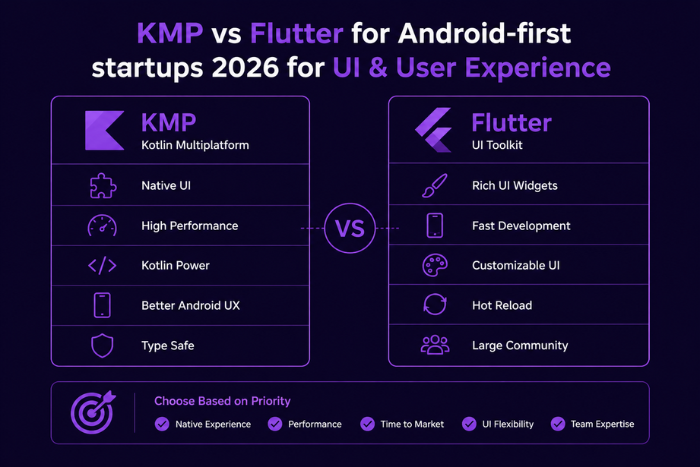
Native UI (KMP) or custom UI (Flutter). - Development Phase
Build features and integrate APIs. - Testing & QA
Ensure performance across devices. - Deployment
Release on Play Store and other platforms. - Maintenance & Scaling
Update and expand app capabilities.
Technology Stack for KMP vs Flutter for Android-First Startups 2026
Modern app development uses advanced technologies:
KMP Stack: Kotlin, Android SDK, Ktor, SQLDelight
Flutter Stack: Dart, Flutter SDK, Firebase
Backend: Node.js, Java, Python
Database: PostgreSQL, MongoDB, Firebase
DevOps: Docker, CI/CD pipelines
Cloud: AWS, Google Cloud, Azure
Testing Tools: JUnit, Espresso, Flutter Test
Cost Factors for KMP vs Flutter for Android-First Startups 2026
Several factors influence development costs:
- Framework Choice
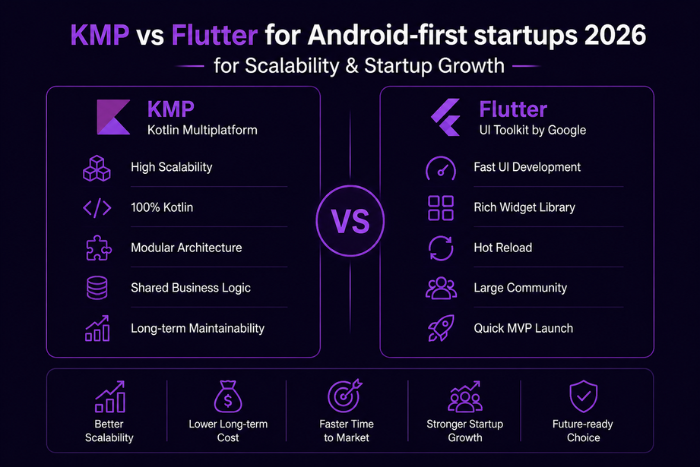
Flutter may reduce initial cost; KMP may reduce long-term cost. - App Complexity
Advanced features increase development effort. - UI Design Requirements
Custom UI may increase cost in Flutter. - Team Expertise
Availability of Kotlin or Dart developers. - Maintenance Costs
Code sharing reduces long-term expenses. - Testing Requirements
Cross-platform testing adds effort. - Scalability Needs
Future expansion impacts cost. - Time-to-Market
Faster delivery may require more resources.
Latest Trends
Key trends shaping cross-platform development in 2026:
- KMP Adoption Growth
Increasing use in enterprise and startups. - Flutter Ecosystem Expansion
Strong support for web and desktop. - Hybrid Architectures
Combining native and cross-platform approaches. - AI Integration
AI-powered mobile applications. - Performance Optimization
Focus on speed and responsiveness. - Developer Experience Improvements
Better tooling and frameworks. - Multi-Platform Strategy
Apps targeting multiple platforms simultaneously.
Why Choose Us for KMP vs Flutter for Android-First Startups 2026
Choosing the right framework requires expertise in both technologies and startup strategy.
Cross-Platform Expertise
Experience with both KMP and Flutter development.
Startup-Focused Approach
Solutions tailored for fast-growing startups.
Performance Optimization
High-performance apps for better user experience.
Scalable Architecture
Future-ready app design.
Cost-Efficient Development
Optimized strategies for budget-conscious startups.
Custom Recommendations
Framework selection based on your business needs.
Transparent Process
Clear communication and development milestones.
End-to-End Support
From strategy to deployment and scaling.
We help startups choose and implement the right technology stack to build scalable, high-performance mobile applications.
Not sure whether to choose KMP or Flutter for your startup?
Let’s build the right mobile strategy for your business.
Contact us today for expert consultation and development support.
Key Points :
- KMP offers native UI with shared business logic, ideal for Android-first strategies.
- Flutter provides a single codebase for faster cross-platform development.
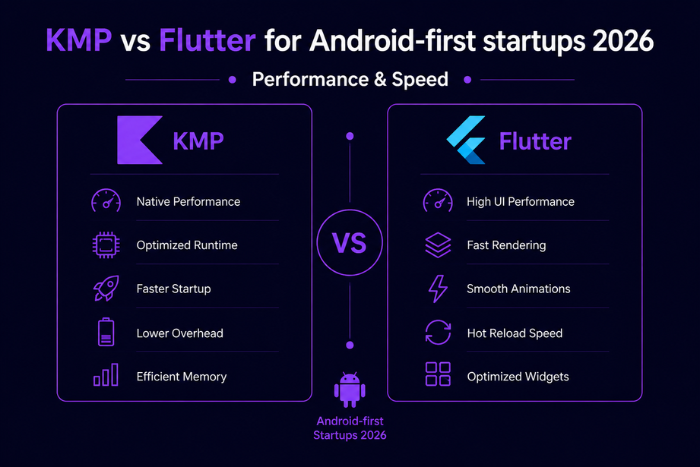
- KMP delivers better native performance and long-term flexibility.
- Flutter excels in rapid MVP development and UI consistency.
- Cost differs: Flutter lowers initial cost, KMP reduces long-term maintenance.
- Choosing the right framework gives startups a strong competitive advantage.
FAQ's
KMP allows sharing business logic across platforms while maintaining native UI.
Flutter is a cross-platform framework that uses a single codebase for multiple platforms.
Flutter offers faster development, but KMP provides better native performance.
Yes, hybrid approaches are possible.
Flutter is cost-effective initially; KMP may reduce long-term costs.
KMP generally offers better native performance.