

Learn UPI 2.0 integration guide for app developers in 2026. Build secure, fast, and scalable payment apps with APIs and best practices.
Introduction
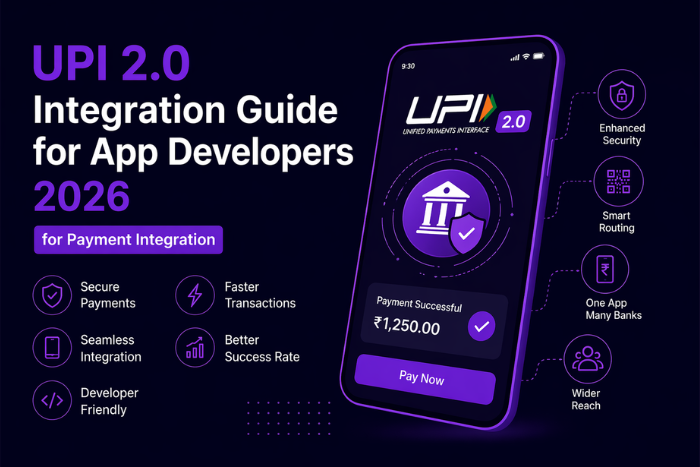
Digital payments in India have evolved rapidly, and UPI 2.0 has emerged as a powerful upgrade that brings enhanced security, faster transactions, and new features for developers and businesses. As mobile apps continue to dominate user interactions, integrating UPI 2.0 is no longer optional—it is a necessity for delivering seamless, real-time payment experiences.
This UPI 2.0 integration guide for app developers 2026 is designed to help businesses and developers understand how to implement modern UPI payment flows efficiently. With features like signed intent, overdraft accounts, invoice verification, and improved authentication mechanisms, UPI 2.0 opens new opportunities for fintech apps, e-commerce platforms, and service-based applications.
For developers, the challenge lies in choosing the right integration method—Intent flow, Collect flow, or QR-based payments—while ensuring compliance with evolving NPCI guidelines. A well-implemented UPI system not only improves transaction success rates but also enhances user trust and retention.
This guide explores the complete integration process, key features, cost considerations, and future trends to help you build robust, secure, and scalable UPI-enabled applications in 2026 and beyond.
Why UPI 2.0 Integration Guide for App Developers 2026 is Important
Understanding UPI integration is critical for building competitive and user-friendly mobile applications in today’s digital economy.
- Massive User Adoption
UPI dominates digital payments in India with billions of monthly transactions. - Real-Time Payment Processing
Instant fund transfers improve user experience and satisfaction. - Higher Conversion Rates
Seamless payment flows reduce drop-offs during checkout. - Enhanced Security Features
UPI 2.0 introduces signed intent and invoice verification. - Cost-Effective Transactions
Lower processing fees compared to traditional payment methods. - Omnichannel Payment Support
Works across mobile apps, web platforms, and QR-based systems.
Types of Solutions in UPI 2.0 Integration Guide for App Developers 2026
Different integration approaches are available depending on your app requirements:
- UPI Intent Flow Integration
App-to-app redirection for faster and more secure payments. - UPI Collect Flow Integration
Request-based payment system where users approve transactions. - QR Code-Based Payments
Scan-and-pay functionality for offline and online use cases. - In-App UPI SDK Integration
Seamless payment experience within the app environment. - Recurring Payment Integration (AutoPay)
Subscription-based billing for SaaS and services. - UPI for E-commerce Checkout
Optimized payment flows for higher conversion rates. - P2P & P2M Payment Solutions
Person-to-person and merchant transactions. - Invoice-Based Payment Integration
Secure payments with verified invoice data.
Key Features of UPI 2.0 Integration Guide for App Developers 2026
Modern UPI 2.0 integration offers powerful capabilities for developers:
- Signed Intent Authentication
Ensures secure and verified payment initiation. - Invoice in the Inbox
Users can verify transaction details before approval. - Overdraft Account Support
Enables payments using pre-approved credit lines. - Real-Time Payment Confirmation
Instant transaction status updates. - Enhanced Security Protocols
Multi-layer authentication and encryption. - High Transaction Success Rates
Optimized flows reduce failures and retries. - Cross-App Compatibility
Works with all major UPI-enabled apps. - Scalable Payment Infrastructure
Handles high transaction volumes efficiently.
Development Process
- Requirement Analysis & Payment Strategy
Define business goals, payment flows, and target users. - Selecting a UPI Payment Gateway
Choose a reliable provider supporting UPI 2.0 features. - API & SDK Integration Setup
Obtain credentials and integrate payment APIs into the app. - Implementing Payment Flows
Configure Intent, Collect, or QR-based payment methods. - Backend Integration & Security Setup
Handle transaction verification, callbacks, and encryption. - Testing in Sandbox Environment
Validate payment flows and error handling. - Deployment & Monitoring
Go live and continuously monitor transaction performance.
Technology Stack for UPI 2.0 Integration Guide for App Developers 2026
Programming Languages: Java, Kotlin, Swift, JavaScript
Mobile Frameworks: Flutter, React Native
Backend Technologies: Node.js, Python, Java (Spring Boot)
Payment Gateways: Razorpay, PhonePe, Paytm, Cashfree
APIs & Protocols: REST APIs, UPI SDKs, OAuth
Security Standards: PCI-DSS, SSL/TLS Encryption
Cloud Platforms: AWS, Google Cloud, Microsoft Azure
Monitoring Tools: Firebase, Datadog, New Relic
Cost Factors for UPI 2.0 Integration Guide for App Developers 2026
Several factors influence the cost of integrating UPI into your app:
- Integration Complexity
Advanced features like AutoPay and invoice verification increase effort. - Payment Gateway Charges
Fees vary based on provider and transaction volume. - Development Time
Custom integrations require more time and resources. - Security & Compliance Requirements
Ensuring adherence to NPCI guidelines adds cost. - Maintenance & Updates
Regular updates to support new features and regulations. - Scalability Needs
High-traffic apps require robust infrastructure. - Testing & QA Effort
Ensuring seamless payment experience across devices.
Latest Trends
- UPI AutoPay Expansion
Growing adoption of subscription-based payments. - Voice-Enabled UPI Payments
Integration of voice assistants for transactions. - Credit on UPI (Overdraft Usage)
Increased use of credit lines for payments. - AI-Based Fraud Detection
Smarter systems to detect and prevent fraud. - Cross-Border UPI Payments
Expansion of UPI beyond India. - UPI Lite for Small Transactions
Faster payments for low-value transactions. - Embedded Finance Integration
Payments integrated directly into apps and platforms.
Why Choose Us for UPI 2.0 Integration Guide for App Developers 2026
UPI Integration Expertise
Deep experience in building secure and scalable UPI-enabled applications.
End-to-End Development
From strategy to deployment, we handle complete integration.
Compliance-Ready Solutions
Ensure adherence to NPCI and banking regulations.
High Conversion Optimization
Design payment flows that maximize success rates.
Secure Architecture
Advanced encryption and fraud prevention mechanisms.
Scalable Infrastructure
Built to support high transaction volumes.
Continuous Support & Monitoring
Ongoing optimization and performance tracking.
Looking to integrate UPI 2.0 into your app seamlessly?
Let’s build a secure and high-performing payment system tailored to your business.
Contact us today to get started with expert UPI integration solutions.
Key Points :
- UPI 2.0 integration enables real-time, secure, and seamless payment experiences in mobile apps
- Developers can choose between Intent, Collect, QR, and AutoPay flows based on app requirements
- Features like signed intent and invoice verification improve transaction security and trust
- Proper API and SDK integration ensures high success rates and smooth user experience
- UPI integration reduces payment costs compared to traditional payment gateways
- Scalable architecture supports high transaction volumes for growing applications
FAQ's
UPI 2.0 introduces features like signed intent, overdraft accounts, and invoice verification for enhanced security and functionality.
UPI Intent flow is generally preferred due to higher success rates and better user experience.
It typically takes 1–3 weeks depending on complexity and features.
Costs depend on development effort, gateway fees, and infrastructure requirements.
Yes, UPI AutoPay enables subscription-based payments.
UPI is expanding globally, but availability depends on supported countries and partnerships.