


Explore subscription app revenue benchmarks 2026, including conversion rates, pricing, retention, and strategies to maximize app revenue growth.
Introduction
Subscription-based apps have become one of the most profitable digital business models in 2026. From SaaS platforms to fitness, AI tools, and content apps, recurring revenue is now the backbone of sustainable growth. However, success in this space isn’t just about launching a subscription—it’s about understanding performance benchmarks, user behavior, and revenue optimization strategies.
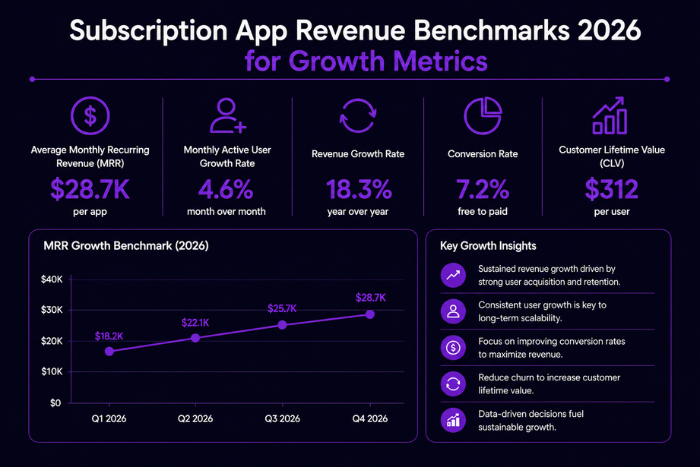
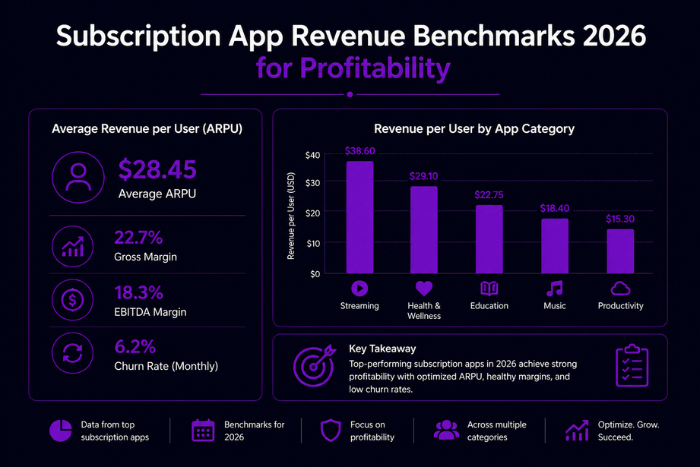
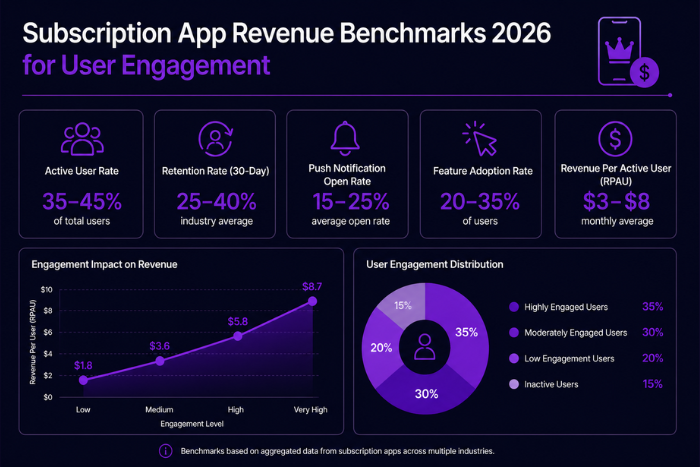
The subscription app revenue benchmarks 2026 provide critical insights into how top-performing apps generate revenue, convert users, and retain subscribers. Metrics like lifetime value (LTV), conversion rates, retention, and pricing strategies define whether your app scales or stagnates.
Recent data shows that subscription apps are evolving rapidly, with hybrid monetization models, AI-driven personalization, and smarter paywalls shaping revenue outcomes.
If you’re building or scaling a subscription-based app, understanding these benchmarks is essential to compete effectively and maximize ROI in today’s highly competitive app ecosystem.
Why Subscription App Revenue Benchmarks 2026 is Important
Understanding subscription app revenue benchmarks 2026 helps businesses make data-driven decisions rather than relying on assumptions.
First, benchmarks provide clarity on performance expectations. Without them, it’s difficult to know whether your app’s conversion rate or revenue per user is above or below industry standards.
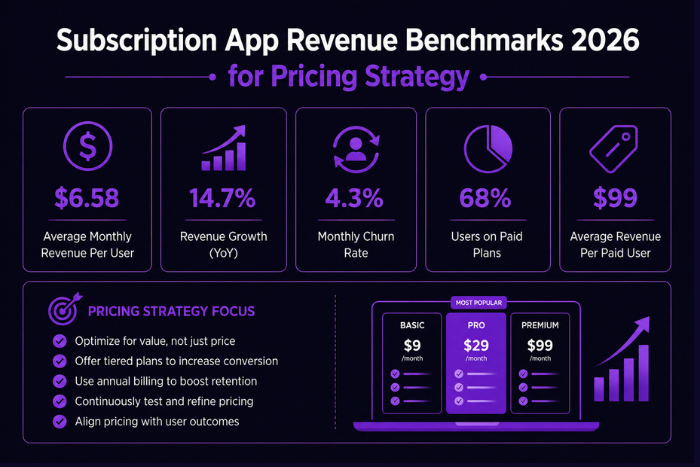
Second, they guide pricing and monetization strategies. Knowing what successful apps charge and how users respond helps you optimize pricing tiers and subscription plans.
Third, benchmarks reduce risk. Instead of experimenting blindly, you can align your strategy with proven revenue models used by top-performing apps.
Finally, they improve scalability. Apps that align with benchmark-driven growth strategies tend to achieve faster revenue growth and better user retention.
In 2026, where competition is intense and user acquisition costs are rising, leveraging benchmarks is no longer optional—it’s a necessity.
Types of Subscription App Revenue Benchmark Solutions
When analyzing subscription app revenue benchmarks 2026, businesses typically focus on multiple solution categories:
- Revenue Benchmark Analysis
Compare your app’s revenue metrics (MRR, ARPU, LTV) with industry averages. - Conversion Funnel Optimization
Evaluate download-to-trial and trial-to-paid conversion benchmarks. - Retention Benchmarking
Analyze churn rates, renewal rates, and long-term subscriber behavior. - Pricing Strategy Benchmarking
Compare weekly, monthly, and annual pricing models across industries. - Paywall Performance Benchmarking
Measure how different paywall designs impact conversions. - Regional Revenue Benchmarking
Understand how revenue performance varies across global markets.
Key Features of Subscription App Revenue Benchmarks 2026
A strong benchmarking strategy includes several critical features:
- Accurate Revenue Metrics Tracking
Monitor key indicators like ARPU, LTV, and revenue per install (RPI). - Conversion Rate Analysis
Track user journey from download to paid subscription. - Retention Insights
Measure how long users stay subscribed and when they churn. - Pricing Optimization Tools
Identify the best-performing pricing tiers for your app category. - User Segmentation
Analyze performance by geography, platform, and user behavior. - Real-Time Data Monitoring
Continuously update benchmarks based on current market trends. - Competitive Benchmarking
Compare your app against top-performing competitors.
Development Process
- Requirement Analysis
Define business goals, target metrics, and key performance indicators (KPIs). - Data Collection & Integration
Gather data from analytics tools, app stores, and user behavior tracking systems. - Benchmark Mapping
Align your app’s metrics with industry benchmarks and performance standards. - Dashboard Development
Build intuitive dashboards for real-time monitoring and insights. - Testing & Validation
Ensure accuracy and reliability of benchmark data. - Deployment & Optimization
Implement insights into your app strategy and continuously refine performance.
Technology Stack for Subscription App Revenue Benchmarks 2026
To implement effective benchmarking, modern technology stacks are essential:
- Analytics Tools: Firebase, Mixpanel, Amplitude
- Backend Technologies: Node.js, Python, Django
- Frontend Frameworks: React, Angular
- Cloud Platforms: AWS, Google Cloud, Azure
- Data Processing: BigQuery, Snowflake
- AI & ML Tools: Predictive analytics for churn and revenue forecasting
These technologies enable real-time tracking, predictive insights, and scalable analytics solutions.
Cost Factors for Subscription App Revenue Benchmarks 2026
Several factors influence the cost of implementing benchmarking solutions:
- Data Complexity
More complex apps require advanced analytics and higher costs. - Integration Requirements
Connecting multiple data sources increases development effort. - Feature Scope
Advanced features like AI predictions and segmentation add to costs. - Team Expertise
Hiring experienced data analysts and developers impacts pricing. - Maintenance & Updates
Continuous monitoring and updates require ongoing investment. - Scale of Operations
Larger apps with global audiences require more robust infrastructure.
Latest Trends
Subscription app monetization is evolving rapidly in 2026. Key trends include:
- AI-Driven Personalization
Apps use AI to tailor pricing and offers for individual users. - Hybrid Monetization Models
Combining subscriptions with in-app purchases and ads. - Shorter Subscription Cycles
Weekly plans are gaining popularity for faster conversions. - Dynamic Paywalls
Personalized paywalls based on user behavior improve conversions. - Web-to-App Funnels
Apps leverage web onboarding to reduce platform fees and increase revenue. - Retention-Focused Growth
Revenue growth is increasingly tied to long-term retention rather than acquisition.
Why Choose Us for Subscription App Revenue Benchmarks 2026
Choosing the right partner can significantly impact your app’s success.
We provide data-driven insights tailored to your business model, ensuring you make informed decisions at every stage. Our expertise in subscription app ecosystems allows us to identify growth opportunities that others miss.
We focus on measurable results—improving conversion rates, increasing retention, and maximizing revenue. Our solutions are scalable, secure, and aligned with the latest industry trends.
With a strong understanding of global app markets and user behavior, we help you stay ahead of competitors and achieve sustainable growth.
Ready to optimize your subscription app revenue?
Contact us today for a customized benchmarking solution.
Let’s turn your app data into scalable revenue growth.
Key Points :
- Focus on subscription app revenue benchmarks 2026 to evaluate app performance accurately
- Track key metrics like LTV, ARPU, conversion rates, and retention for growth
- Optimize pricing strategies (weekly, monthly, annual plans) for higher revenue
- Improve download-to-paid conversion using data-driven funnel optimization
- Leverage AI-driven personalization and dynamic paywalls for better monetization
FAQ's
They are industry standards for metrics like revenue, conversion rates, and retention used to evaluate app performance.
Top-performing apps achieve 5–10% or higher download-to-paid conversion rates depending on the category.
LTV measures the total revenue generated by a user during their subscription lifecycle.
A mix of weekly, monthly, and annual plans with free trials performs best.
Yes, many AI apps show higher monetization potential but may face retention challenges.
They help startups validate their business model and make data-driven growth decisions.