
Explore AI app development cost in 2026, pricing factors, budget ranges, and how businesses can plan scalable AI solutions.
Introduction
Artificial Intelligence (AI) is no longer a futuristic concept—it’s a core driver of digital transformation across industries. From chatbots and recommendation engines to predictive analytics and automation tools, AI applications are reshaping how businesses operate and compete. However, one of the most common questions companies ask is about the AI app development cost in 2026: what businesses should budget to build effective and scalable solutions.
The cost of developing an AI-powered application varies significantly depending on factors like complexity, data requirements, infrastructure, and integration needs. Unlike traditional app development, AI projects require additional investment in data processing, model training, and continuous optimization.
For startups and enterprises alike, understanding these cost dynamics is essential for proper planning and ROI optimization. With the right strategy and development partner, businesses can build powerful AI solutions that deliver long-term value while staying within budget.
Why AI App Development Cost in 2026: What Businesses Should Budget is Important
Understanding the AI app development cost in 2026: what businesses should budget is crucial for making informed decisions and avoiding unexpected expenses.
- Accurate Budget Planning
Helps businesses allocate resources effectively. - Better ROI Forecasting
Enables realistic expectations for returns on investment. - Avoiding Hidden Costs
Identifies expenses like data preparation and infrastructure scaling. - Strategic Decision Making
Helps choose the right AI approach based on budget. - Efficient Resource Allocation
Ensures optimal use of development teams and technologies. - Scalability Planning
Prepares for future growth and increasing data demands.
Types of AI App Development Solutions
AI applications vary widely based on business goals and use cases. Each type impacts the overall cost differently:
- AI Chatbot Development
Customer support bots with natural language processing capabilities. - Recommendation Systems
Personalized suggestions for e-commerce and content platforms. - Computer Vision Applications
Image and video recognition systems for healthcare, retail, and security. - Predictive Analytics Solutions
Data-driven forecasting for business insights and decision-making. - Generative AI Applications
Content generation tools using advanced AI models. - Voice Recognition Systems
Speech-to-text and voice assistant applications. - Fraud Detection Systems
AI-powered security solutions for financial platforms. - Automation & Workflow AI Tools
Intelligent automation for business processes.
Key Features of AI App Development Cost in 2026: What Businesses Should Budget
AI-powered applications require advanced features that influence cost and performance:
- Data Processing & Management
Handling large datasets efficiently. - Machine Learning Model Integration
Custom or pre-trained AI models for specific use cases. - Real-Time Analytics
Instant insights and decision-making capabilities. - Scalable Cloud Infrastructure
Flexible systems to support growth and high usage. - API & Third-Party Integration
Seamless connectivity with external platforms. - Security & Compliance
Data protection and regulatory compliance. - User-Friendly Interface
Simplified interaction with complex AI systems. - Continuous Learning Capabilities
Models that improve over time with new data.
Development Process
A structured approach ensures efficient AI app development and cost control:
- Requirement Analysis & Use Case Definition
Identifying business goals and AI implementation scope. - Data Collection & Preparation
Gathering and cleaning data for model training. - Model Selection & Training
Choosing algorithms and training AI models. - Application Development
Building frontend and backend systems. - Integration & Deployment
Connecting AI models with applications and deploying them. - Testing & Optimization
Ensuring accuracy, performance, and reliability. - Monitoring & Maintenance
Continuous updates and model improvements.
Technology Stack for AI App Development Cost in 2026: What Businesses Should Budget
Modern AI applications rely on advanced tools and frameworks:
Programming Languages: Python, R, Java, C++
AI/ML Frameworks: TensorFlow, PyTorch, Scikit-learn
NLP Tools: OpenAI APIs, spaCy, NLTK
Data Processing Tools: Apache Spark, Hadoop
Cloud Platforms: AWS, Google Cloud, Microsoft Azure
Database: MongoDB, PostgreSQL, BigQuery
DevOps Tools: Docker, Kubernetes
Visualization Tools: Tableau, Power BI
Cost Factors for AI App Development Cost in 2026: What Businesses Should Budget
The cost of AI app development varies based on several critical factors:
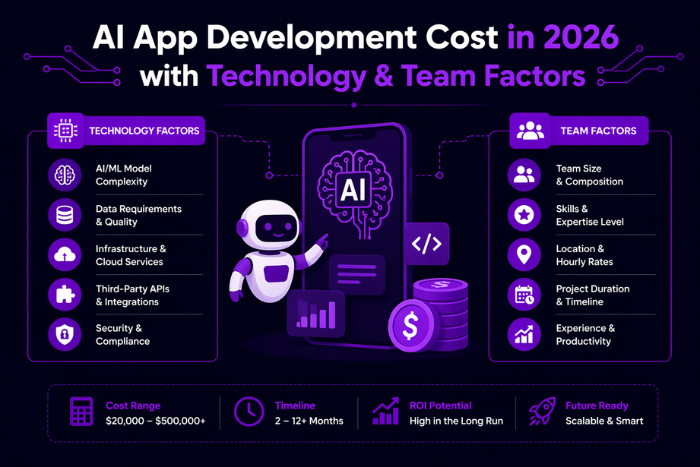
- AI Model Complexity
Simple models cost less than advanced deep learning systems. - Data Availability & Quality
High-quality data reduces training time but may increase acquisition costs. - Development Team Location
Costs vary between in-house, offshore, and hybrid teams. - Infrastructure & Computing Power
High-performance computing resources increase expenses. - Integration with Existing Systems
Complex integrations can add to development time and cost. - Project Scope & Features
More features lead to higher development costs. - Maintenance & Updates
Continuous model improvement and monitoring add ongoing costs.
Estimated Cost Range (2026)
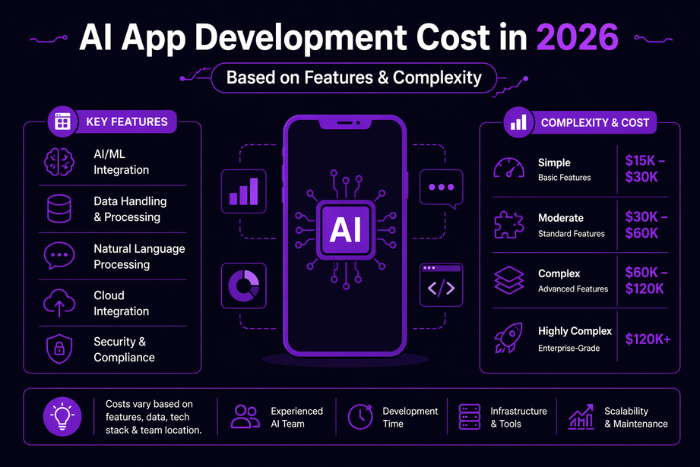
- Basic AI Applications: $15,000 – $50,000
- Mid-Level AI Applications: $50,000 – $200,000
- Advanced AI Solutions: $200,000 – $500,000+
Latest Trends
AI development in 2026 is influenced by several emerging trends that impact cost and innovation:
- Generative AI Expansion
Increased adoption of AI for content creation and automation. - AI-as-a-Service (AIaaS)
Businesses leveraging cloud-based AI solutions to reduce costs. - Edge AI Computing
Processing data locally for faster performance. - Responsible AI & Ethics
Focus on transparency, fairness, and compliance. - Low-Code AI Platforms
Faster development with reduced technical complexity. - AI + IoT Integration
Smart devices powered by real-time AI insights. - Automation at Scale
Businesses using AI to automate large-scale operations.
Why Choose Us for AI App Development Cost in 2026: What Businesses Should Budget
Choosing the right development partner is critical for managing costs and ensuring successful AI implementation.
AI Expertise
Our team specializes in building scalable and efficient AI-powered applications.
Cost-Optimized Solutions
We design solutions that balance performance with budget constraints.
End-to-End Development
From ideation to deployment, we handle the entire lifecycle.
Custom AI Models
Tailored solutions designed for your specific business needs.
Advanced Technology Stack
We use cutting-edge tools and frameworks for future-ready applications.
Transparent Pricing
Clear cost structure with no hidden charges.
Scalable Architecture
Solutions designed to grow with your business.
We focus on delivering AI solutions that maximize ROI while minimizing unnecessary costs.
Planning your AI project and unsure about the budget?
Let our experts guide you with a tailored cost estimate and strategy.
Contact us today for a free consultation and AI roadmap.
Key Points :
- Understand AI app development cost in 2026 to plan accurate business budgets
- Estimate costs based on AI complexity, data requirements, and infrastructure
- Choose the right AI solution type (chatbots, analytics, generative AI, etc.)
- Optimize costs using cloud-based AI and pre-trained models
- Account for hidden expenses like data processing and model maintenance
- Leverage scalable AI architecture for long-term business growth
FAQ's
Costs range from $15,000 for basic apps to $500,000+ for advanced AI solutions depending on complexity and features.
Key factors include data quality, model complexity, infrastructure, team location, and integration requirements.
Development typically takes 3–9 months depending on project scope and complexity.
Hidden costs include data preparation, model retraining, infrastructure scaling, and maintenance.
Industries include healthcare, finance, retail, logistics, education, and more.