
Build AI healthcare apps with AI app development for healthcare: HIPAA compliance 2026. Secure and scalable solutions for healthcare systems.
Introduction
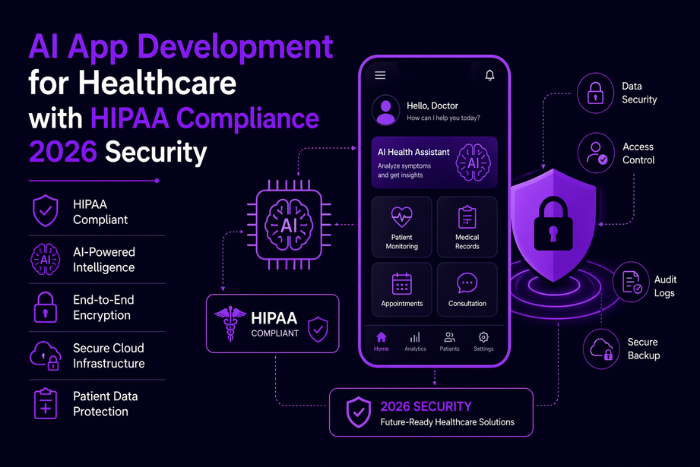
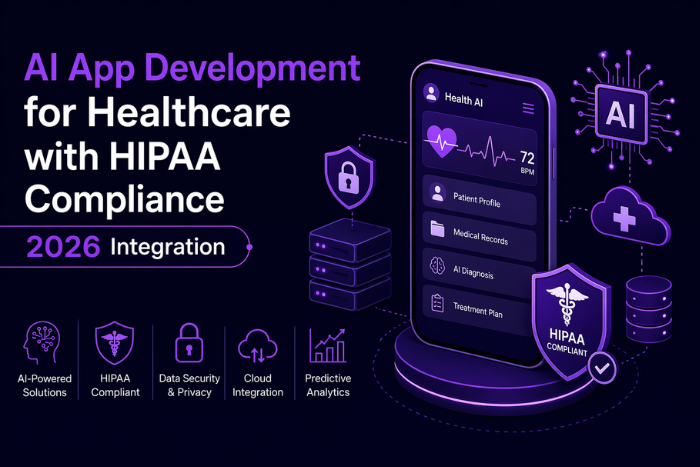
The healthcare industry is rapidly embracing digital transformation, and Artificial Intelligence is playing a central role in improving patient care, operational efficiency, and clinical decision-making. However, with the increasing use of AI in healthcare applications comes a critical responsibility—ensuring strict compliance with regulations like HIPAA. This is why understanding AI app development for healthcare: HIPAA compliance 2026 is essential for healthcare providers, startups, and enterprises.
HIPAA (Health Insurance Portability and Accountability Act) sets the standard for protecting sensitive patient data, also known as Protected Health Information (PHI). When developing AI-powered healthcare apps, compliance is not optional—it is mandatory. AI systems must be designed to handle data securely while maintaining transparency, accountability, and privacy.
In 2026, healthcare apps are leveraging AI for diagnostics, patient monitoring, telemedicine, and predictive analytics. At the same time, organizations must ensure that these applications meet compliance requirements without compromising innovation. This balance between advanced AI capabilities and data security defines the future of healthcare app development.
Why AI App Development for Healthcare: HIPAA Compliance 2026 is Important
Ensuring compliance while building AI-driven healthcare apps is critical for both legal and operational success.
- Protection of Patient Data (PHI)
Safeguards sensitive medical information from breaches. - Regulatory Compliance
Avoids legal penalties and ensures adherence to HIPAA standards. - Trust & Credibility
Builds confidence among patients and healthcare providers. - Secure Data Management
Ensures encryption, access control, and audit tracking. - Risk Mitigation
Reduces the likelihood of cyber threats and data leaks. - Scalable Healthcare Solutions
Enables growth while maintaining compliance standards.
Types of Solutions for AI App Development for Healthcare: HIPAA Compliance 2026
AI-powered healthcare applications with compliance requirements span multiple use cases:
- Telemedicine Applications
Secure video consultations and remote patient care. - AI Chatbots & Virtual Health Assistants
Patient interaction, appointment scheduling, and support. - Remote Patient Monitoring (RPM)
Real-time tracking of patient health data. - Medical Imaging & Diagnostics Apps
AI-powered analysis of scans and imaging data. - Electronic Health Record (EHR) Systems
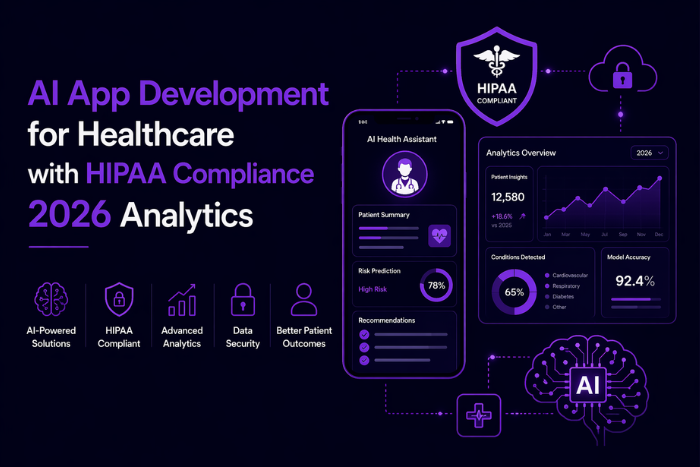
Secure storage and management of patient records. - Predictive Analytics Platforms
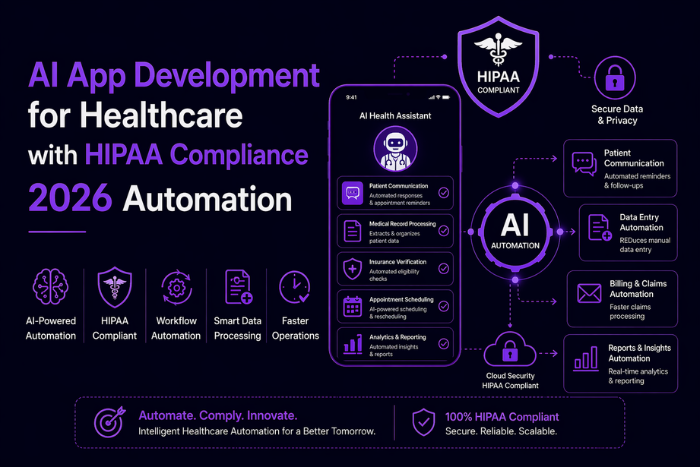
Early detection of diseases and risk assessment. - Healthcare Workflow Automation
Streamlining administrative processes. - Personalized Treatment Apps
AI-driven recommendations for patient care.
Key Features of AI App Development for Healthcare: HIPAA Compliance 2026
HIPAA-compliant AI healthcare apps require advanced security and performance features:
- End-to-End Data Encryption
Protects data during storage and transmission. - Role-Based Access Control (RBAC)
Restricts access based on user roles. - Audit Logs & Monitoring
Tracks system activity for compliance. - Data Anonymization & De-Identification
Protects patient identity in AI processing. - Secure Cloud Infrastructure
Ensures compliant hosting environments. - Multi-Factor Authentication (MFA)
Adds an extra layer of security. - Compliance Reporting Tools
Ensures adherence to regulatory standards. - AI Transparency & Explainability
Improves trust in AI-driven decisions.
Development Process
A structured approach ensures both innovation and compliance in healthcare AI apps:
- Requirement Analysis & Risk Assessment
Identifying compliance needs and AI use cases. - Data Classification & Management
Separating sensitive and non-sensitive data. - Secure Architecture Design
Building systems aligned with HIPAA standards. - AI Model Development & Integration
Implementing AI features securely. - Security Implementation
Encryption, access control, and monitoring. - Testing & Compliance Validation
Ensuring the app meets regulatory requirements. - Deployment & Continuous Monitoring
Ongoing updates and compliance checks.
Technology Stack for AI App Development for Healthcare: HIPAA Compliance 2026
Modern healthcare AI applications rely on secure and scalable technologies:
Programming Languages: Python, Java, JavaScript, C#
AI Frameworks: TensorFlow, PyTorch
Healthcare Standards: HL7, FHIR
Cloud Platforms: AWS (HIPAA-compliant), Google Cloud Healthcare API, Microsoft Azure
Database: PostgreSQL, MongoDB, HIPAA-compliant storage
Security Tools: Encryption protocols, IAM systems
DevOps Tools: Docker, Kubernetes
Analytics Tools: Power BI, Tableau
Cost Factors for AI App Development for Healthcare: HIPAA Compliance 2026
The cost of developing compliant healthcare AI apps depends on multiple factors:
- Compliance Requirements
Implementing HIPAA standards increases development complexity. - AI Model Complexity
Advanced features require more resources. - Data Security Measures
Encryption and secure infrastructure add to costs. - Integration with Healthcare Systems
EHR and third-party integrations increase effort. - Development Team Expertise
Skilled healthcare AI developers impact pricing. - Testing & Certification
Compliance validation processes add time and cost. - Maintenance & Updates
Continuous monitoring and updates for compliance.
Latest Trends
Healthcare AI development is evolving rapidly with new trends:
- AI-Powered Diagnostics
Faster and more accurate disease detection. - Agentic AI in Healthcare
Autonomous systems assisting medical workflows. - Remote Patient Monitoring Growth
Increased adoption of wearable devices. - Data Privacy & Security Innovations
Advanced encryption and compliance tools. - Interoperability Standards (FHIR)
Seamless data exchange across systems. - Edge AI in Healthcare
Processing data locally for faster insights. - Personalized Medicine
AI-driven treatment tailored to individuals.
Why Choose Us for AI App Development for Healthcare: HIPAA Compliance 2026
Choosing the right development partner is critical for building secure and scalable healthcare applications. We specialize in AI app development for healthcare: HIPAA compliance 2026 to deliver high-quality, compliant solutions.
Healthcare AI Expertise
Deep experience in AI-driven healthcare solutions.
Compliance-First Approach
Ensuring full adherence to HIPAA regulations.
Custom Healthcare Solutions
Tailored applications for specific medical use cases.
End-to-End Development
From planning to deployment and maintenance.
Advanced Security Implementation
Robust data protection and compliance measures.
Scalable Architecture
Solutions designed for growth and high performance.
Transparent Communication
Clear updates throughout the development process.
We help healthcare organizations build secure, intelligent, and compliant AI applications that improve patient outcomes and operational efficiency.
Looking to build a HIPAA-compliant AI healthcare app?
Let’s create secure and scalable healthcare solutions tailored to your needs.
Contact us today for a free consultation and development strategy.
Key Points :
- Ensure HIPAA compliance to protect sensitive patient data (PHI)
- Build secure AI healthcare apps with encryption, RBAC, and audit logs
- Use AI for telemedicine, diagnostics, and remote patient monitoring
- Implement data anonymization and privacy-first AI processing
- Improve patient outcomes with AI-driven insights and automation
- Develop scalable, compliant healthcare apps for long-term growth
FAQ's
HIPAA compliance ensures the protection of sensitive patient data (PHI).
It ensures data privacy, security, and legal compliance.
Apps handling patient data, such as telemedicine and EHR systems.
Costs vary based on complexity, features, and compliance requirements.
Yes, with proper encryption, access control, and compliance measures.
Typically 3–9 months depending on complexity.