
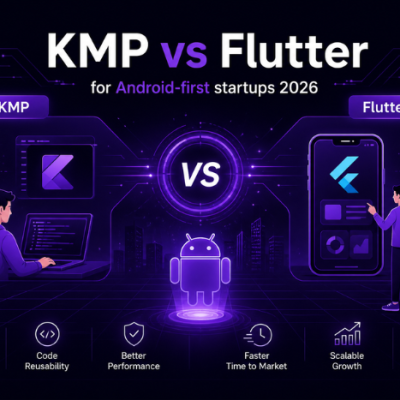
Compare App development with .NET MAUI vs Flutter 2026 for performance, cost, scalability, enterprise use, and cross-platform success.
Introduction
Cross-platform app development continues to dominate modern software strategy, enabling businesses to build applications faster, reduce costs, and reach multiple platforms with unified codebases. In 2026, two major frameworks stand out in this space: .NET MAUI and Flutter. Both platforms offer powerful tools for building iOS, Android, desktop, and web applications, but their strengths, weaknesses, and ideal business use cases differ significantly.
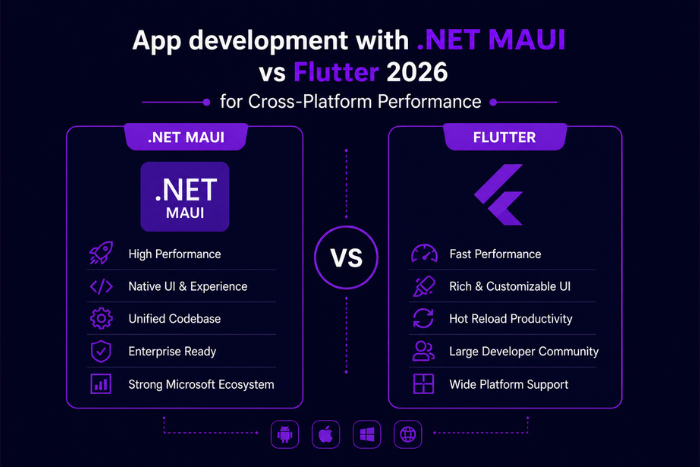
Understanding App development with .NET MAUI vs Flutter 2026 is essential for startups, enterprises, SaaS providers, and digital transformation leaders seeking the best framework for long-term product success. Flutter excels in highly customizable UI, strong community support, and rapid mobile-first development, while .NET MAUI offers deep Microsoft ecosystem integration, enterprise reliability, and native control advantages.
Choosing the right framework directly impacts performance, hiring costs, development speed, maintainability, and scalability. This guide explores technical comparisons, strategic business factors, and future trends to help organizations confidently select the best cross-platform development path.
Why App Development with .NET MAUI vs Flutter 2026 is Important
Framework selection affects product performance, operational efficiency, and long-term ROI.
- Optimizes Development Speed
Faster product launches improve competitiveness. - Controls Budget
Efficient frameworks reduce development and maintenance costs. - Supports Scalability
Proper architecture enables sustainable growth. - Improves User Experience
Framework performance impacts customer satisfaction. - Enhances Integration Flexibility
Supports modern cloud, AI, and enterprise ecosystems. - Reduces Technical Debt
Strategic framework selection improves maintainability. - Strengthens Market Position
Better apps outperform competitors.
Types of Solutions for App Development with .NET MAUI vs Flutter 2026
Different business goals align with different framework strengths.
- Enterprise Business Applications
.NET MAUI excels with Microsoft stack integration. - Consumer Mobile Apps
Flutter provides strong UI flexibility and rapid deployment. - Cross-Platform SaaS Products
Both frameworks support scalable SaaS ecosystems. - Internal Operational Tools
.NET MAUI often aligns with enterprise software environments. - MVP & Startup Products
Flutter often accelerates product validation. - Desktop + Mobile Unified Solutions
.NET MAUI offers broader enterprise desktop capabilities. - AI-Integrated Applications
Both frameworks can integrate modern AI systems. - High-Customization Consumer Platforms
Flutter often leads for design-centric applications.
Key Features of App Development with .NET MAUI vs Flutter 2026
Modern framework evaluation involves multiple strategic criteria.
- Cross-Platform Code Sharing
Both reduce duplicate development effort. - Performance Optimization
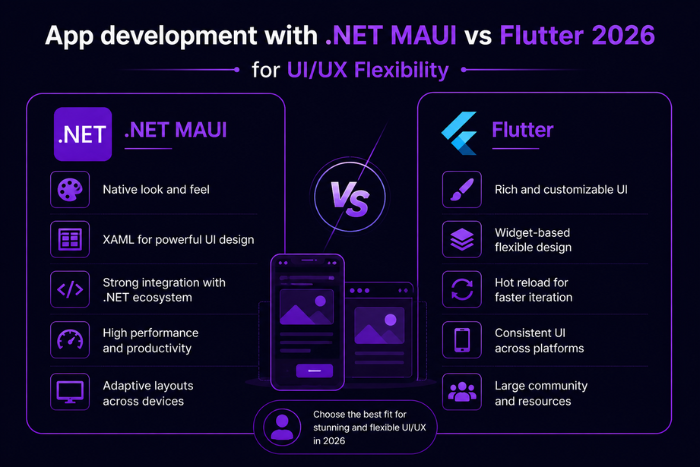
Flutter offers smooth rendering; MAUI leverages native controls. - UI/UX Customization
Flutter provides highly flexible design systems. - Enterprise Integration
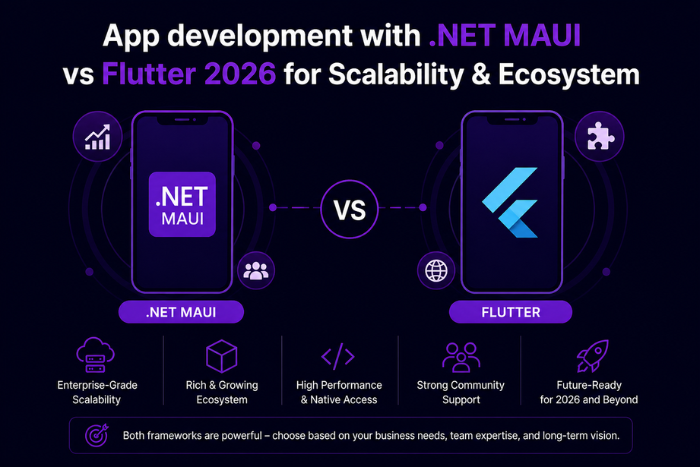
MAUI supports Microsoft infrastructure deeply. - Developer Ecosystem
Flutter has broader community support; MAUI benefits from .NET maturity. - Security & Compliance
MAUI often aligns well with enterprise governance. - Tooling & IDE Support
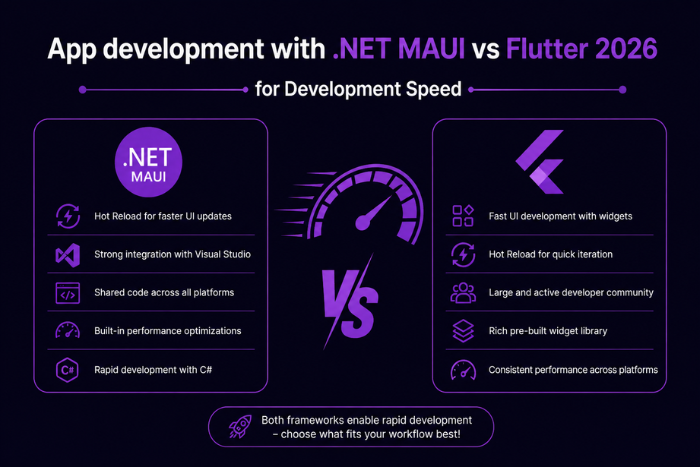
Visual Studio strengthens MAUI; Flutter offers flexible tooling. - Maintenance Efficiency
Unified codebases simplify support.
Development Process
Choosing and implementing the right framework requires structured planning.
- Business Requirement Analysis
Defining scalability, design, and infrastructure needs. - Framework Feasibility Assessment
Evaluating MAUI vs Flutter fit. - UI/UX Architecture Planning
Aligning product experience goals. - Development Environment Setup
Establishing optimized toolchains. - Core Development & Integration
Building applications with backend and cloud systems. - Testing & Optimization
Ensuring performance across devices. - Deployment & Ongoing Support
Launching and maintaining products.
Technology Stack for App Development with .NET MAUI vs Flutter 2026
Each framework operates within distinct ecosystems:
.NET MAUI: C#, .NET 10, Visual Studio, Azure
Flutter: Dart, Flutter SDK, Firebase, Google Cloud
Backend Technologies: Node.js, .NET Core, Python
Databases: PostgreSQL, MongoDB, Firebase Firestore
DevOps Tools: Docker, Jenkins, GitHub Actions
Cloud Platforms: AWS, Azure, Google Cloud
Testing Tools: Appium, Selenium, XCTest
AI Integrations: OpenAI APIs, TensorFlow, Azure AI Services
Cost Factors for App Development with .NET MAUI vs Flutter 2026
Framework choice directly impacts project economics.
- Developer Availability
Flutter often has broader hiring pools. - Enterprise Licensing
Microsoft ecosystem costs may impact MAUI budgets. - Project Complexity
UI-heavy apps may favor Flutter. - Maintenance Costs
Both frameworks offer cost efficiencies. - Cloud Infrastructure
Backend ecosystems vary. - Integration Requirements
Enterprise systems may increase MAUI value. - Long-Term Scalability
Framework suitability impacts future redevelopment risk.
Latest Trends
Cross-platform ecosystems are rapidly evolving.
- AI-Integrated App Development
Smarter apps influencing framework strategies. - Desktop-Mobile Convergence
Broader platform support becoming essential. - Low-Code + Cross-Platform Expansion
Faster enterprise development. - Security-First Framework Adoption
Compliance-focused decision-making. - Composable Architecture
Modular software ecosystems. - Performance Benchmark Competition
Framework optimization races. - Developer Productivity Automation
AI-assisted coding tools. - Cloud-Native App Growth
Backend scalability priorities.
Why Choose Us for App Development with .NET MAUI vs Flutter 2026
Choosing the right framework requires strategic expertise and technical precision.
Cross-Platform Development Expertise
Deep experience across both Flutter and .NET MAUI ecosystems.
Strategic Framework Consulting
Helping businesses select the best architecture for growth.
Enterprise & Startup Support
Solutions tailored for varying business scales.
Cost-Optimized Development
Maximizing ROI through smart framework decisions.
Performance-Driven Engineering
Building scalable, reliable applications.
Transparent Delivery Process
Clear milestones and measurable outcomes.
Future-Ready Innovation
Solutions built for evolving technology ecosystems.
We empower businesses to build successful cross-platform applications using the most effective framework for their unique goals.
Ready to choose between .NET MAUI and Flutter for your next app?
Let’s build scalable, high-performance cross-platform applications tailored to your business.
Contact us today for expert app development consulting.
Key Points :
- Flutter offers strong UI flexibility, rapid development, and broad developer adoption.
- .NET MAUI provides deep Microsoft ecosystem integration and enterprise-grade architecture.
- Framework choice directly impacts performance, scalability, hiring costs, and maintenance.
- Flutter is often ideal for startups, MVPs, and consumer-focused applications.
- .NET MAUI is highly suitable for enterprise systems and desktop-mobile integration.
- AI integration, cloud-native architecture, and security are major framework considerations in 2026.
FAQ's
It depends on business goals—Flutter often excels in UI flexibility, while MAUI is strong for enterprise integration.
Flutter often offers smoother rendering, especially for design-heavy apps.
Flutter generally has broader community adoption.
Flutter may offer lower hiring and ecosystem costs, while MAUI can reduce enterprise integration expenses.
Yes, both integrate well with modern AI services.
By evaluating scalability, infrastructure, design needs, hiring availability, and long-term business strategy.