
Explore blockchain app development use cases beyond crypto 2026, including supply chain, healthcare, identity, and enterprise solutions.

Introduction
The evolution of blockchain technology has moved far beyond its original association with cryptocurrencies. In 2026, enterprises are increasingly adopting blockchain app development use cases beyond crypto 2026 to solve real-world business challenges such as transparency, security, automation, and data integrity.
Blockchain is now a foundational technology powering industries like healthcare, logistics, finance, government, education, and supply chain management. Unlike traditional centralized systems, blockchain enables decentralized, tamper-proof, and transparent data exchanges that significantly reduce fraud, operational inefficiencies, and dependency on intermediaries.
Businesses are now leveraging blockchain applications for identity verification, smart contracts, asset tokenization, secure data sharing, and decentralized applications (dApps). These innovations are not only improving operational efficiency but also creating entirely new business models.
As organizations focus on digital transformation, blockchain is becoming a critical enabler of trust-based systems. Understanding blockchain app development use cases beyond crypto 2026 helps businesses identify opportunities to innovate, reduce costs, and enhance security in their digital ecosystems.
This service page explores key use cases, development processes, technology stacks, trends, and strategic benefits of blockchain beyond cryptocurrency applications.
Why Blockchain App Development Use Cases Beyond Crypto 2026 is Important
Understanding blockchain app development use cases beyond crypto 2026 is essential for businesses aiming to build secure, scalable, and future-ready digital systems.
- Enhanced Data Security
Blockchain ensures immutable and tamper-proof data storage. - Improved Transparency
Every transaction is traceable and verifiable in real time. - Reduced Operational Costs
Eliminates intermediaries and manual verification processes. - Trust in Digital Systems
Decentralization increases trust among users and stakeholders. - Automation Through Smart Contracts
Self-executing contracts reduce delays and human errors. - Cross-Industry Adoption
Applicable across healthcare, finance, logistics, and governance.
Types of Solutions in Blockchain App Development Use Cases Beyond Crypto 2026
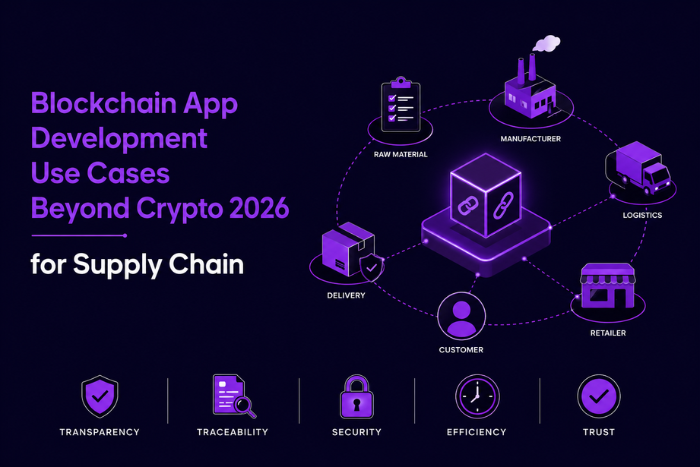
Supply Chain Management Solutions
- End-to-end product traceability
- Fraud prevention in logistics networks
- Real-time shipment tracking systems
Healthcare Blockchain Applications
- Secure patient data management
- Interoperable electronic health records
- Drug traceability and verification
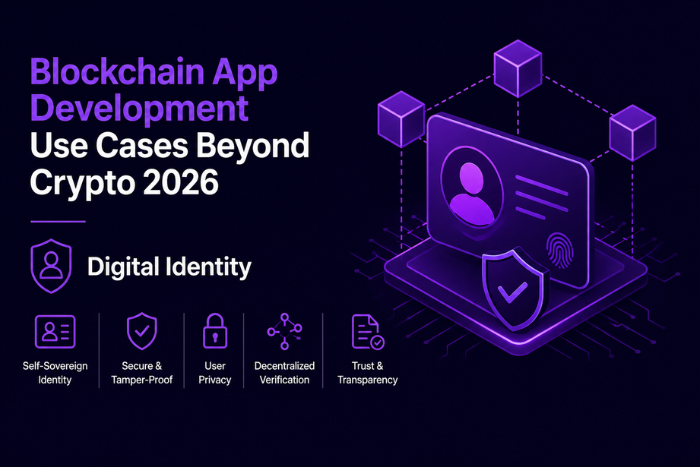
Digital Identity Verification Systems
- Decentralized identity (DID) platforms
- Secure KYC and onboarding processes
- Identity fraud prevention systems
Smart Contract Automation Solutions
- Automated payment processing systems
- Legal contract execution platforms
- Insurance claim automation tools
Financial & Banking Applications (Beyond Crypto)
- Secure cross-border transactions
- Fraud detection systems
- Digital asset management platforms
Government & Public Sector Systems
- Transparent voting systems
- Land registry management
- Public record verification systems
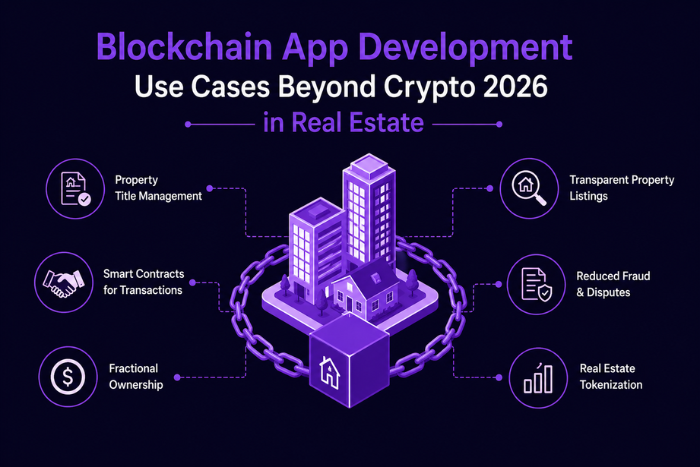
Real Estate Blockchain Applications
- Property ownership verification
- Tokenized real estate assets
- Smart rental agreements
Education & Certification Systems
- Verified digital certificates
- Academic record management
- Credential authentication platforms
Key Features of Blockchain App Development Use Cases Beyond Crypto 2026
- Decentralized Architecture
Eliminates single points of failure in systems. - Immutable Data Storage
Ensures records cannot be altered or deleted. - Smart Contract Automation
Automates business logic execution securely. - High-Level Security
Cryptographic protection for all transactions. - Transparency & Traceability
Full visibility of data history and changes. - Interoperability
Integration with existing enterprise systems. - Scalability Support
Designed for enterprise-level performance. - Auditability
Easy tracking and compliance verification.
Development Process
- Requirement Analysis
Define business objectives and blockchain use cases. - Platform Selection
Choose blockchain networks like Ethereum, Hyperledger, or Solana. - Architecture Design
Plan on-chain and off-chain system structure. - Smart Contract Development
Build secure and automated business logic. - Frontend & Backend Integration
Connect blockchain with user-facing applications. - Testing & Security Audits
Ensure vulnerability-free and high-performance systems. - Deployment
Launch on mainnet or enterprise blockchain networks. - Maintenance & Scaling
Continuous upgrades and performance optimization.
Technology Stack for Blockchain App Development Use Cases Beyond Crypto 2026
Blockchain Platforms: Ethereum, Hyperledger, Solana, Polygon
Smart Contracts: Solidity, Rust, Vyper
Backend Technologies: Node.js, Python, Go
Frontend Frameworks: React.js, Angular, Vue.js
Databases: MongoDB, PostgreSQL, IPFS
DevOps Tools: Docker, Kubernetes, Jenkins
Security Tools: OpenZeppelin, Truffle, Hardhat
Cloud Platforms: AWS, Azure, Google Cloud
Cost Factors in Blockchain App Development Use Cases Beyond Crypto 2026
- Project Complexity
Advanced enterprise systems require higher investment. - Blockchain Platform Choice
Public vs private blockchain affects cost structure. - Smart Contract Complexity
More logic increases development time and cost. - Integration Requirements
Connecting with legacy systems adds complexity. - Security Audits
Mandatory audits increase initial project cost. - Scalability Requirements
Enterprise-scale apps require robust infrastructure. - Development Team Expertise
Skilled blockchain developers influence pricing. - Maintenance & Upgrades
Continuous updates add long-term cost.
Latest Trends
- Tokenization of Real-World Assets
Digital representation of physical assets. - Enterprise Blockchain Adoption
Large-scale business integration of blockchain systems. - AI + Blockchain Integration
Smart automation with secure data ecosystems. - Decentralized Identity (DID) Growth
User-controlled identity systems. - Blockchain as a Service (BaaS)
Cloud-based blockchain infrastructure solutions. - Cross-Chain Interoperability
Seamless communication between blockchain networks. - Regulatory Blockchain Solutions
Compliance-focused blockchain systems.
Why Choose Us for Blockchain App Development Use Cases Beyond Crypto 2026
We help businesses build secure, scalable, and future-ready blockchain solutions designed for real-world enterprise challenges.
Expert Blockchain Development Team
Skilled professionals delivering secure and high-performance decentralized applications.
Custom Blockchain Solutions
Tailored development aligned with your industry needs and business goals.
Strong Security Standards
End-to-end encryption, audits, and compliance-focused development approach.
Scalable Architecture
Blockchain systems designed to grow with your business demands.
Advanced Technology Integration
Seamless integration with AI, IoT, cloud, and enterprise systems.
End-to-End Development Support
Complete support from ideation, development, deployment to maintenance.
Industry-Focused Experience
Proven expertise across healthcare, finance, logistics, and government sectors.
We empower enterprises to adopt blockchain beyond crypto with innovation, trust, and scalability.
Let’s build secure and scalable decentralized applications for your future.
Contact us today to get started with expert blockchain consulting.
Key Points :
- Blockchain in 2026 is widely used beyond crypto for enterprise and real-world applications.
- Key use cases include supply chain, healthcare, identity verification, and smart contracts.
- Businesses reduce operational costs by removing intermediaries and automating processes.
- Industries like finance, logistics, government, and education are rapidly adopting blockchain.
- Blockchain supports decentralized identity and secure data management systems.
FAQ's
They include supply chain, healthcare, identity management, smart contracts, and enterprise systems.
Yes, blockchain is widely used in non-financial industries for security and transparency.
Healthcare, finance, logistics, government, and education benefit the most.
They are self-executing agreements coded on blockchain networks.
Costs depend on complexity, platform choice, and security requirements.
It allows users to control their identity without centralized authorities.