




Discover the must-have features of a review website including ratings, moderation, search, and SEO tools to build a trusted review platform.


Must-Have Features of a Review Website
Online review platforms have become a crucial part of the modern digital ecosystem. Before purchasing a product, choosing a service provider, or booking a hotel, most consumers rely on reviews to make informed decisions. Because of this shift in consumer behavior, businesses and entrepreneurs are increasingly building review websites that allow users to share experiences, rate services, and discover trusted recommendations.
Understanding the must-have features of a review website is essential when creating a platform that attracts users and maintains credibility. A successful review website is not just a collection of opinions—it is a structured system that ensures authenticity, usability, and meaningful user engagement.
Modern review platforms include features such as rating systems, verified user reviews, advanced filtering, moderation tools, search functionality, and SEO optimization. These features help users quickly find trustworthy reviews while ensuring that the content remains useful and reliable.
Whether you are planning to build a product review site, business directory, travel review platform, or niche review community, implementing the right features will determine the success and scalability of your platform. This guide explores the most important components every high-performing review website should include.
Why Must-Have Features of a Review Website Are Important
Review websites influence purchasing decisions and brand reputation more than ever before. Platforms that provide transparent, reliable, and easy-to-navigate reviews quickly gain user trust and grow their communities.
Having the right features on a review website provides several advantages:
Builds user trust and credibility by displaying authentic feedback and ratings
Improves user engagement through comments, ratings, and community interactions
Helps businesses understand customer feedback and improve their services
Increases search engine visibility because review-based content often ranks well in search results
Supports better decision-making for users comparing products, services, or locations
Without proper structure and moderation, review platforms can easily become cluttered with spam or low-quality content. By implementing the correct features, you ensure the platform remains trustworthy and scalable.
Types of Review Website Solutions
Review platforms can serve many industries and purposes depending on the target audience.
Some common types of review websites include:
Product Review Websites
Platforms where users review gadgets, electronics, beauty products, and other consumer goods.Business Review Platforms
Websites that allow customers to rate businesses such as restaurants, agencies, or local services.Travel Review Platforms
Websites where travelers share experiences about hotels, destinations, airlines, and tours.Software and SaaS Review Websites
Platforms where users review digital tools, software products, and SaaS solutions.Local Service Review Platforms
Websites focused on plumbers, electricians, contractors, and other local service providers.Niche Community Review Platforms
Specialized review websites focused on a specific industry such as education, healthcare, or finance.Marketplace Review Systems
Review platforms integrated with eCommerce marketplaces to evaluate sellers and products.
Each of these platforms requires strong review management and user experience features.
Key Features of a Review Website
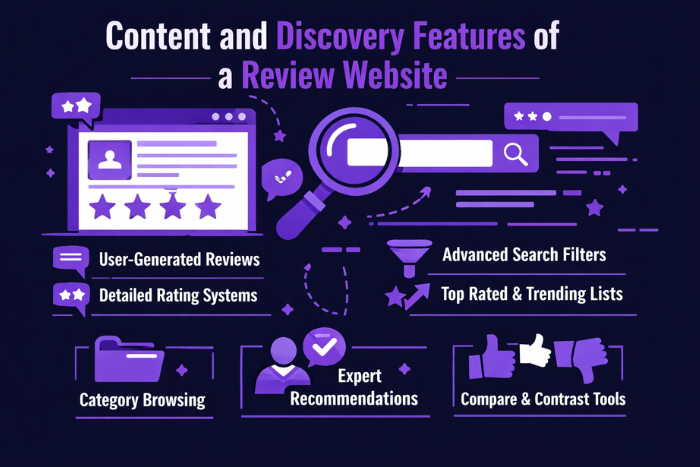
A successful review platform requires features that make reviews reliable, accessible, and engaging for users.
Some of the must-have features of a review website include:
Rating and Scoring System
Star ratings or numerical scoring systems allow users to quickly evaluate products or services.User Review Submission
A simple interface for users to write reviews, upload images, and share experiences.Verified Reviews
Verification systems ensure that reviews come from real users or actual customers.Advanced Search and Filters
Users should be able to filter reviews by rating, category, date, or popularity.Sorting Options
Reviews can be sorted by newest, highest rating, most helpful, or most relevant.Review Moderation Tools
Administrators can remove spam, inappropriate content, or fake reviews.User Profiles and Activity Tracking
Profiles display a user’s review history and credibility.Helpful Vote System
Users can vote whether a review was helpful, promoting the most useful feedback.Mobile-Friendly Design
Responsive layouts allow users to browse and submit reviews easily on smartphones.SEO-Friendly Review Pages
Structured data, optimized URLs, and rich snippets help review pages rank in search results.
These features ensure that users can trust the platform and easily navigate its content.
Development Process
Developing a reliable review website requires a structured development strategy.
Requirement Analysis and Market Research
Identifying the target audience, platform purpose, and core features required.Information Architecture Planning
Designing categories, filters, and content organization for easy navigation.UI/UX Design
Creating intuitive user interfaces that make browsing and posting reviews simple.Backend Development
Implementing databases, authentication systems, and review management systems.Feature Integration
Adding rating systems, review verification, search filters, and moderation tools.Testing and Quality Assurance
Performing performance testing, security checks, and usability testing.Deployment and Optimization
Launching the platform on scalable infrastructure and optimizing performance.
A well-structured development process ensures the review website includes essential features and remains secure, scalable, and easy to maintain.
Technology Stack
Modern review websites rely on robust technology stacks to handle user-generated content and high traffic.
Front-End: React.js, Vue.js, Angular, Next.js
Back-End: Node.js, Django, Laravel, Ruby on Rails
Databases: PostgreSQL, MongoDB, MySQL, Redis
Search Engines: Elasticsearch, Algolia
Cloud Services: AWS, Google Cloud, Microsoft Azure
DevOps: Docker, Kubernetes, CI/CD pipelines
Security: OAuth authentication, SSL encryption, role-based access control (RBAC)
Using reliable technologies ensures smooth performance and long-term scalability.

Cost Factors
The cost of developing a review website depends on various factors.
Important cost considerations include:
Complexity of rating and review systems
User authentication and verification systems
Search and filtering functionality
Moderation and spam detection tools
Custom UI/UX design
Third-party integrations such as maps or payment systems
Hosting and infrastructure setup
Ongoing maintenance and feature updates
A basic review website can be built as an MVP with essential features, while a large-scale platform with millions of users may require advanced infrastructure and development resources.
Flexible pricing models such as fixed-cost development or dedicated teams can help businesses scale their platform gradually.
Latest Trends in Review Website Development
Review platforms continue evolving as technology advances and user expectations grow.
Some emerging trends include:
AI-powered sentiment analysis for reviews
Automated spam detection and moderation
Voice and video reviews
Personalized review recommendations
Integration with social media platforms
Local review platforms with geolocation features
Gamification systems for reviewers
Rich snippets and structured data for SEO
These innovations help improve trust, engagement, and content discovery on review platforms.
Why Choose Us to Build Your Review Website?
Creating a successful review website requires more than just technical development—it requires designing a platform with powerful features that users trust and enjoy using.
Our team specializes in building scalable, high-performance review platforms tailored to your business goals.
Here’s what makes us the right development partner:
User-Centric Platform Design – Clean and intuitive interfaces for seamless browsing and review submission.
Scalable Architecture – Systems designed to handle growing communities and large volumes of reviews.
Advanced Moderation Tools – Protecting the platform from spam, fake reviews, and abusive content.
SEO-Optimized Review Pages – Structured data and optimized layouts that help your platform rank higher in search results.
Mobile-First Development – Fully responsive platforms that work perfectly on smartphones and tablets.
Cloud-Ready Infrastructure – Reliable performance and scalability with modern cloud technologies.
Custom Feature Development – Tailored rating systems, review verification, and user engagement tools.
Long-Term Support and Optimization – Continuous updates, monitoring, and performance improvements.
We help you build a trusted review platform that attracts users and delivers real value.
Ready to launch your own review website platform?
Let’s build a scalable and trustworthy review system tailored to your business.
Contact us today for a free consultation and customized quote.
Key Points :
- A review website must include a rating system (stars or scores) so users can quickly evaluate products or services.
- User-generated reviews with text, images, or videos help provide detailed experiences and increase credibility.
- Advanced search and filtering options allow users to sort reviews by rating, date, popularity, or category.
- Verified review systems ensure feedback comes from real users, increasing trust and authenticity.
- Moderation and spam control tools help maintain quality content and prevent fake or misleading reviews.
- Helpful vote or like system highlights the most valuable reviews for other users.
FAQ's
Important features include rating systems, verified reviews, moderation tools, search filters, user profiles, and SEO-friendly review pages.
They use verification systems, moderation tools, spam filters, and community reporting to ensure reviews are genuine.
Yes. Review platforms generate user-generated content and rich snippets, which can improve search engine visibility.
Platforms use verification systems, AI-based moderation, CAPTCHA, and community reporting features.
Yes. With scalable architecture and optimized databases, review websites can support millions of users.
A basic MVP review platform may take 4–8 weeks, while advanced platforms may require several months.
Industries such as travel, eCommerce, SaaS, healthcare, and local services benefit significantly from review platforms.