
Compare no-code app development vs custom apps ROI 2026, costs, scalability, and best choice for your business growth.
Introduction
In 2026, businesses are increasingly evaluating whether to build applications using no-code platforms or invest in fully custom development. The debate around no-code application development vs custom apps: ROI 2026 has become central to digital strategy, especially for startups and enterprises aiming to optimize costs while scaling efficiently.
No-code and low-code platforms have gained massive traction due to their speed and accessibility, enabling non-technical users to build apps quickly. On the other hand, custom app development offers unmatched flexibility, scalability, and long-term value—making it the preferred choice for complex and high-growth businesses.
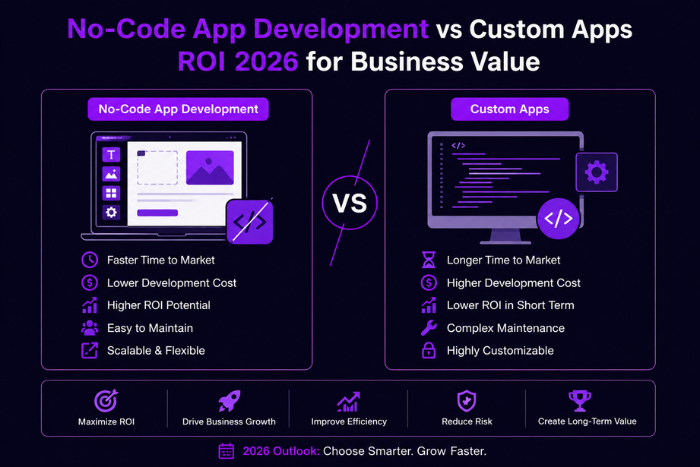
The real question is not just which option is cheaper, but which delivers the best return on investment (ROI) over time. While no-code solutions reduce initial costs, they may introduce limitations in customization, performance, and scalability. Custom apps, though requiring higher upfront investment, often provide better long-term ROI through tailored features and ownership.
This service helps businesses evaluate both approaches, understand ROI implications, and choose the right development strategy for sustainable growth in 2026.
Why No-code App Development vs Custom Apps: ROI 2026 is Important
Choosing the right development approach directly impacts business growth and profitability.
- Cost vs Long-Term Value
Balance between initial investment and future returns. - Speed of Development
Faster launches vs scalable solutions. - Flexibility & Customization
Ability to adapt to business needs. - Scalability Considerations
Support for growth and increasing users. - Ownership & Control
Data and system ownership differences. - Competitive Advantage
Custom features vs standard templates.
Types of Solutions in No-code App Development vs Custom Apps: ROI 2026
Businesses can choose from multiple development approaches:
- No-Code Platforms
Drag-and-drop tools for rapid app creation. - Low-Code Development
Minimal coding with some customization. - Custom App Development
Fully tailored applications built from scratch. - Hybrid Development Approach
Combining no-code with custom features. - MVP Development with No-Code
Quick validation of ideas. - Enterprise Custom Applications
Complex systems with advanced integrations. - SaaS-Based No-Code Solutions
Subscription-based platforms. - Migration from No-Code to Custom
Scaling apps as business grows.
Key Features of No-code App Development vs Custom Apps: ROI 2026
Understanding feature differences helps evaluate ROI:
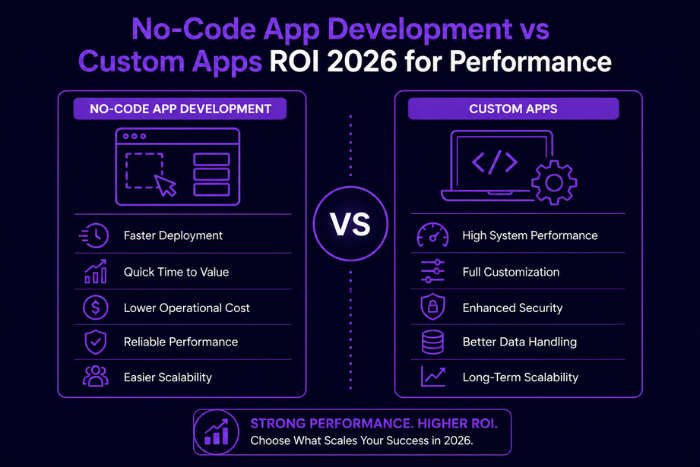
- Development Speed
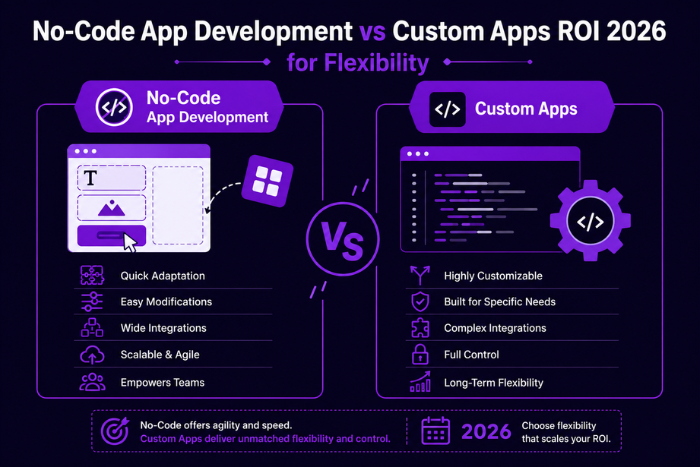
No-code offers faster deployment. - Customization Capability
Custom apps provide full flexibility. - Scalability
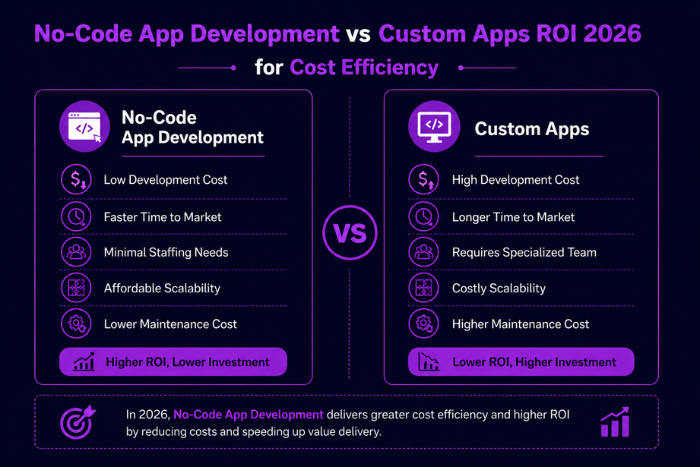
Custom apps handle large user bases better. - Cost Efficiency
No-code reduces upfront costs. - Integration Capabilities
Custom apps support complex integrations. - Performance Optimization
Custom apps deliver higher performance. - Security & Compliance
Custom solutions offer better control. - Ownership & Data Control
Custom apps ensure full ownership.
Development Process
- Requirement Analysis & Business Goals
Define objectives and expected ROI. - Approach Selection (No-Code vs Custom)
Choose the right development strategy. - UI/UX Design & Prototyping
Create user-friendly interfaces. - Application Development
Build using chosen approach. - Integration & Testing
Ensure compatibility and performance. - Deployment & Launch
Release the application. - Monitoring & Optimization
Improve performance and ROI over time.
Technology Stack for No-code App Development vs Custom Apps: ROI 2026
No-Code Platforms: Bubble, Adalo, Glide, Webflow
Low-Code Platforms: OutSystems, Mendix
Programming Languages: JavaScript, Python, Java, Kotlin, Swift
Frameworks: Flutter, React Native, Angular, Node.js
Backend Technologies: Django, Spring Boot, Express.js
Databases: MongoDB, PostgreSQL, MySQL
Cloud Platforms: AWS, Google Cloud, Microsoft Azure
Analytics Tools: Firebase, Mixpanel
Cost Factors for No-code App Development vs Custom Apps: ROI 2026
Several factors influence ROI and cost:
- Initial Development Cost
No-code is cheaper upfront; custom requires investment. - Subscription & Licensing Fees
No-code platforms have recurring costs. - Scalability Costs
Custom apps scale more efficiently. - Maintenance & Updates
Custom apps offer better long-term control. - Integration Requirements
Complex integrations increase cost. - Performance Optimization Needs
Custom apps may require additional investment. - Migration Costs
Moving from no-code to custom can be expensive. - Total Cost of Ownership (TCO)
Long-term cost comparison is crucial.
Latest Trends
- Rise of No-Code Adoption
Startups using no-code for rapid MVPs. - Hybrid Development Models
Combining no-code with custom solutions. - AI Integration in No-Code Platforms
Enhancing capabilities and automation. - Shift Toward Custom for Scaling
Businesses moving to custom apps as they grow. - Focus on ROI-Driven Development
Decisions based on long-term value. - Low-Code Enterprise Solutions
Increasing adoption in large organizations. - Improved No-Code Capabilities
Expanding features and integrations.
Why Choose Us for No-code App Development vs Custom Apps: ROI 2026
Strategic Consulting
We help you choose the best development approach.
ROI-Focused Solutions
Maximize long-term value and performance.
Custom & No-Code Expertise
Experience in both development models.
Scalable Development Strategies
Build solutions that grow with your business.
Cost Optimization
Balance budget and performance effectively.
End-to-End Services
From planning to deployment and scaling.
Continuous Support
Ongoing improvements and optimization.
Not sure whether to choose no-code or custom development?
Let’s help you make the right decision for maximum ROI.
Contact us today to start building your app strategy.
Key Points :
- Custom app development provides better scalability, flexibility, and long-term ROI for growing businesses
- No-code platforms have limitations in customization, performance, and complex integrations
- Custom apps ensure full ownership, better security, and advanced feature capabilities
- Hybrid approaches combining no-code and custom development are becoming popular in 2026
- Total cost of ownership (TCO) is crucial when comparing long-term ROI between both approaches
FAQ's
No-code uses pre-built tools, while custom apps are built from scratch.
Custom apps provide better long-term ROI, while no-code is cost-effective initially.
Yes, it’s ideal for MVPs and quick launches.
Yes, but migration may involve additional costs.
Costs vary depending on complexity and features.
Combining no-code tools with custom development for flexibility.