
On-device AI in mobile apps: Apple vs Google approach 2026 for privacy, performance, scalability, and smarter app innovation.
Introduction
The future of mobile application development is rapidly shifting toward edge intelligence, where AI processing occurs directly on smartphones instead of relying heavily on cloud infrastructure. Understanding On-device AI in mobile apps: Apple vs Google approach 2026 is critical for businesses, developers, and product leaders aiming to build faster, smarter, and privacy-first digital experiences.
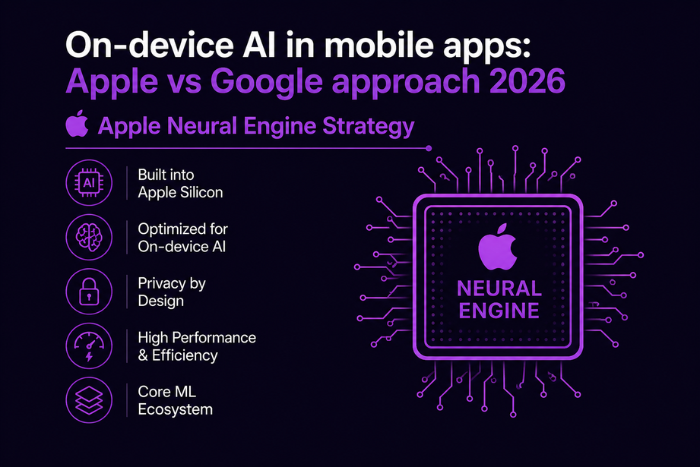
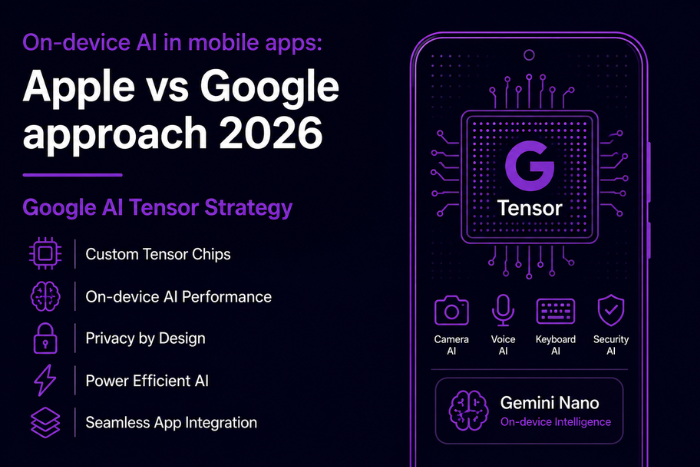
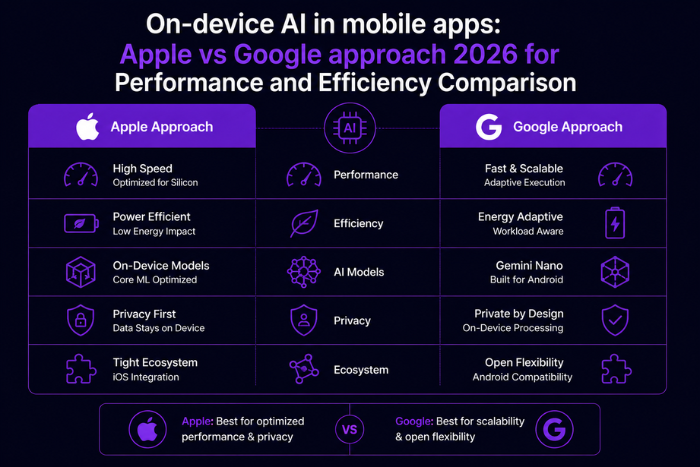
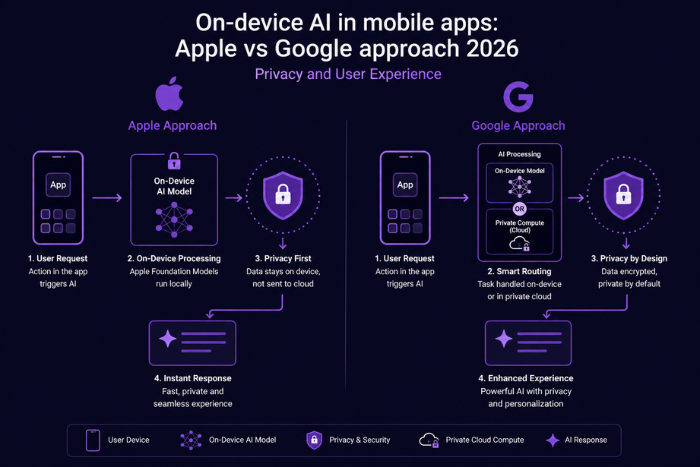
Apple and Google are shaping two distinct strategies in on-device AI. Apple prioritizes privacy, hardware-software integration, and tightly controlled ecosystem performance, while Google focuses on scalability, broader AI model accessibility, and cloud-enhanced hybrid intelligence. Both approaches significantly impact app architecture, personalization, security, latency, and monetization opportunities.
As AI becomes central to mobile apps—from virtual assistants to predictive analytics and multimodal interfaces—choosing the right platform strategy can directly influence user trust, competitive advantage, and long-term product success in 2026 and beyond.
Why On-Device AI in Mobile Apps: Apple vs Google Approach 2026 is Important
On-device AI is transforming mobile ecosystems globally.
- Enhanced Privacy
User data stays on-device. - Faster Performance
Reduced cloud dependency lowers latency. - Improved Reliability
Offline AI functionality improves usability. - Cost Optimization
Lower server costs. - Personalized User Experiences
Real-time intelligent customization. - Security Benefits
Reduced external data transmission. - Platform Differentiation
Apple and Google ecosystems offer unique opportunities. - Future-Proof App Development
Supports long-term AI trends.
Types of Solutions for On-Device AI in Mobile Apps: Apple vs Google Approach 2026
On-device AI influences multiple mobile product categories:
- AI Assistants & Voice Interfaces
Siri, Gemini, and conversational UX. - Computer Vision Apps
Image recognition and augmented reality. - Healthcare Monitoring Apps
Real-time health diagnostics. - Productivity Applications
Predictive automation tools. - Smart Security Apps
Face recognition and authentication. - Gaming & AR/VR Platforms
Real-time immersive experiences. - Fintech Applications
Fraud detection and security. - Enterprise Mobile Solutions
Workflow automation and analytics.
Key Features of On-Device AI in Mobile Apps: Apple vs Google Approach 2026
Modern mobile AI ecosystems offer advanced capabilities:
- Low-Latency AI Processing
Instant responses. - Privacy-Centric Architecture
Secure local processing. - Offline Functionality
Reduced connectivity dependence. - Hardware Acceleration
Neural engines and tensor chips. - Multimodal AI Support
Voice, text, image, and contextual intelligence. - Battery Optimization
Efficient processing. - Cross-App Intelligence
Deeper ecosystem integration. - Advanced Personalization
Behavioral adaptation. - Scalable AI Model Deployment
Broader app innovation.
Development Process
Successful on-device AI integration requires strategic planning:
- Platform Strategy Analysis
Apple vs Google ecosystem alignment. - Use Case Identification
Define AI-powered app opportunities. - Model Selection & Optimization
Lightweight mobile AI models. - Hardware Compatibility Planning
Device capability optimization. - AI Integration
Embed Core ML or TensorFlow Lite. - Testing & Privacy Validation
Security and performance assurance. - Deployment
Launch across target devices. - Continuous Optimization
Adapt to AI ecosystem evolution.
Technology Stack
Modern on-device AI systems rely on:
Apple Ecosystem: Core ML, SiriKit, Swift, Neural Engine
Google Ecosystem: TensorFlow Lite, Android AI APIs, Kotlin, Gemini integrations
Cross-Platform: Flutter, React Native
Programming Languages: Swift, Kotlin, Python
Cloud Infrastructure: AWS, Google Cloud, Azure
DevOps: Docker, Kubernetes
Data Processing: ONNX, TensorRT
Analytics: Firebase, GA4, Power BI
Cost Factors for On-Device AI in Mobile Apps: Apple vs Google Approach 2026
Investment depends on platform complexity:
- Platform Ecosystem
Apple may require tighter optimization. - Model Development
AI training and deployment complexity. - Hardware Compatibility
Device support requirements. - Privacy Compliance
Regulatory standards. - Development Team Expertise
Specialized AI engineering. - Performance Optimization
Mobile efficiency tuning. - Maintenance
Ongoing AI model updates. - Cross-Platform Support
Broader deployment increases costs.
Latest Trends
Mobile AI continues evolving rapidly:
- AI-Native Mobile Architecture
Apps designed around AI-first experiences. - Hybrid AI Models
Combining local and cloud intelligence. - Multimodal Interfaces
Voice + visual + contextual AI. - Private AI Assistants
Personalized mobile agents. - Generative AI Integration
Content creation within apps. - Edge Computing Expansion
Faster decentralized intelligence. - AI-Powered Personalization
Dynamic user experiences. - Regulatory Privacy Expansion
Stronger user protections.
Why Choose Us for On-Device AI in Mobile Apps: Apple vs Google Approach 2026
We help businesses build intelligent mobile applications optimized for future AI ecosystems.
AI Mobile Development Expertise
Deep experience in Apple and Android AI systems.
Privacy-First Architecture
Secure and compliant app development.
Performance Optimization
Low-latency, scalable AI experiences.
Cross-Platform Innovation
Apple, Google, and hybrid solutions.
Enterprise-Grade Security
Advanced governance standards.
Strategic Technology Planning
Future-ready AI product development.
Transparent Delivery
Clear communication and measurable outcomes.
Continuous AI Growth Support
Long-term optimization for evolving markets.
We empower businesses to capitalize on mobile AI innovation with scalable, secure, and intelligent app ecosystems designed for 2026 and beyond.
Ready to future-proof your mobile app with on-device AI innovation?
Let’s build intelligent mobile experiences optimized for Apple, Google, or hybrid ecosystems.
Contact us today for expert AI-powered mobile app development consultation.
Key Points :
- Learn how on-device AI improves app speed, offline functionality, security, and user personalization.
- Explore key business use cases including AI assistants, healthcare apps, fintech security, enterprise mobility, and smart ecommerce.
- Understand the technology stack behind mobile AI, including Core ML, TensorFlow Lite, Swift, Kotlin, and cross-platform frameworks.
- Analyze development costs based on AI model complexity, platform ecosystem, compliance, and hardware optimization.
- Identify which platform approach—Apple, Google, or hybrid—is best for long-term scalability and business growth.
FAQ's
AI processing that occurs directly on smartphones rather than cloud servers.
It improves privacy, speed, and offline functionality.
Apple emphasizes privacy and hardware integration, while Google focuses on broader scalability and hybrid AI.
Generally yes, due to reduced external data sharing.
Core ML, TensorFlow Lite, SiriKit, and Android AI APIs.
By investing in scalable, privacy-first, AI-native mobile architectures.