

PHP 8.4 vs Node.js for web apps: Speed comparison 2026 for performance, scalability, cost, and backend strategy.
Introduction
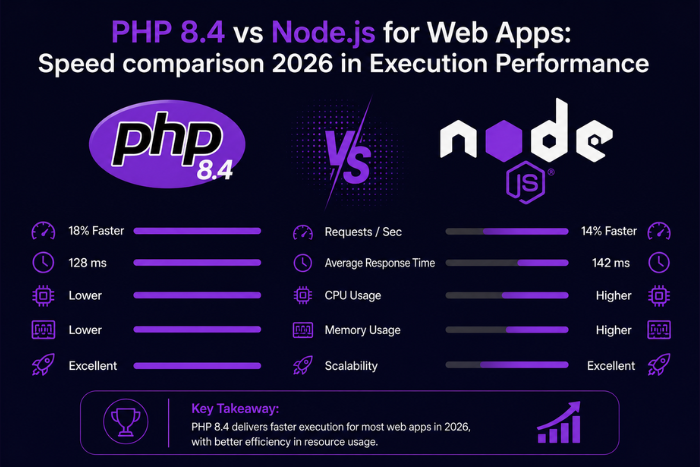
As businesses increasingly rely on high-performance web applications, selecting the right backend technology has become a crucial strategic decision. Understanding PHP 8.4 vs Node.js for web apps: Speed comparison 2026 helps organizations choose the most effective framework for scalability, speed, cost efficiency, and long-term digital success.
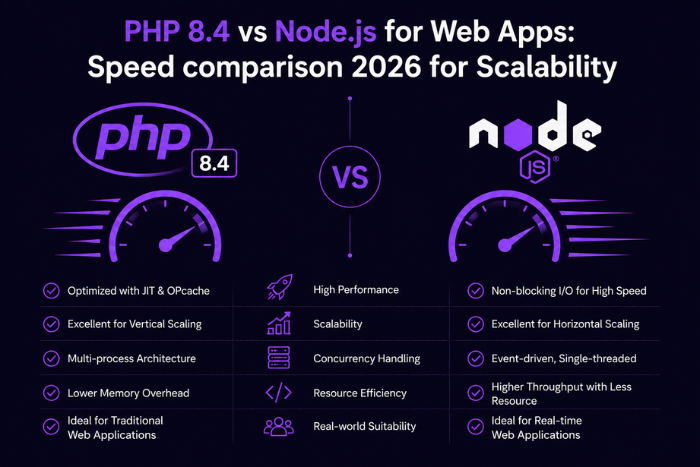
In 2026, PHP 8.4 continues evolving with stronger execution performance, JIT improvements, asynchronous capabilities, and modern frameworks like Laravel. Meanwhile, Node.js remains a dominant force for real-time applications, microservices, APIs, and event-driven systems due to its non-blocking architecture and JavaScript ecosystem.
The right choice depends on business goals—whether building enterprise applications, SaaS platforms, eCommerce websites, APIs, or high-concurrency systems. Evaluating speed, throughput, development costs, security, maintainability, and deployment flexibility is essential for maximizing ROI and future-proofing web infrastructure.
Why PHP 8.4 vs Node.js for Web Apps: Speed Comparison 2026 is Important
Backend architecture directly impacts business performance.
- Application Speed
Faster systems improve UX and SEO. - Scalability
Supports growing traffic demands. - Operational Efficiency
Optimized stacks reduce resource costs. - Development Speed
Framework productivity affects timelines. - Security
Strong backend systems reduce vulnerabilities. - Maintenance Costs
Long-term sustainability matters. - Real-Time Capability
Critical for modern digital products. - Business ROI
Technology choices impact profitability.
Types of Solutions
Different backend technologies serve different business models:
- PHP for Business Websites
Corporate websites, CMS, and eCommerce. - Node.js for Real-Time Applications
Chat, streaming, live tracking. - PHP for Enterprise Platforms
Workflow systems and portals. - Node.js for APIs & Microservices
Event-driven architectures. - Hybrid Architectures
Combining PHP core systems with Node.js services. - SaaS Platforms
Framework selection based on scalability. - Marketplace Platforms
Performance and transactional needs. - Custom Web Applications
Tailored backend solutions.
Key Features of PHP 8.4 vs Node.js for Web Apps: Speed Comparison 2026
Each technology offers distinct strengths:
- PHP 8.4 JIT Enhancements
Improved execution efficiency. - Laravel Ecosystem
Rapid enterprise development. - Node.js Non-Blocking I/O
High concurrency support. - JavaScript Full-Stack Potential
Unified frontend/backend development. - Microservices Readiness
Strong Node.js advantage. - Database Flexibility
Broad ecosystem support. - Security Frameworks
Mature solutions across both platforms. - Cloud Deployment Compatibility
Modern infrastructure support. - Community Ecosystem
Extensive tooling and packages.
Development Process
Choosing the right backend requires strategic analysis:
- Business Requirement Assessment
Define traffic, features, and scalability goals. - Performance Benchmarking
Compare speed and throughput. - Architecture Planning
Monolith, microservices, or hybrid. - Framework Selection
Laravel, Symfony, NestJS, Express, etc. - Development Implementation
Build secure and scalable systems. - Security Testing
OWASP and compliance validation. - Performance Optimization
Caching, scaling, and infrastructure tuning. - Deployment & Continuous Monitoring
Long-term optimization.
Technology Stack
Modern backend systems leverage advanced technologies:
PHP Stack: PHP 8.4, Laravel, Symfony, MySQL, Redis
Node.js Stack: Node.js, NestJS, Express, MongoDB, PostgreSQL
Frontend: React, Next.js, Vue.js
Hosting: AWS, DigitalOcean, Vercel, Azure
DevOps: Docker, Kubernetes, CI/CD
Security: OAuth, JWT, WAF, SSL
Monitoring: Datadog, New Relic, Sentry
Caching: Redis, Memcached
Cost Factors
Investment depends on multiple business variables:
- Developer Availability
Talent pool costs vary. - Framework Complexity
Project structure impacts budgets. - Infrastructure Costs
Resource efficiency matters. - Maintenance Requirements
Ongoing support costs. - Scaling Demands
Growth increases complexity. - Security Compliance
Regulatory standards add expenses. - Integration Scope
APIs and third-party systems. - Migration Costs
Switching technologies can be expensive.
Latest Trends
Backend ecosystems continue evolving:
- Modern PHP Async Growth
Enhanced performance capabilities. - Node.js Enterprise Expansion
Broader adoption for APIs and SaaS. - Hybrid Architecture Popularity
Combining strengths of both stacks. - Serverless Deployments
Faster infrastructure scaling. - AI Integration
Smarter backend workflows. - Microservices Adoption
Flexible architecture models. - Zero Trust Security
Backend security modernization. - Performance-Driven Development
Core Web Vitals influencing backend choices.
Why Choose Us for PHP 8.4 vs Node.js for Web Apps: Speed Comparison 2026
We help businesses choose and implement backend technologies that maximize speed, scalability, and ROI.
Backend Strategy Expertise
Deep specialization across PHP and Node.js ecosystems.
Performance Optimization
Building faster, more efficient applications.
Scalable Architecture Design
Future-ready backend systems.
Security-First Development
Compliance-driven infrastructure.
Transparent Cost Planning
Budget-focused development strategies.
Enterprise-Grade Solutions
Robust systems for growing businesses.
Hybrid Technology Consulting
Combining strengths for optimal outcomes.
Continuous Support
Long-term digital growth partnerships.
We empower businesses to build powerful, secure, and scalable web applications with the right backend technology strategy.
Ready to choose the ideal backend for your business in 2026?
Let’s build high-performance web applications optimized for speed, scalability, and profitability.
Contact us today for expert backend consultation and development.
Key Points :
- Compare PHP 8.4 vs Node.js for web apps: Speed comparison 2026 for performance, scalability, and business ROI.
- Evaluate backend speed, throughput, and real-world efficiency for enterprise websites, SaaS, APIs, and real-time applications.
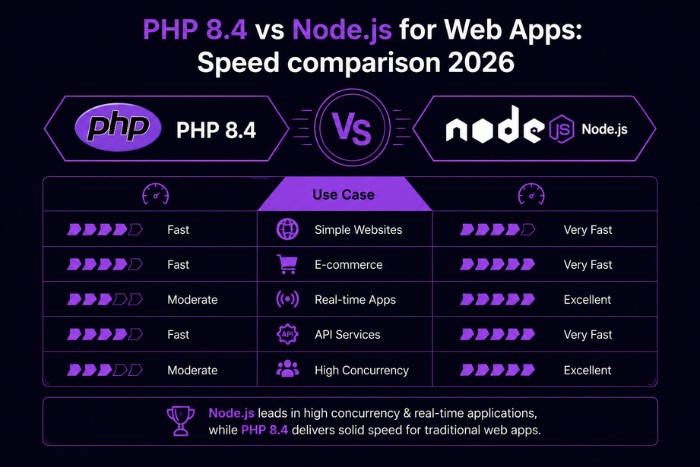
- Understand when PHP 8.4 excels for business systems, eCommerce, and enterprise platforms.
- Discover why Node.js remains strong for APIs, microservices, and high-concurrency applications.
- Analyze development costs, maintenance, hosting, and long-term scalability factors.
- Leverage modern frameworks like Laravel, Symfony, NestJS, and Express for optimized web development.
FAQ's
Yes, PHP 8.4 introduces major performance improvements.
Yes, Node.js excels in event-driven, high-concurrency environments.
PHP (Laravel, Magento, WooCommerce) often remains strong for traditional commerce.
Node.js often scales more efficiently for high-concurrency apps, but architecture matters most.
Yes, hybrid architectures are increasingly common.
PHP often offers lower development costs for standard business systems.