
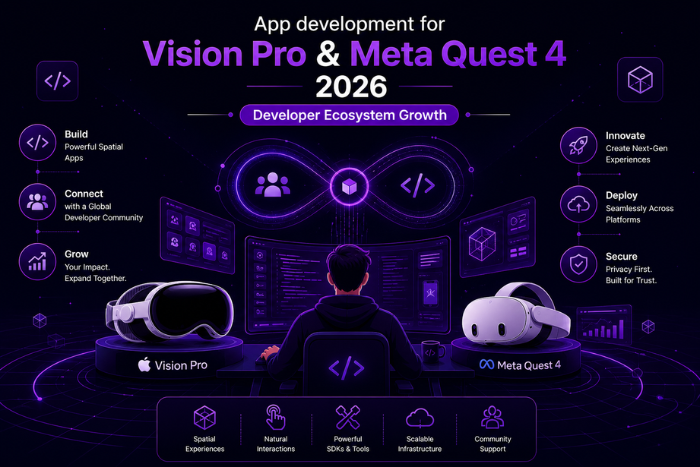
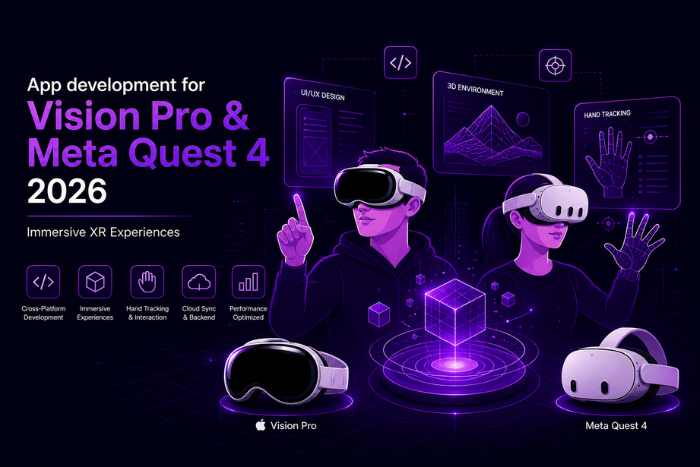
App development for Vision Pro & Meta Quest 4 2026 covers XR apps, spatial UX, immersive performance, and enterprise innovation.
Introduction
Spatial computing is rapidly redefining the future of digital experiences, and 2026 marks a major turning point for businesses investing in immersive technologies. With Apple Vision Pro and Meta Quest 4 leading the premium mixed reality (MR), virtual reality (VR), and augmented reality (AR) markets, organizations are increasingly exploring next-generation application development to stay ahead of evolving consumer and enterprise demands.
Understanding App development for Vision Pro & Meta Quest 4 2026 is essential for startups, enterprises, educators, healthcare providers, retailers, and entertainment brands looking to capitalize on the spatial computing revolution. These platforms offer opportunities far beyond traditional mobile applications, enabling 3D user interfaces, gesture controls, spatial collaboration, immersive commerce, enterprise training, and real-time simulations.
Developing for Vision Pro and Meta Quest 4 requires specialized technical expertise in XR frameworks, optimized 3D assets, platform-specific SDKs, and user-centric immersive design. This guide explores how businesses can leverage cutting-edge XR development to build scalable, future-ready applications for both ecosystems while maximizing innovation, performance, and ROI.
Why App Development for Vision Pro & Meta Quest 4 2026 is Important
Spatial computing platforms are transforming digital interactions across industries.
- Expands Market Opportunities
Access premium XR consumer and enterprise ecosystems. - Enhances User Engagement
Immersive experiences improve retention and interaction. - Supports Enterprise Innovation
Enables training, collaboration, and operational efficiency. - Future-Proofs Digital Products
Positions businesses for next-generation technology shifts. - Unlocks New Revenue Models
Spatial commerce, immersive subscriptions, and virtual services. - Improves Brand Differentiation
Early adoption builds competitive advantage. - Enables Advanced Human-Computer Interaction
Eye tracking, hand gestures, and spatial controls.
Types of Solutions for App Development for Vision Pro & Meta Quest 4 2026
Different industries require specialized XR app development solutions.
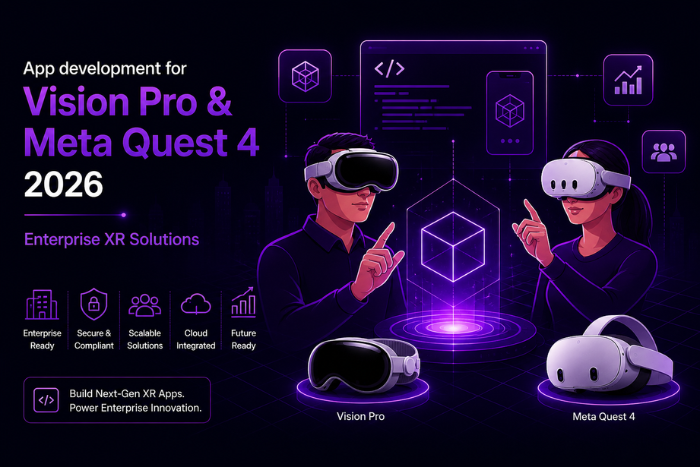
- Enterprise Training Applications
Interactive simulations and workforce education. - Healthcare & Medical XR Apps
Surgical visualization, patient care, and therapy. - Retail & eCommerce Spatial Apps
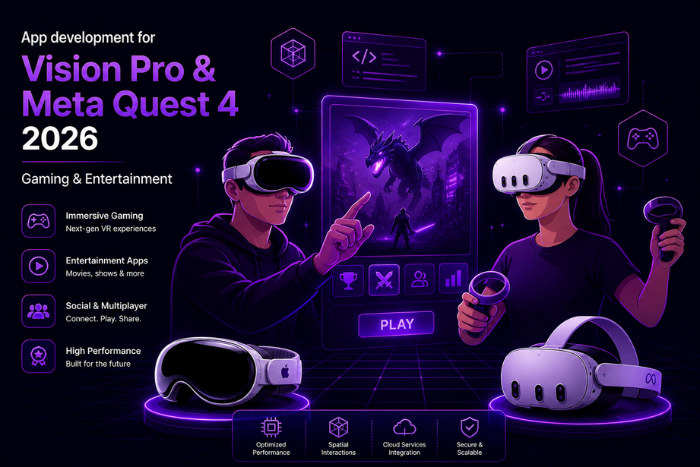
Virtual product visualization and immersive shopping. - Gaming & Entertainment Platforms
High-performance VR and MR experiences. - Collaborative Productivity Tools
Virtual meetings and remote teamwork solutions. - Education & eLearning Platforms
Immersive educational environments. - Real Estate & Architecture Visualization
3D property walkthroughs and design simulations. - Industrial & Manufacturing Solutions
Workflow optimization and operational support.
Key Features of App Development for Vision Pro & Meta Quest 4 2026
Modern XR applications require advanced platform-specific capabilities.
- Spatial User Interfaces
3D environments optimized for immersion. - Hand, Eye & Gesture Tracking
Natural interaction models. - High-Fidelity 3D Rendering
Realistic visual experiences. - Cross-Platform XR Compatibility
Support for VisionOS, OpenXR, and Meta ecosystems. - Real-Time Collaboration
Multi-user immersive environments. - Performance Optimization
Low-latency, high-frame-rate execution. - Cloud & Edge Integration
Scalable backend infrastructure. - Security & Privacy Compliance
Enterprise-grade data protection.
Development Process
Successful XR app development requires structured planning and technical precision.
- Business Goal & Use Case Analysis
Identifying strategic XR opportunities. - Platform Selection Strategy
Vision Pro, Meta Quest 4, or cross-platform. - UX/UI Spatial Design
Creating immersive user journeys. - 3D Asset Development & Optimization
Building efficient volumetric experiences. - Platform-Specific Development
Utilizing VisionOS, Unity, Unreal, or OpenXR. - Testing & Performance Benchmarking
Ensuring hardware efficiency and comfort. - Deployment & Continuous Support
Launching and evolving applications.
Technology Stack for App Development for Vision Pro & Meta Quest 4 2026
Advanced XR development relies on powerful frameworks and tools:
Vision Pro Development: SwiftUI, RealityKit, ARKit, Xcode
Meta Quest 4 Development: Unity, Unreal Engine 5, OpenXR, Meta Presence Platform
Cross-Platform Engines: Unity PolySpatial, Unreal Engine, WebXR
3D Asset Tools: Blender, Maya, Reality Composer Pro
Programming Languages: Swift, C#, C++, JavaScript
Cloud Platforms: AWS, Azure, Google Cloud
DevOps Tools: Docker, Jenkins, GitHub Actions
Analytics & Monitoring: Firebase, Datadog, AppDynamics
Cost Factors for App Development for Vision Pro & Meta Quest 4 2026
Several variables impact XR app development budgets.
- Platform Complexity
Native VisionOS and Meta development vary in cost. - 3D Asset Production
Advanced immersive content increases investment. - Hardware Optimization
Performance tuning for XR devices. - Cross-Platform Requirements
Broader compatibility increases scope. - Enterprise Security Needs
Compliance-heavy industries require larger budgets. - Real-Time Collaboration Features
Multi-user systems increase backend complexity. - Ongoing Maintenance
Continuous updates and compatibility support.
Latest Trends
The XR landscape is rapidly evolving with major innovations.
- Spatial Commerce
Immersive shopping experiences. - Enterprise Metaverse Solutions
Corporate collaboration and training ecosystems. - AI-Powered XR Applications
Smarter adaptive environments. - Mixed Reality Productivity Tools
Spatial workspaces. - Cross-Platform XR Standardization
OpenXR adoption growth. - Volumetric Video Integration
Richer immersive media. - Digital Twin Applications
Industrial and enterprise simulation growth. - Privacy-First XR Development
Advanced biometric and user protection.
Why Choose Us for App Development for Vision Pro & Meta Quest 4 2026
Building successful XR applications requires deep technical expertise and strategic execution.
Specialized XR Development Expertise
Comprehensive experience across Vision Pro, Meta Quest, and OpenXR ecosystems.
Enterprise-Grade Spatial Solutions
Scalable immersive platforms for business growth.
Performance-Driven Development
Optimized experiences for speed, comfort, and retention.
Advanced 3D & Spatial UX Design
Immersive interfaces designed for real-world usability.
Cross-Platform Capability
Building apps that maximize ecosystem reach.
Transparent Development Process
Clear timelines, measurable KPIs, and strategic collaboration.
Future-Ready Innovation
Solutions built for the next era of spatial computing.
We help businesses transform ambitious XR ideas into scalable, immersive digital products that lead in the spatial computing era.
Ready to build immersive XR apps for Vision Pro and Meta Quest 4?
Let’s create cutting-edge spatial experiences tailored to your business goals.
Contact us today for expert XR app development solutions.
Key Points :
- Vision Pro and Meta Quest 4 enable immersive AR, VR, and mixed reality experiences.
- Spatial UX, gesture controls, and 3D interfaces are critical for XR app success.
- Cross-platform XR development expands reach across premium immersive ecosystems.
- Enterprise, healthcare, retail, and education sectors benefit from advanced XR applications.
- Unity, Unreal Engine, VisionOS, and OpenXR power next-generation spatial app development.
FAQ's
Healthcare, education, retail, gaming, enterprise collaboration, and industrial sectors.
Vision Pro often excels in premium enterprise productivity, while Meta Quest 4 offers broader cost accessibility.
Costs vary significantly depending on complexity, 3D assets, and enterprise requirements.
Yes, frameworks like Unity and OpenXR support broader deployment.
Performance optimization, user comfort, hardware compatibility, and immersive UX design.
Early adoption provides competitive advantage as spatial computing rapidly expands.