
Discover No-code vs low-code vs custom apps: When to use what for speed, scalability, cost, and business growth in 2026.
Introduction
As businesses race toward digital transformation in 2026, choosing the right software development approach has become a critical strategic decision. Organizations now have more options than ever, ranging from no-code platforms and low-code frameworks to fully custom-built applications. Each model offers unique advantages depending on business goals, budget, scalability, and technical complexity.
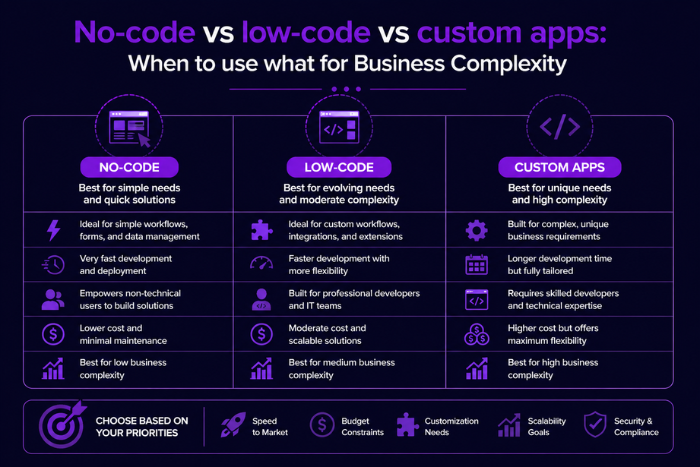
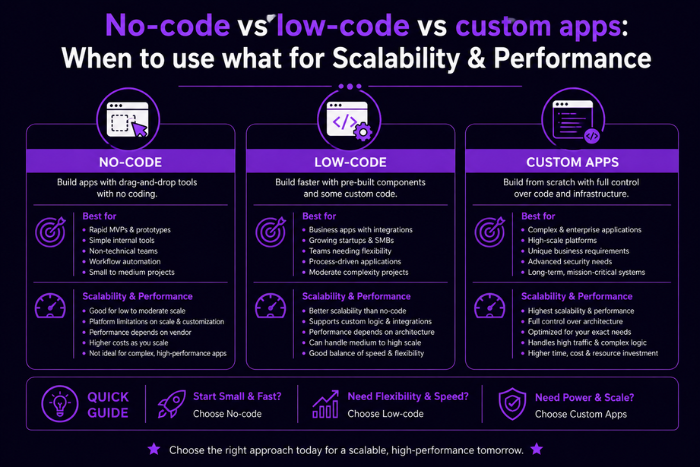
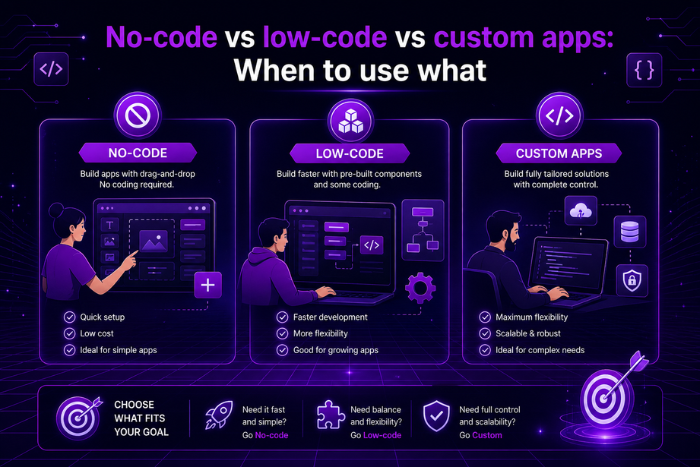
Understanding No-code vs low-code vs custom apps: When to use what is essential for startups, enterprises, and decision-makers looking to optimize development speed while balancing long-term growth. No-code solutions offer rapid deployment for simple applications, low-code platforms provide faster customization with moderate flexibility, and custom development delivers maximum scalability, security, and control for complex systems.
Selecting the right approach can dramatically impact operational efficiency, innovation, and ROI. This guide explores the differences, ideal use cases, cost implications, and strategic considerations to help businesses determine the best path for their digital products.
Why No-code vs Low-code vs Custom Apps: When to Use What is Important
Choosing the correct development model influences business agility, technical scalability, and long-term competitiveness.
- Faster Digital Transformation
Businesses can deploy solutions aligned with urgency and resources. - Optimized Budget Allocation
Prevents overinvestment or underbuilding. - Scalable Growth
Ensures technology supports future expansion. - Improved Operational Efficiency
Right-fit platforms streamline workflows. - Risk Reduction
Avoids costly migration or redevelopment. - Enhanced Innovation
Supports strategic experimentation and rapid iteration. - Security & Compliance Alignment
Ensures proper governance for industry-specific needs.
Types of Solutions for No-code vs Low-code vs Custom Apps: When to Use What
Different development paths serve different business needs and technical requirements.
- No-Code App Development
Best for internal tools, MVPs, landing pages, and workflow automation. - Low-Code Development
Ideal for CRM systems, business process automation, moderate SaaS products, and enterprise dashboards. - Custom App Development
Suitable for complex enterprise systems, fintech platforms, healthcare apps, marketplaces, and scalable SaaS ecosystems. - Hybrid Development Strategies
Combining low-code for operational tools and custom development for core systems. - Workflow Automation Solutions
Rapid process digitization without deep technical expertise. - Customer Portal Platforms
Flexible development based on scalability requirements. - AI-Integrated Applications
Often requiring low-code or custom infrastructure. - Industry-Specific Compliance Platforms
Custom solutions for regulated sectors.
Key Features of No-code vs Low-code vs Custom Apps: When to Use What
Modern software development models offer diverse capabilities:
- Development Speed
No-code offers fastest deployment. - Customization Flexibility
Custom apps provide unlimited control. - Scalability
Custom development supports large-scale growth. - Cost Efficiency
No-code and low-code reduce initial expenses. - Integration Capabilities
Low-code and custom apps support broader API ecosystems. - Security Controls
Custom apps offer advanced compliance and governance. - Maintenance Requirements
Platform dependency impacts support complexity. - User Accessibility
No-code empowers non-technical teams.
Development Process
Choosing and implementing the right model requires strategic planning:
- Business Requirement Analysis
Defining technical needs and scalability goals. - Platform Feasibility Assessment
Evaluating no-code, low-code, or custom fit. - Budget & Timeline Planning
Aligning investment with business priorities. - UI/UX Design
Creating effective user experiences. - Development & Integration
Building and connecting systems. - Testing & Security Validation
Ensuring reliability and compliance. - Deployment & Continuous Optimization
Scaling based on business evolution.
Technology Stack for No-code vs Low-code vs Custom Apps: When to Use What
Different approaches leverage distinct ecosystems:
No-Code Platforms: Bubble, Webflow, Adalo, Zapier
Low-Code Platforms: OutSystems, Mendix, Microsoft Power Apps, Appian
Custom Development Languages: Python, JavaScript, Java, Swift, Kotlin
Frameworks: React, Angular, Node.js, Flutter
Cloud Platforms: AWS, Azure, Google Cloud
Databases: PostgreSQL, MongoDB, Firebase
DevOps Tools: Docker, Kubernetes, Jenkins
AI Integration: OpenAI APIs, TensorFlow, PyTorch
Cost Factors for No-code vs Low-code vs Custom Apps: When to Use What
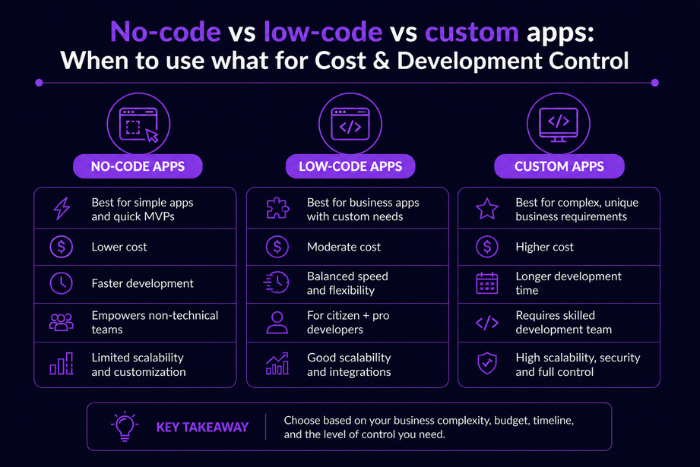
Each model presents unique financial implications.
- Initial Development Costs
No-code is lowest; custom is highest. - Subscription or Licensing Fees
No-code and low-code often involve recurring platform costs. - Scalability Expenses
Growth may increase platform or redevelopment costs. - Customization Complexity
Advanced features drive custom investment. - Maintenance Requirements
Custom apps may require larger ongoing budgets. - Security Compliance Costs
Regulated industries may require custom solutions. - Migration Costs
Switching from no-code to custom later can be expensive.
Latest Trends
The development landscape is evolving rapidly.
- AI-Assisted No-Code Development
Faster automation and prototyping. - Enterprise Low-Code Expansion
Increased adoption in corporate ecosystems. - Composable Custom Architecture
Modular enterprise applications. - Hybrid Development Models
Strategic combination of development approaches. - Vertical SaaS Platforms
Industry-specific app ecosystems. - Security-First Development
Compliance-driven architecture. - API Economy Growth
Enhanced integrations across all platforms. - Citizen Development
Non-technical users building business tools.
Why Choose Us for No-code vs Low-code vs Custom Apps: When to Use What
Choosing the right development strategy requires technical expertise and business foresight.
Strategic Technology Consulting
We help businesses identify the ideal development path.
Full-Spectrum Development Expertise
Experience across no-code, low-code, and custom ecosystems.
Cost-Optimized Solutions
Maximizing ROI while minimizing unnecessary expenses.
Scalable Product Development
Building systems designed for long-term growth.
Security & Compliance Focus
Protecting your business and customers.
Transparent Process
Clear strategy, milestones, and measurable results.
Future-Ready Innovation
Solutions designed to evolve with market changes.
We empower businesses to choose and implement the most effective development model for sustainable success.
Ready to choose the right app development strategy for your business?
Let’s build scalable, efficient digital solutions tailored to your growth goals.
Contact us today for expert no-code, low-code, or custom app consulting.
Key Points :
- No-code platforms offer rapid deployment for simple apps and MVPs.
- Low-code solutions balance speed, flexibility, and moderate scalability.
- Custom apps provide maximum security, performance, and enterprise-grade scalability.
- Development model selection directly impacts cost, ROI, and long-term growth.
- Hybrid development strategies are becoming increasingly popular in 2026.
- Strategic platform decisions reduce future migration risks and improve digital transformation success.
FAQ's
No-code requires no programming, low-code involves minimal coding, and custom apps are fully built from scratch.
For simple tools, MVPs, and rapid deployment with limited complexity.
Yes, many low-code platforms support enterprise automation and moderate scalability.
Initially yes, but scaling limitations may increase future costs.
Yes, but migration can be costly depending on system complexity.
No-code or low-code often provides faster validation and lower costs.