
Build AI-powered apps with on-device LLMs in 2026 for faster performance, privacy, and scalable mobile AI solutions.

Introduction
Artificial Intelligence is entering a new phase where performance, privacy, and speed are becoming top priorities for mobile applications. One of the biggest innovations driving this shift is the rise of on-device Large Language Models (LLMs). Instead of relying entirely on cloud-based AI, businesses are now focusing on building AI-powered apps with on-device LLMs in 2026 to deliver faster, more secure, and cost-efficient solutions.
On-device LLMs allow AI models to run directly on smartphones, tablets, and edge devices. This means reduced latency, offline functionality, and improved data privacy—critical factors in industries like healthcare, finance, and enterprise applications. With advancements in mobile hardware and optimized AI frameworks, deploying LLMs locally is now more practical than ever.
For businesses, this shift opens new opportunities to create intelligent mobile apps that are responsive, scalable, and user-centric. Whether it’s AI assistants, recommendation engines, or real-time analytics, on-device AI is redefining how mobile applications are built and experienced in 2026.
Why Building AI-Powered Apps with On-Device LLMs in 2026 is Important
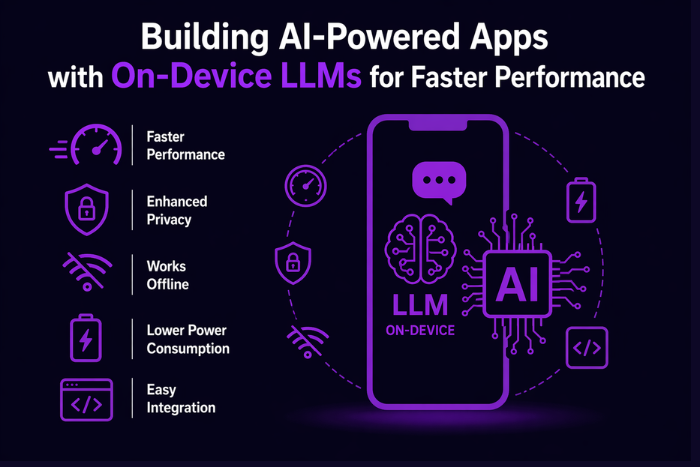
The move toward on-device AI is transforming mobile app development. Understanding building AI-powered apps with on-device LLMs in 2026 helps businesses stay ahead of technological trends.
- Enhanced Privacy & Security
Sensitive data stays on the device, reducing risks. - Faster Response Time
Eliminates dependency on cloud latency. - Offline Functionality
Apps work even without internet connectivity. - Reduced Cloud Costs
Lower reliance on expensive cloud infrastructure. - Improved User Experience
Real-time interactions with minimal delay. - Regulatory Compliance
Easier adherence to data protection laws.
Types of Solutions for Building AI-Powered Apps with On-Device LLMs in 2026
On-device LLMs enable a wide range of innovative mobile applications:
- AI Chatbots & Assistants
Offline conversational AI with instant responses. - Personal Productivity Apps
Smart assistants for scheduling, writing, and task management. - Healthcare AI Applications
On-device diagnostics and patient data processing. - Voice & Speech Recognition Apps
Real-time speech processing without cloud dependency. - Smart Keyboard & Writing Tools
Predictive text and grammar correction using local AI models. - Recommendation Systems
Personalized suggestions processed directly on the device. - Enterprise Mobile Solutions
Secure AI applications for business operations. - Edge AI Applications
Real-time analytics for IoT and connected devices.
Key Features of Building AI-Powered Apps with On-Device LLMs in 2026
On-device AI introduces powerful features that enhance mobile app performance:
- Low Latency Processing
Instant AI responses without network delays. - Data Privacy by Design
No need to send sensitive data to external servers. - Offline AI Capabilities
Functionality available without internet access. - Energy-Efficient Models
Optimized AI models for mobile hardware. - Real-Time Decision Making
Immediate insights and actions. - Seamless User Experience
Smooth and uninterrupted interactions. - Reduced Bandwidth Usage
Less reliance on data transmission. - Adaptive Learning Models
AI improves based on user behavior locally.
Development Process
Building AI-powered mobile apps with on-device LLMs requires a strategic approach:
- Use Case Definition & Planning
Identifying where on-device AI adds value. - Data Collection & Optimization
Preparing datasets suitable for lightweight models. - Model Selection & Compression
Choosing and optimizing LLMs for mobile deployment. - App Development & Integration
Embedding AI models into mobile applications. - Performance Optimization
Ensuring efficient memory and battery usage. - Testing & Validation
Verifying accuracy and responsiveness. - Deployment & Monitoring
Launching and continuously improving the app.
Technology Stack for Building AI-Powered Apps with On-Device LLMs in 2026
Modern on-device AI apps rely on advanced technologies:
Programming Languages: Python, Swift, Kotlin, JavaScript
AI Frameworks: TensorFlow Lite, PyTorch Mobile, ONNX Runtime
Mobile Frameworks: Flutter, React Native
Edge AI Tools: Core ML, Android ML Kit
Cloud Platforms: AWS, Google Cloud (for hybrid models)
Database: SQLite, Firebase
DevOps Tools: Docker, Kubernetes
Optimization Tools: Quantization, Model Pruning


Cost Factors for Building AI-Powered Apps with On-Device LLMs in 2026
The cost of developing on-device AI apps depends on several factors:
- Model Complexity & Size
Larger models require more optimization effort. - Device Compatibility
Supporting multiple devices increases development cost. - Data Preparation
High-quality datasets require time and resources. - Development Expertise
Skilled AI engineers impact overall cost. - Testing & Optimization
Ensuring performance across devices. - Hybrid Infrastructure Needs
Combining cloud and on-device processing. - Maintenance & Updates
Continuous improvements and model updates.
Latest Trends
The evolution of on-device AI is shaping the future of mobile applications:
- Edge AI Expansion
More processing happening directly on devices. - Smaller, Efficient LLMs
Lightweight models optimized for mobile. - Privacy-First AI Development
Focus on user data protection. - Hybrid AI Architectures
Combining cloud and on-device processing. - AI-Powered Super Apps
Multi-functional apps with integrated AI features. - Hardware Acceleration
AI chips improving mobile performance. - Real-Time Personalization
Instant, user-specific experiences.
Why Choose Us for Building AI-Powered Apps with On-Device LLMs in 2026
Choosing the right development partner is crucial for leveraging on-device AI effectively. We specialize in building AI-powered apps with on-device LLMs in 2026 that are fast, secure, and scalable.
AI & Edge Expertise
Deep experience in on-device and edge AI development.
Custom AI Solutions
Tailored applications based on your business needs.
Performance Optimization
Efficient models for speed and battery performance.
End-to-End Development
From strategy to deployment and maintenance.
Scalable Architecture
Apps designed to grow with your business.
Advanced Technology Stack
Using cutting-edge AI frameworks and tools.
Transparent Communication
Clear updates throughout the development process.
We help businesses build next-generation AI apps that deliver real value and competitive advantage.
Want to build fast and privacy-first AI apps with on-device LLMs?
Let’s create intelligent mobile solutions tailored to your business.
Contact us today for a free consultation and AI strategy.
Key Points :
- Build faster apps with on-device LLMs for real-time AI performance
- Enhance data privacy by processing user data directly on devices
- Enable offline AI functionality without relying on cloud connectivity
- Reduce cloud infrastructure costs with edge AI processing
- Deliver seamless user experience with low latency responses
- Use optimized lightweight AI models for mobile performance
FAQ's
On-device LLMs are AI models that run directly on mobile devices instead of cloud servers.
It improves privacy, reduces latency, and enables offline functionality.
They are optimized for efficiency, though slightly smaller than cloud models.
Yes, on-device AI enables full offline functionality.
Healthcare, finance, education, retail, and enterprise applications.
Technologies include TensorFlow Lite, Core ML, and PyTorch Mobile.