
Explore voice AI app development trends after GPT-4o updates, including real-time voice agents, speech AI, and next-gen mobile apps.


Introduction
Voice technology is undergoing a major transformation, driven by advancements in real-time AI and multimodal capabilities. With the introduction of powerful models like GPT-4o, voice AI has evolved from basic speech recognition to fully interactive, human-like communication systems. This shift is redefining how users interact with mobile applications.
Understanding voice AI app development trends after GPT-4o updates is crucial for businesses aiming to deliver next-generation digital experiences. Modern voice-enabled apps are no longer limited to commands—they can now engage in natural conversations, process context, and respond instantly with high accuracy.
From customer support and virtual assistants to healthcare and enterprise solutions, voice AI is becoming a core feature across industries. With real-time speech-to-speech capabilities, emotion detection, and multilingual support, businesses have new opportunities to enhance user engagement and streamline operations.
As voice AI continues to evolve, companies that adopt these innovations early will gain a significant competitive advantage in the mobile app ecosystem.
Why Voice AI App Development Trends After GPT-4o Updates is Important
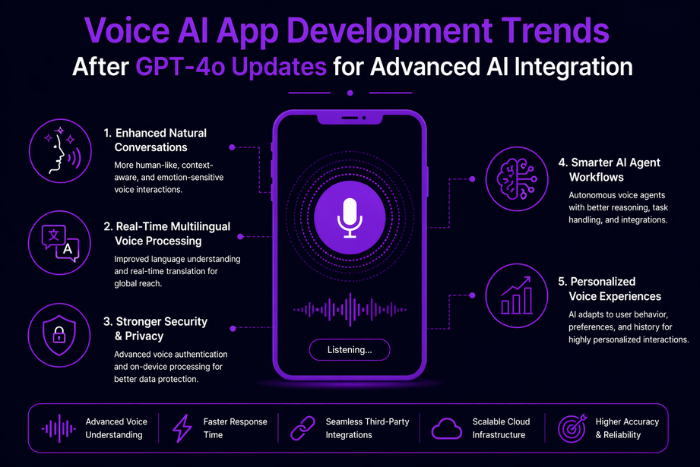
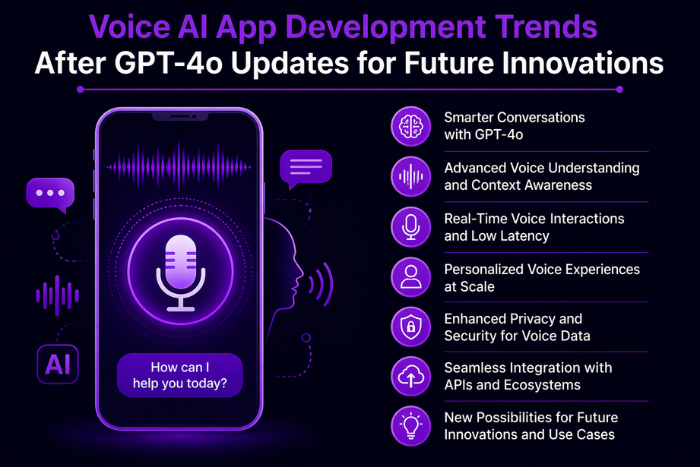
The advancements introduced by GPT-4o have significantly impacted how voice AI applications are built and used. Understanding voice AI app development trends after GPT-4o updates helps businesses stay ahead in a competitive market.
- Natural Human-Like Conversations
AI models now support fluid, context-aware interactions. - Real-Time Voice Processing
Faster responses improve user experience. - Multimodal Capabilities
Integration of voice, text, and visual inputs. - Increased Automation
Voice AI can handle complex workflows and tasks. - Enhanced Accessibility
Voice interfaces make apps more inclusive. - Global Reach
Multilingual support expands market opportunities.
Types of Voice AI App Development Solutions
Voice AI is transforming multiple types of mobile applications:
- Voice Assistants & Chatbots
Intelligent assistants for customer support and personal productivity. - Voice Commerce Applications
Hands-free shopping and transactions. - Healthcare Voice Apps
Patient interaction, diagnostics, and virtual consultations. - Smart Home & IoT Apps
Voice-controlled devices and automation systems. - Enterprise Voice Solutions
Workflow automation and internal communication tools. - Education & Learning Apps
Voice-based tutoring and interactive learning. - Voice-Enabled Navigation Apps
Real-time directions and assistance. - Multilingual Communication Apps
Real-time translation and global communication tools.
Key Features of Voice AI App Development Trends After GPT-4o Updates
Modern voice AI applications offer advanced features that enhance usability and performance:
- Speech-to-Speech Interaction
Real-time voice conversations without text conversion delays. - Context Awareness
Understanding user intent across multiple interactions. - Emotion & Tone Detection
AI adapts responses based on user sentiment. - Low Latency Responses
Instant interaction for seamless experiences. - Custom Voice Generation
Unique brand voices and personalized interactions. - Multilingual Support
Support for multiple languages and dialects. - Secure Voice Authentication
Voice-based identity verification. - Offline Voice Capabilities
Functionality without constant internet connectivity.
Development Process
Building voice AI-powered applications requires a strategic and structured approach:
- Use Case Definition & Strategy
Identifying where voice AI adds the most value. - Data Collection & Voice Training
Gathering datasets for speech recognition and synthesis. - Model Selection & Integration
Choosing the right voice AI models and APIs. - App Development & UI/UX Design
Designing intuitive voice-first interfaces. - Testing & Optimization
Ensuring accuracy, latency, and performance. - Deployment & Integration
Launching the app across platforms. - Monitoring & Continuous Improvement
Updating models and improving user experience.
Technology Stack for Voice AI App Development Trends After GPT-4o Updates
Modern voice AI applications rely on advanced technologies:
Programming Languages: Python, JavaScript, Swift, Kotlin
AI Frameworks: TensorFlow, PyTorch
Voice AI APIs: OpenAI Audio APIs, Google Speech-to-Text, Amazon Polly
Mobile Frameworks: Flutter, React Native
Cloud Platforms: AWS, Google Cloud, Microsoft Azure
Edge AI Tools: TensorFlow Lite, Core ML
Database: MongoDB, Firebase
DevOps Tools: Docker, Kubernetes
Cost Factors for Voice AI App Development Trends After GPT-4o Updates
The cost of developing voice AI applications depends on several factors:
- Complexity of Voice Features
Advanced features like emotion detection increase costs. - Model Selection & API Usage
Usage-based pricing impacts overall budget. - Data Requirements
High-quality voice datasets require investment. - Integration Complexity
Connecting voice AI with existing systems. - Infrastructure Costs
Cloud and edge computing expenses. - Testing & Optimization
Ensuring accuracy across different accents and environments. - Maintenance & Updates
Continuous improvements and model upgrades.
Latest Trends
The voice AI landscape is evolving rapidly with new innovations:
- Real-Time Conversational AI
Instant voice interactions without delays. - Voice AI Agents
Autonomous systems handling complex tasks. - Multimodal AI Integration
Combining voice, text, and visual AI. - Edge Voice AI
Processing voice data directly on devices. - AI Personalization
Custom voice experiences for users. - Voice Commerce Growth
Increasing adoption of voice-based transactions. - AI-Powered Accessibility Tools
Helping users with disabilities interact easily.
Why Choose Us for Voice AI App Development Trends After GPT-4o Updates
Adopting voice AI requires expertise and strategic implementation. We help businesses leverage the latest voice AI application development trends after GPT-4o updates to build innovative and scalable applications.
Voice AI Expertise
Specialized in developing advanced voice-enabled applications.
Custom Voice Solutions
Tailored apps designed for your business needs.
End-to-End Development
From concept to deployment and support.
Scalable Architecture
Apps built to handle growth and increasing demand.
Advanced Technology Integration
Using cutting-edge AI and voice technologies.
Cost-Optimized Solutions
Efficient development strategies for better ROI.
Transparent Communication
Clear updates and collaboration throughout the project.
We focus on delivering intelligent voice applications that enhance user engagement and business growth.
Ready to transform your app with advanced voice AI capabilities?
Let’s build real-time, intelligent voice-powered applications.
Contact us today for a free consultation and development roadmap.
Key Points :
- Leverage GPT-4o for real-time, human-like voice interactions
- Build voice AI apps with speech-to-speech and low-latency responses
- Enable multilingual and context-aware conversational experiences
- Integrate voice AI into mobile, IoT, and enterprise applications
- Enhance user engagement with personalized voice assistants
- Stay competitive with next-gen voice AI trends and technologies
FAQ's
Trends include real-time voice interaction, multimodal AI, and voice agents
GPT-4o enables faster, more natural, and context-aware voice interactions.
Yes, with edge AI technologies, some features can work offline.
Costs vary based on features, complexity, and infrastructure.
Technologies include AI frameworks, speech APIs, and cloud platforms.
Partner with an experienced development company for best results.