



Explore Jetpack Compose vs XML: What companies use in 2026, differences, adoption trends, and how modern Android apps are built today.
Introduction
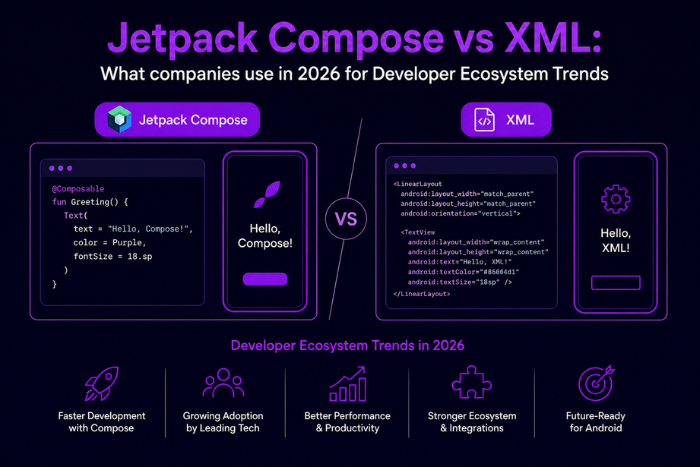
The debate around Jetpack Compose vs XML: What companies use in 2026 has become one of the most important discussions in Android development. As mobile applications evolve toward faster performance, cleaner architectures, and more dynamic user interfaces, companies are actively rethinking their UI development strategies.
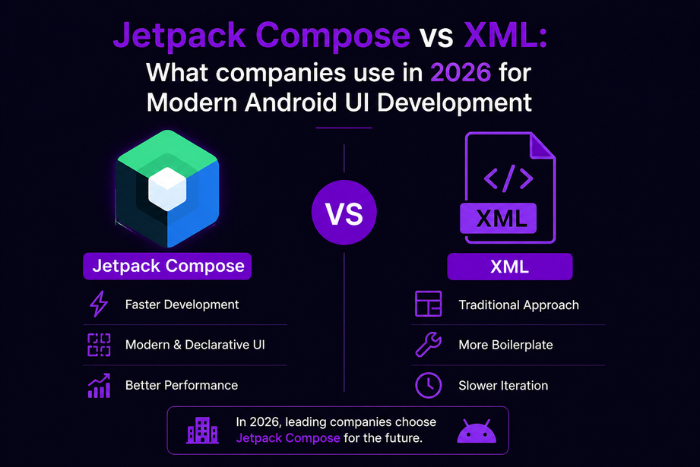
XML has been the backbone of Android UI development for years. It is stable, widely supported, and deeply integrated into legacy systems. However, it is also verbose and requires significant boilerplate code, which slows down development and increases maintenance complexity.
Jetpack Compose introduces a modern, declarative UI approach built on Kotlin, enabling developers to design interfaces more efficiently with less code and better scalability. It simplifies state management and accelerates UI development cycles.
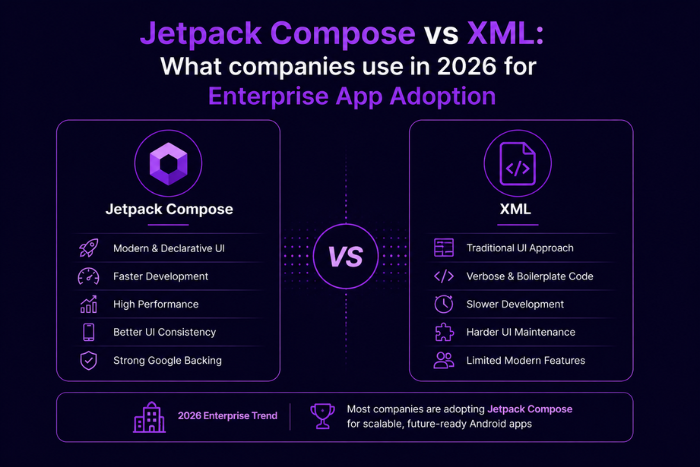
In 2026, companies are not simply replacing XML with Compose. Instead, they are strategically evaluating Jetpack Compose vs XML: What companies use in 2026 based on product requirements, team expertise, and long-term scalability goals. Most real-world applications now use a hybrid approach where both technologies coexist.
Why Jetpack Compose vs XML: What Companies Use in 2026 is Important
Understanding Jetpack Compose vs XML is critical for making informed architectural decisions in Android development.
- Faster Development Cycles
Jetpack Compose reduces UI boilerplate and accelerates development speed. - Improved Developer Productivity
Kotlin-based declarative UI simplifies coding and maintenance. - Legacy System Compatibility
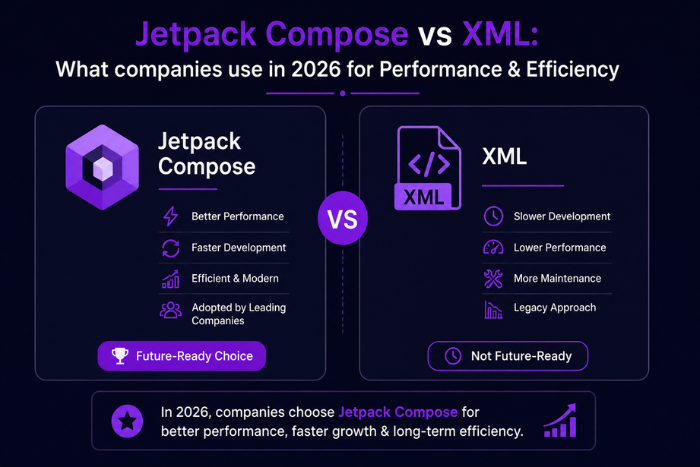
Many enterprises still rely on XML-based UI structures. - Better Performance Optimization
Compose improves rendering efficiency and UI responsiveness. - Strategic Technology Planning
Companies align UI frameworks with long-term product goals. - Hiring and Skill Availability
Developer expertise influences adoption of Compose or XML.
Types of Solutions in Jetpack Compose vs XML: What Companies Use in 2026
Full Jetpack Compose Adoption
- New Android apps built from scratch using Compose
- AI-driven apps with dynamic UI updates
- Fast-scaling startup products
Hybrid UI Approach (Most Common in 2026)
- XML used for legacy screens
- Jetpack Compose used for new features
- Gradual migration strategy to reduce risk
XML-Based Enterprise Systems
- Large banking and enterprise applications
- Stable legacy systems with long-term maintenance
- Strict compliance and reliability-focused apps
Incremental Migration Strategy
- Step-by-step replacement of XML with Compose
- Module-wise modernization approach
- Performance optimization during transition
Cross-Platform UI Strategy
- Compose Multiplatform for shared UI systems
- Android + desktop + web UI reuse
- Unified design system across platforms
Key Features of Jetpack Compose vs XML: What Companies Use in 2026
Jetpack Compose Features
- Declarative UI built with Kotlin
- Minimal boilerplate code for faster development
- Real-time UI previews and instant updates
- Efficient state management system
- Seamless integration with modern Android libraries
- Faster iteration and development cycles
XML Features
- Stable and mature Android UI system
- Strong backward compatibility support
- Extensive documentation and community usage
- Predictable layout rendering behavior
- Easy integration with existing legacy apps
- Widely supported across all Android versions
Key Comparison Insight
- Jetpack Compose focuses on speed, flexibility, and modern development
- XML focuses on stability, compatibility, and enterprise reliability
- Most companies in 2026 use a hybrid approach combining both
Development Process
The development workflow for Jetpack Compose vs XML: What companies use in 2026 follows a structured engineering approach:
- Requirement Analysis
Identify UI complexity and system dependencies. - Architecture Planning
Decide between Compose, XML, or hybrid architecture. - UI/UX Design Mapping
Convert designs into scalable UI components. - Development Implementation
Build interfaces using Jetpack Compose or XML. - Testing & Optimization
Ensure performance, responsiveness, and stability. - Deployment & Monitoring
Continuous optimization based on user feedback.
Technology Stack
Modern Android development in Jetpack Compose vs XML includes:
Programming Languages: Kotlin, Java
UI Frameworks: Jetpack Compose, XML
Architecture Patterns: MVVM, MVI, Clean Architecture
Dependency Injection: Hilt, Dagger
Networking: Retrofit, Ktor
Asynchronous Tools: Coroutines, Flow
Database: Room, SQLite
Testing Tools: JUnit, Espresso, Compose Testing
Build Tools: Gradle, Android Studio
Cost Factors
Cost considerations play a major role in Jetpack Compose vs XML: What companies use in 2026 decisions.
- Development Speed
Compose reduces UI development time and cost. - Migration Costs
Switching from XML to Compose requires engineering investment. - Developer Expertise
Skilled Compose developers may have higher initial costs. - Maintenance Efficiency
Compose reduces long-term maintenance effort. - Infrastructure Optimization
Modern UI frameworks improve performance efficiency. - Testing Requirements
Hybrid systems require additional testing layers.
Latest Trends
The evolution of Jetpack Compose vs XML is shaping Android development trends:
- Compose as Default for New Apps
Most new applications prioritize Jetpack Compose. - Hybrid Architecture Standard
Compose and XML coexist in enterprise apps. - Compose Multiplatform Expansion
Extending UI across Android, desktop, and web. - AI-Driven UI Systems
Dynamic interfaces based on user behavior. - Declarative UI Standardization
Industry-wide shift toward modern UI paradigms. - Performance-Focused UI Design
Optimized rendering and smoother user experiences.
Why Choose Us for Jetpack Compose vs XML: What Companies Use in 2026
We help businesses make the right architectural decisions for Jetpack Compose vs XML: What companies use in 2026 and build scalable Android applications.
Expert Android Development
Deep expertise in Jetpack Compose and XML-based architectures.
Migration Support
Seamless transition from XML to modern Compose systems.
Scalable App Architecture
Future-ready designs built for long-term growth.
High Performance UI
Optimized Android applications with smooth user experiences.
End-to-End Development
From planning to deployment and optimization.
Business-Aligned Solutions
Technology decisions aligned with product goals.
We ensure your Android applications are ready for the future of mobile development.
Want to modernize your Android app with Jetpack Compose?
Let’s build scalable, high-performance mobile solutions.
Contact us today to get started with expert guidance.
Key Points :
- XML is still widely used in enterprises for stability and legacy system support.
- Most companies follow a hybrid approach using both Compose and XML together.
- Compose improves productivity with less boilerplate and declarative Kotlin UI.
- XML remains important for large-scale, stable, production systems.
- Many companies are gradually migrating from XML to Jetpack Compose
FAQ's
It refers to how companies choose between modern Jetpack Compose and traditional XML for Android UI development.
No, most companies use a hybrid approach combining Compose and XML.
Because it reduces boilerplate code and improves development speed.
Yes, especially in legacy and enterprise applications.
Startups and modern tech companies prefer Compose-first development.
Not yet, but it is gradually becoming the standard for new apps.