
SwiftUI vs UIKit for iOS apps in 2026: compare performance, cost, and scalability to choose the right framework for your app.
Introduction
Choosing the right framework is one of the most critical decisions in iOS development. As Apple continues to evolve its ecosystem, the debate around SwiftUI vs UIKit for iOS apps in 2026 has become more relevant than ever. Developers and businesses must evaluate which framework aligns best with their goals, performance needs, and long-term scalability.
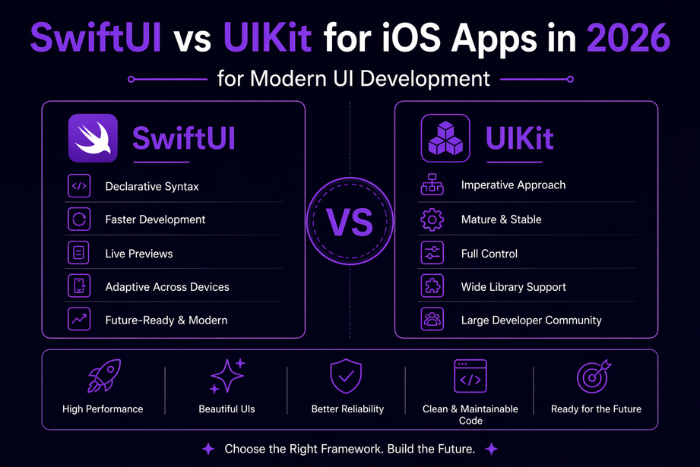
SwiftUI represents Apple’s modern, declarative approach to building user interfaces, enabling faster development and real-time previews. On the other hand, UIKit remains a mature and powerful framework that has been the foundation of iOS apps for years.
In 2026, both frameworks coexist, offering unique advantages. SwiftUI is gaining rapid adoption due to its simplicity and efficiency, while UIKit continues to be preferred for complex, highly customized applications. Understanding their differences is essential for making informed decisions.
This guide will help you compare both frameworks in terms of performance, development speed, scalability, and business impact—so you can choose the best approach for your iOS app.
Why SwiftUI vs UIKit for iOS Apps in 2026 is Important
Selecting the right framework directly impacts your app’s success. Understanding SwiftUI vs UIKit for iOS apps in 2026 helps developers and businesses make strategic decisions.
- Development Speed
Faster development cycles with modern frameworks. - Performance Optimization
Choosing the right framework ensures smooth performance. - Scalability & Maintenance
Impacts long-term growth and updates. - User Experience Quality
Determines UI responsiveness and design flexibility. - Cost Efficiency
Influences development and maintenance costs. - Future-Proof Development
Aligns with Apple’s evolving ecosystem.
Types of Solutions for SwiftUI vs UIKit for iOS Apps in 2026
Both frameworks support a wide range of applications:
- Startup MVP Applications
SwiftUI is ideal for rapid prototyping and quick launches. - Enterprise Applications
UIKit is preferred for complex business systems. - E-commerce Apps
Both frameworks support scalable shopping platforms. - Healthcare & Fintech Apps
Secure and performance-driven applications. - Social Media Apps
Real-time interactions and dynamic UI. - Media & Entertainment Apps
High-performance video and content apps. - Gaming Interfaces
Custom UI components for immersive experiences. - Hybrid Apps (SwiftUI + UIKit)
Combining both frameworks for optimal results.
Key Features of SwiftUI vs UIKit for iOS Apps in 2026
Understanding the features of both frameworks helps in making the right choice:
- Declarative vs Imperative Programming
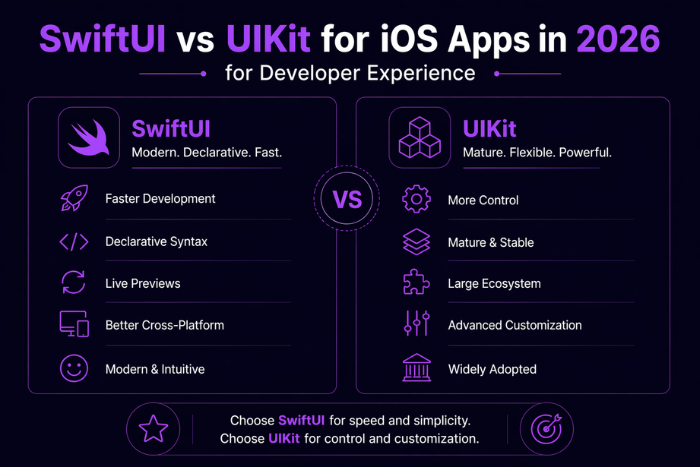
SwiftUI uses declarative syntax; UIKit follows imperative approach. - Development Speed
SwiftUI enables faster UI development with less code. - UI Flexibility
UIKit offers more control for complex designs. - Real-Time Preview
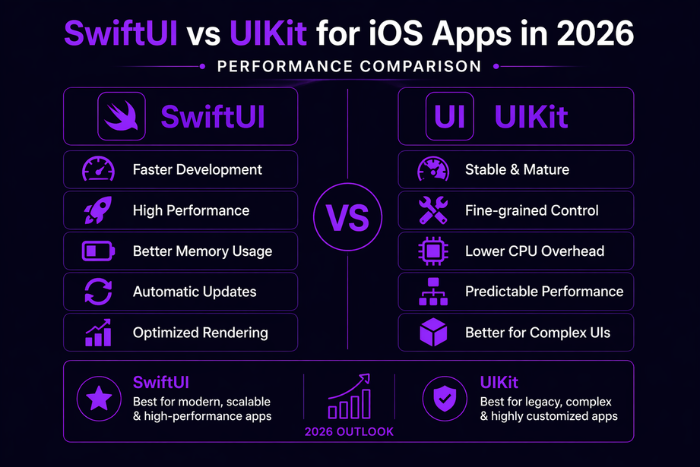
SwiftUI provides live previews during development. - Performance Optimization
UIKit excels in complex and large-scale apps. - Integration Capabilities
Both frameworks can work together seamlessly. - Community & Ecosystem
UIKit has a mature ecosystem; SwiftUI is rapidly growing. - Cross-Device Compatibility
SwiftUI supports multiple Apple platforms.
Development Process
A structured approach ensures efficient iOS app development:
- Requirement Analysis & Framework Selection
Choosing between SwiftUI, UIKit, or a hybrid approach. - UI/UX Design
Designing intuitive and responsive interfaces. - App Development
Implementing features using selected framework. - Integration & API Development
Connecting backend services and third-party tools. - Testing & Optimization
Ensuring performance and compatibility. - Deployment & App Store Launch
Publishing apps with proper optimization. - Maintenance & Updates
Continuous improvements and scaling.
Technology Stack for SwiftUI vs UIKit for iOS Apps in 2026
Modern iOS development uses advanced tools and technologies:
Programming Languages: Swift, Objective-C
Frameworks: SwiftUI, UIKit
Development Tools: Xcode
Backend Technologies: Node.js, Django, Firebase
Database: Core Data, SQLite, Firebase
Cloud Platforms: AWS, Apple CloudKit
Testing Tools: XCTest, TestFlight
DevOps Tools: CI/CD pipelines, Docker
Cost Factors for SwiftUI vs UIKit for iOS Apps in 2026
Development costs depend on several factors:
- Project Complexity
More features increase cost. - Framework Choice
SwiftUI may reduce development time; UIKit may require more effort. - UI/UX Requirements
Custom designs impact pricing. - Development Team Expertise
Skilled developers influence cost. - Integration Complexity
Backend and API integrations add cost. - Maintenance & Updates
Long-term support requirements. - Scalability Needs
Future growth considerations.
Latest Trends
iOS development is evolving with new trends shaping framework adoption:
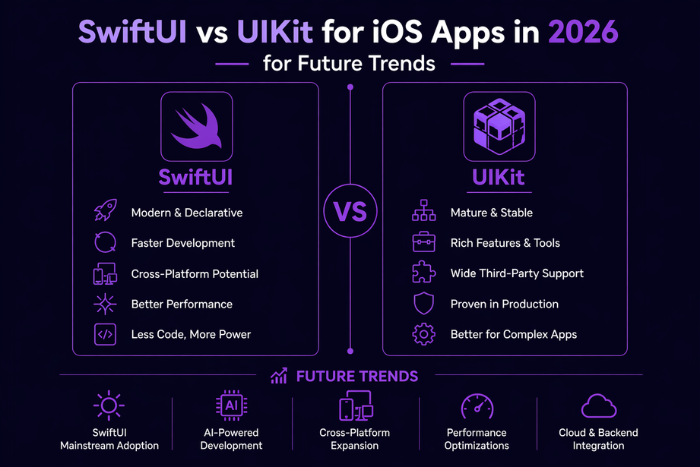
- SwiftUI Rapid Adoption
Becoming the preferred framework for new apps. - Hybrid Development Approach
Combining SwiftUI and UIKit for flexibility. - AI-Driven UI Enhancements
Smarter and adaptive interfaces. - Cross-Platform Apple Ecosystem
Unified apps across iPhone, iPad, and Mac. - Performance Optimization Focus
Improving speed and responsiveness. - Low-Code UI Development
Faster UI creation with modern tools. - Developer Productivity Tools
Enhanced workflows and automation.
Why Choose Us for SwiftUI vs UIKit for iOS Apps in 2026
Choosing the right development partner ensures successful app delivery. We help businesses decide and implement the best solution for SwiftUI vs UIKit for iOS apps in 2026.
iOS Development Expertise
Experienced in both SwiftUI and UIKit frameworks.
Strategic Consultation
Helping you choose the right framework for your project.
Custom App Solutions
Tailored applications for different industries.
End-to-End Development
From idea to launch and maintenance.
Scalable Architecture
Apps designed for long-term growth.
Cost-Effective Development
Optimized solutions for better ROI.
Transparent Communication
Clear updates throughout the project.
We deliver high-performance iOS applications that align with your business goals.
Not sure whether to choose SwiftUI or UIKit?
Let our experts guide you to the best solution for your app.
Contact us today for a free consultation and project estimate.
Key Points :
- Compare SwiftUI and UIKit for iOS app development in 2026
- SwiftUI offers faster development with a modern declarative approach
- UIKit provides better control for complex and large-scale applications
- Choose SwiftUI for MVPs and rapid UI development
- Choose UIKit for advanced customization and performance-heavy apps
- Select the framework aligned with your team skills and app complexity
FAQ's
It depends on project requirements, complexity, and scalability needs.
SwiftUI enables faster development, but performance depends on use case.
UIKit remains essential for complex applications.
Yes, hybrid development is common in modern iOS apps.
UIKit is often preferred for advanced and complex applications.
It supports most features, but some advanced cases still require UIKit.